Our Blog

Pregnancy After Amputation: A Complete Guide for India
If you are pregnant or planning a family after limb loss, three questions probably keep circling: will my socket still fit, will my doctors and family take my pregnancy seriously, how will I carry my baby once she arrives? Pregnancy after amputation is one of the least discussed subjects in Indian prosthetic care, even though women in Delhi, Mumbai, Hyderabad and every city in between are living it right now, mostly without a single local resource to guide them.
This guide is India's first dedicated resource on the topic. It walks you through what genuinely changes in your residual limb trimester by trimester, what delivery and the postpartum weeks look like, and how to keep moving safely while your body shifts around you.
Can You Have a Safe Pregnancy After Amputation?
Yes. Clinical research shows most women with limb loss continue prosthetic use throughout pregnancy, with 14 of 16 women in one 2025 study staying mobile on their prosthesis. Expect socket fit to change as your residual limb swells, especially in the second and third trimesters, so regular prosthetist check-ins matter.
That finding comes from an April 2025 survey published in Prosthetics and Orthotics International, which tracked 31 pregnancies among women with limb loss. What India lacks here is data, not capability: no national registry from ICMR or the Health Ministry currently tracks pregnancy outcomes among Indian amputees, which is exactly why so many women plan a pregnancy with no local reference point at all. Your amputation is a mobility variable to manage, not a medical reason to avoid motherhood.
How Pregnancy Affects Your Residual Limb and Socket Fit
Think of your socket like a well-fitted shoe. Change the shape of the foot even slightly and suddenly the whole thing rubs, slips or pinches. Pregnancy changes that shape more than once.
Trimester 1: Small Shifts You Feel Before You See Them
Hormones soften your ligaments, fluid balance changes and fatigue arrives early. Many women notice their walking pattern feels subtly “off” long before a bump shows, and the sound-side hip and knee quietly start taking extra load.
Trimester 2: Swelling, and a Socket That No Longer Sits Right
This is when residual-limb swelling becomes the main story. Fluid retention commonly alters the volume of a transtibial (below-knee) or transfemoral (above-knee) residual limb, and in everyday clinical experience that volume can fluctuate over short periods, so a socket that felt perfect at breakfast may press uncomfortably by evening. Across the full pregnancy, six of the 16 women in the 2025 survey needed a completely new prosthetic fitting, so a refit partway through is common rather than a sign that something has gone wrong.
Trimester 3: New Weight, New Balance
Your centre of gravity moves forward and upward, which changes how your prosthesis loads with every step. Across pregnancy overall, the same survey found that 64% of women reported lower back pain and roughly 38% experienced a fall, and shifting third-trimester balance is a major contributor to that risk. Residual-limb volume changes throughout pregnancy and again after childbirth, which is why amputee mothers often need more than one socket adjustment between the first trimester and the postpartum period.
Staying Mobile Through Each Trimester: Practical Guidance
Tell your prosthetist you are pregnant as early as you are comfortable doing so, then book check-ins roughly every six to eight weeks rather than waiting for pain to force the appointment. Fit problems caught early are usually solved with liner changes, socket modifications or a fresh scan; fit problems ignored for a month become skin breakdown.
At Instalimb, we have designed over 500 prosthetics across Delhi, Gurugram, Hyderabad, Bangalore, Mumbai and Vizag, and our 3D-CAD and 3D-printing workflow lets us redesign a socket iteratively to 1mm-level precision. That matters during pregnancy, because your limb is not going to hold one shape for nine months.
A few practical habits protect you:
-
Footwear and balance. Choose flat, closed, non-slip footwear on both feet, keep floors dry and use a cane or walker without embarrassment in the third trimester. Ask your physiotherapist about [stretches that maintain hip and knee mobility], which matter more as your posture changes. World Physical Therapy Day on 8 September is a good annual prompt to book that session.
-
Nutrition. Ask your obstetrician about [supporting bone and skin health during pregnancy], since your skin is now doing harder work inside the socket.
-
Monsoon and humidity. Indian humidity plus pregnancy sweating is a genuine fit problem. Damp liners slip, and slipping causes friction sores. Practise a strict routine of drying, cleaning and rotating liners, and read our guide to [managing socket sweat] before the rains set in.
Delivery and Postpartum: What Indian Mothers Should Know
Both vaginal and caesarean deliveries are possible after amputation, and your amputation alone does not decide the route. The 2025 survey reported a caesarean rate of 45% among its participants, so it is worth discussing positioning, anaesthesia and post-operative mobility with your obstetrician well before your due date.
Most women get back on their prosthesis quickly: 64% resumed prosthetic use within days of delivery. Do not assume that will be you, though. Nearly 40% had no backup mobility plan, which is a risky gap if swelling or a caesarean recovery slows you down. Arrange a cane, walker or wheelchair in advance, so it is a spare tyre you never needed rather than an emergency purchase.
Mental health deserves the same planning. That survey recorded postpartum depression in 25% of participants, roughly three times the national average of 8.7%. Broken sleep makes everything harder, so our tips for [better rest during pregnancy and postpartum fatigue] are worth reading early. Speak up if you feel low. It is a clinical symptom, not a character flaw.
Caring for Your Baby With a Prosthetic Leg
The first weeks are about stable positions, not heroics. Practise picking up, settling and soothing your baby while seated, with your back supported and your prosthesis planted, before you attempt it while walking across a room. Pivot with your whole body instead of twisting on your socket.
For feeding, choose positions that keep your hips level and your residual limb unloaded: a chair with arms, a firm cushion under the baby and your feet flat rather than tucked under you. Side-lying feeding takes the socket out of the equation altogether during night feeds.
Here Indian families have a real advantage. Traditional postpartum confinement practices and joint-family caregiving mean you may have grandparents, sisters-in-law and aunts around for weeks, exactly when your balance and socket fit are still settling. Accepting that help is a mobility strategy, not a failure. Ask specifically for the tasks that involve carrying the baby on stairs or across wet floors, and get your socket professionally rechecked before you return to full-time standing childcare.
Addressing the Doubts: What Family and Community Often Get Wrong
You may hear that pregnancy will “damage” your remaining limb, that delivery is too dangerous or that a mother who wears a prosthesis cannot raise a child. None of that is supported by evidence.
What the evidence does show is a care gap, not an ability gap. Women with disabilities in India, most commonly locomotor disability, receive significantly fewer antenatal care visits than women without disabilities, according to Annual Health Survey data covering more than 140,000 married women in Rajasthan. The 2014 SIDE Study in BMC Women's Health found women with disabilities in South India were far less likely to report a pregnancy at all, alongside much higher odds of depression. The problem is how the system treats these women, not what their bodies can do.
When to See Your Prosthetist: A Pregnancy Checklist
Book an appointment when any of these appear:
1. Your socket feels tight, loose or uneven, or you notice pistoning (where your limb slides up and down inside the socket as you walk).
2. You see redness, blisters or skin that stays marked more than 20 minutes after removal.
3. You have had a fall, a near-fall or new instability on stairs.
4. Lower back, hip or sound-side knee pain is increasing.
5. Your liner slips repeatedly in humid weather.
6. You are entering your third trimester, even if nothing hurts.
7. You have delivered and swelling has started to settle.
Instalimb provides iterative, 1mm-level socket customisation and test-fitting for below-knee and above-knee amputees across Delhi, Gurugram, Hyderabad, Bangalore, Mumbai and Vizag, a process suited to the changing residual-limb shape that pregnancy and postpartum recovery bring.
Frequently Asked Questions About Pregnancy and Amputation
Can a person with a leg amputation have a normal pregnancy and delivery?
Yes, most women with lower-limb amputation can have a safe, healthy pregnancy and delivery. A 2025 national survey tracking 31 pregnancies among 16 women with limb loss found the majority continued using their prosthesis and stayed mobile throughout, although socket fit, balance and lower back comfort typically need closer monitoring and adjustment as the pregnancy progresses, especially in the second and third trimesters.
Does pregnancy affect how a prosthetic leg or socket fits?
Yes. As residual-limb tissue swells and body weight and posture shift during pregnancy, an existing socket can become tight, loose or uneven, causing rubbing, pain or reduced stability. Many amputee mothers need at least one socket adjustment during pregnancy and a further refitting after delivery, once swelling subsides and the limb settles closer to its pre-pregnancy shape and volume.
Is it safe to keep wearing a prosthetic leg during pregnancy?
For most women, continuing to wear a well-fitted prosthesis through pregnancy is safe and often better for overall mobility and independence than stopping altogether. Balance shifts as pregnancy progresses, so falls become more common: around 38% of amputee mothers in one survey reported a fall during pregnancy. This makes regular socket checks, supportive footwear and open communication with both an obstetrician and a prosthetist important.
How soon can an amputee walk on her prosthetic leg after giving birth?
Many women resume prosthetic use within days of giving birth, though exact timing depends on delivery type, residual-limb swelling and how the socket fits at that stage. One 2025 survey found 64% of women resumed prosthetic use within days postpartum, but the same group reported a 45% caesarean rate and a postpartum depression rate roughly three times the national average, both of which can affect recovery pace.
How does an amputee mother safely carry and care for her baby postpartum?
Carrying and caring for a baby safely takes practice, since balance, socket fit and stamina are all still recovering in the weeks after delivery. Many new mothers find it helpful to arrange a backup mobility plan, family support, a cane or a wheelchair for the early postpartum weeks, practise seated or supported holds first and get the socket professionally refitted before returning to full-time standing childcare.
Conclusion
You are not choosing between your mobility and motherhood. With a prosthetist who adjusts your socket as your body changes, an obstetrician who takes you seriously and family who carry the baby down the stairs on a wet monsoon morning, pregnancy after amputation becomes what it should be: an ordinary, hopeful chapter with a few extra appointments in it.
Check out our blog section for more!

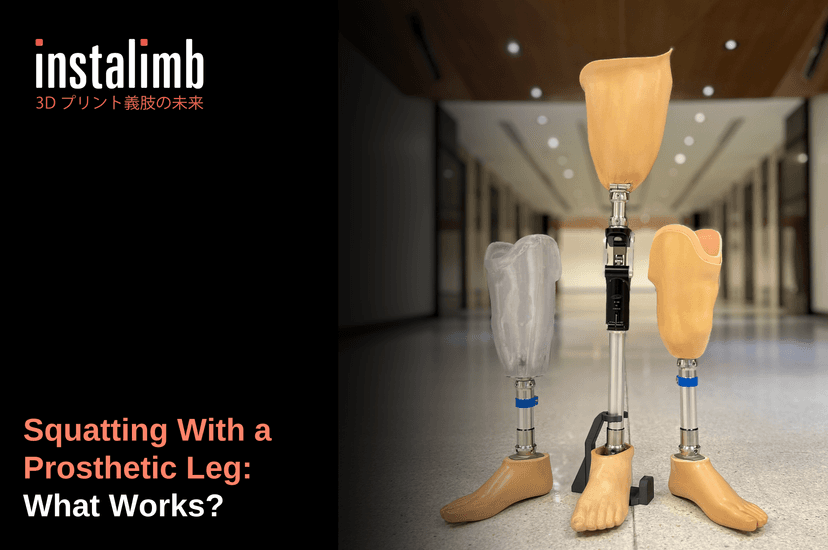
Squatting With a Prosthetic Leg: What Works
If you've ever hesitated before a squat-style toilet, a temple visit, or sitting down for a meal on the floor with family, you already know how ordinary moments can turn into obstacles after amputation. Squatting with a prosthetic leg is one of the most common concerns Indian amputees raise with their prosthetist, and it deserves a straight answer instead of vague reassurance. With the right knee, foot, and socket combination, deep squatting and sitting cross-legged are realistic goals for many users, not rare exceptions.
Squatting With a Prosthetic Leg: Why It Is Harder Than Walking
Squatting with a prosthetic leg is harder than walking because deep squatting needs roughly 135 degrees of knee flexion, while many standard prosthetic knees are built mainly for a smooth, stable walking gait rather than extreme bending. A healthy knee bends up to roughly 160 degrees, so most everyday prosthetic knees fall short unless they are specifically chosen or adjusted for flexion.
Below-knee amputees generally have an easier time, since their own knee joint is intact. Their challenge is usually the foot: not every prosthetic foot flexes upward enough to keep the heel down in a deep squat, so people often end up rising onto their toes or losing balance.
The Role of 3D-Printed Design in Squat-Friendly Fit
A traditional prosthetic socket is shaped from a single plaster cast taken in one position, usually standing, which makes it a compromise for every other posture your limb takes, including a deep squat. 3D-printed prosthetic design changes that starting point by letting a socket be built, and rebuilt, around how your limb actually bears weight and shifts pressure through a full range of movement, not just its resting shape.
Research combining AI with 3D printing has mapped pressure and force across the residual limb during standing, walking, and leaning, then used that data to generate a custom internal lattice structure inside the socket itself (Amputee Store; MedicalXpress, 2026). Early lattice-based 3D-printed sockets have shown dramatic gains in how well they absorb and redistribute load compared to solid, traditionally cast sockets, exactly the kind of stress a deep squat places on a socket wall.
For Instalimb, this is the same principle behind our 1mm-level socket customisation. 3D-CAD design and AI-assisted fitting let a prosthetist model your socket around your specific movement goals, including squatting, rather than asking you to adapt to a shape built only for standing still.
What Actually Determines Whether You Can Squat Comfortably
Four things decide it: knee flexion range, foot dorsiflexion, your amputation level, and how precisely your socket is fitted. Specialised transfemoral mechanisms have been engineered to reach over 140 degrees of flexion for squatting, well past what a standard walking-focused knee offers, so component choice matters as much as effort or practice.
-
Knee flexion range: look for a knee rated for high flexion, not just a standard walking knee.
-
Foot dorsiflexion: a foot that flexes upward lets the heel stay grounded through the squat instead of forcing you onto your toes.
-
Amputation level: above-knee users depend on the prosthetic knee itself for flexion; below-knee users mainly need the right foot.
-
Socket precision: a socket that is even slightly off will pinch or slip exactly at the deepest, most flexed point of a squat, which is precisely why fit matters more here than during normal walking.
Getting There Safely: What to Ask Your Prosthetist
Squatting capability is not something to discover by accident on your first attempt. Raise it directly during your fitting so your prosthetist can factor it into component selection from day one.
-
Ask the exact flexion range of the knee being recommended, and whether it changes if you swap the foot.
-
Ask whether your current foot allows meaningful dorsiflexion, or whether a different foot would serve you better for floor-based living.
-
If deep squatting matters to you, say so before the socket is finalised. It shapes both the socket design and the component recommendation.
-
Never force a deep squat in an old or worn component. Loose knee bushings or a degraded foot can fail unpredictably under that load.
Building the Habit: Practising Squats Safely at Home
Confidence in a deep squat is built gradually, the same way you learned to trust your first steps on the prosthesis.
-
Practise near a grab bar, sturdy railing, or wall so you always have something to hold if balance shifts.
-
Work on hip and ankle flexibility with your physiotherapist; a stiff sound-side hip often limits a squat as much as the prosthetic knee does.
-
Avoid practising late in the day when residual limb volume has dropped and the socket fits more loosely than usual.
-
Use a floor cushion or low stool as an intermediate step before attempting a full squat unsupported.
How Instalimb Approaches Squat-Friendly Fittings
At Instalimb, we have designed over 500 prosthetics across Delhi, Gurugram, Hyderabad, Bangalore, Mumbai, and Vizag, and squatting comfortably is one of the most common goals patients raise before their first fitting even begins. Our 1mm-level socket customisation, built using 3D-CAD design and AI-assisted fitting, is aimed at exactly the pressure points that a deep squat exposes: the parts of the socket that only feel tight once your knee is fully bent.
We will not pretend every knee and foot combination supports a full deep squat equally, that depends on your amputation level, activity level, and the specific components chosen. What we can do is have that conversation honestly during your fitting, so your goals shape the recommendation instead of being an afterthought.
Frequently Asked Questions
Can a prosthetic leg allow full squatting like an Indian-style toilet requires?
For many users, yes, but it depends on the knee and foot chosen and on your amputation level. Functional squatting generally needs about 135 degrees of knee flexion, and not every everyday prosthetic knee is built for that. Discuss your goal specifically with your prosthetist so the right components are selected from the start.
Which prosthetic foot is best for squatting in India?
There is no single best foot for everyone. What matters is dorsiflexion, how far the foot flexes upward, and increasingly, whether it was 3D printed and tuned around your own pressure and movement data rather than a generic mould. A digitally designed foot can be adjusted for more dorsiflexion during your fitting itself, instead of forcing you to accept a fixed off-the-shelf range. Ask your prosthetist to assess your gait and test squat depth directly with the options available.
Is squatting harder for above-knee or below-knee amputees?
It is generally harder for above-knee amputees, since the prosthetic knee itself must provide the flexion a squat requires. Below-knee amputees keep their own knee joint, so their main requirement is a foot that allows enough upward flexion to keep the heel grounded through the movement.
Can I train my body to squat better with a prosthetic leg?
Yes, hip and ankle flexibility work with a physiotherapist often improves squat depth as much as the prosthetic components do. Practising near a support rail, using a cushion as an intermediate step, and building up gradually all help you squat more confidently over time.
Will a poorly fitted socket affect squatting?
Yes, a socket that fits even slightly off tends to pinch or slip exactly at the deepest point of a squat, since that is where pressure concentrates most. A precisely fitted socket reduces this risk and makes a deep squat far more comfortable to hold.
Conclusion
Squatting comfortably is not a luxury request, it is a daily reality for anyone living in India, and it deserves to be treated as a real fitting goal rather than an afterthought. With the right knee, foot, and a socket built around your specific movement, getting back to the floor, the toilet, and the family meal is within reach for most users.
Check out our blog section for more!
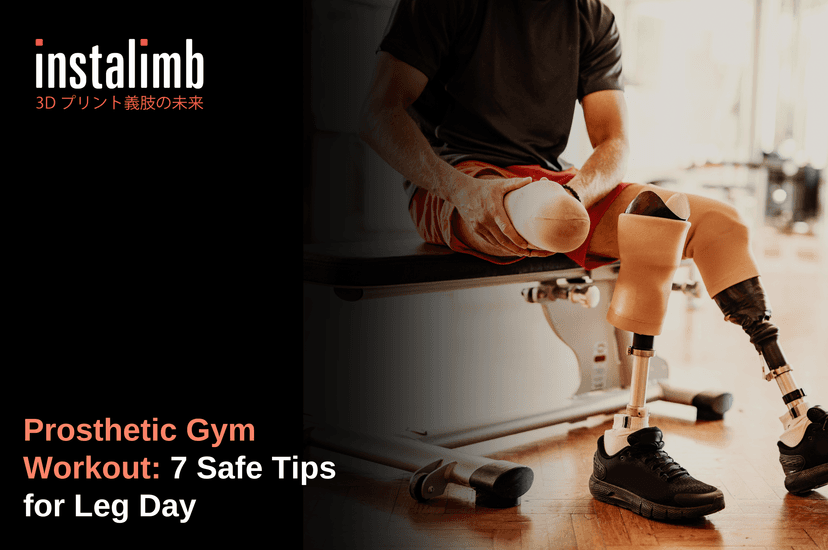
Prosthetic Gym Workout: 7 Safe Tips for Leg Day
Walking back into the gym after amputation is intimidating enough. Add barbells, squat racks, and a leg day routine, and most amputees quietly skip lower body work altogether. A safe prosthetic gym workout is absolutely possible; you just need a few adjustments most trainers were never taught.
What Makes a Prosthetic Gym Workout Different?
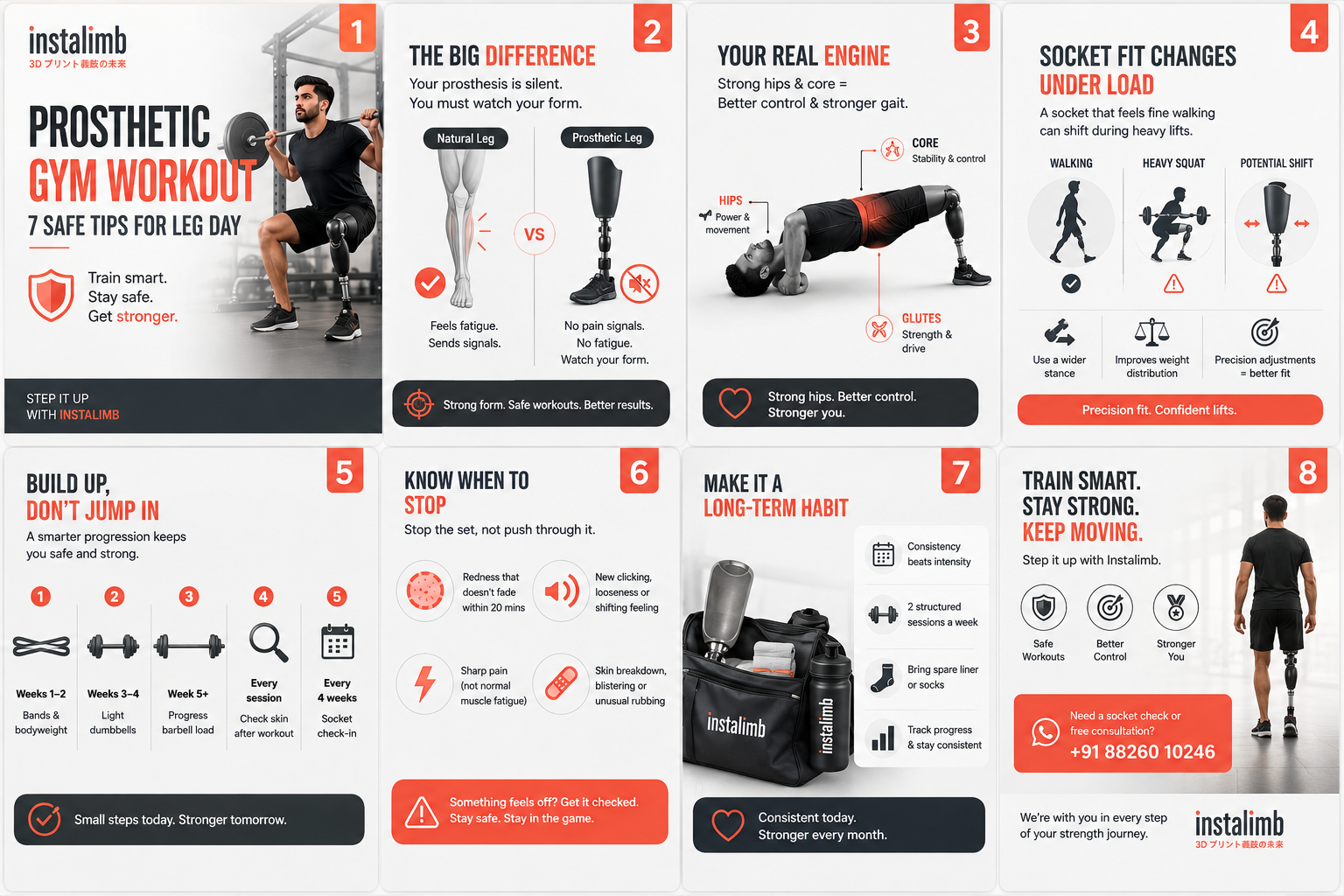
A prosthetic gym workout differs from a typical routine mainly in socket stability and hip or core engagement. Your prosthetic leg doesn't fatigue or send pain signals the way sound muscle does, so form breaks down silently. The fix is prioritising a wider stance, controlled tempo, and strength in the muscles that actually control your prosthesis: your hips, glutes, and core.
Think of your prosthetic knee or ankle as a smart but silent teammate. It won't tell you when it's overloaded, so you have to watch the form instead of waiting for feedback. Before adding weight to squats or lunges, loop in your prosthetist. A quick alignment check before leg day prevents most gym-related fit problems.
Why Hip and Core Strength Matter More Than Leg Strength
Above-knee amputees in particular often lean on momentum instead of muscle to swing the prosthetic knee through a stride. Physical therapy research consistently points to weak hip extensors and hamstrings as the main driver of that pattern, not the prosthesis itself.
Prioritise these muscle groups on leg day:
-
Glutes: hip bridges, glute bridges, cable kickbacks
-
Hip flexors and abductors: banded walks, standing hip flexion
-
Core: planks, dead bugs, standing cable rotations
Think of your hips as the engine and your prosthetic leg as the wheel. A strong engine controls the wheel; a weak one just gets dragged along. Building hip and core strength does more for your gait than isolated leg exercises ever will.
Socket Fit Changes Under Load: What to Watch For
A socket that fits perfectly for walking can still shift under the load of a heavy squat. Heavier lifts push more force through the socket wall, and an interface that felt fine on a walk can suddenly feel loose mid-rep.
A systematic review published in the National Library of Medicine's PMC database looked at resistance training in people with lower limb amputations and found consistent strength and functional gains, while also flagging socket fit and alignment as recurring safety factors clinicians need to monitor as load increases.
A slightly wider stance during squats and lunges improves your base of support and evens out weight distribution. At Instalimb, socket adjustments are made against a digital file with 1mm-level precision, so even small shifts in your residual limb from a new training routine can be corrected quickly instead of guessed at.
Your First Month of Leg Day: A Safer Progression
At Instalimb, we've designed over 500 prosthetics across Delhi, Gurugram, Hyderabad, Bangalore, Mumbai, and Vizag, and getting active patients back to structured training safely is part of everyday practice. Jumping straight into heavy squats is how most gym injuries start, prosthetic or not. Build up in layers instead:
-
Weeks 1-2: bodyweight and resistance bands only, focused on tempo and balance
-
Weeks 3-4: add light dumbbells, and keep your stance slightly wider than usual
-
Week 5 onward: progress barbell load only after your prosthetist confirms alignment is holding
-
Every session: check your residual limb skin for redness or rubbing once you're done
-
Every 4 weeks: book a quick socket check, since muscle gained from training can change your limb volume
Skipping the check-in step is the single most common reason a good gym routine turns into a skin problem.
When to Pause and Call Your Prosthetist
Some warning signs mean stop the set, not push through it:
-
Redness that doesn't fade within 20 minutes of removing your liner
-
A new clicking, looseness, or shifting feeling mid-lift
-
Sharp pain, as opposed to normal muscle fatigue
-
Any skin breakdown, blistering, or unusual rubbing
None of these mean you have to quit leg day. They mean it's time for a quick prosthetist visit before your next session, not after three more weeks of pushing through it.
Making Leg Day a Long-Term Habit
Consistency beats intensity when you're rebuilding strength with a prosthesis. Two structured sessions a week that you actually attend will do more for your gait than one brutal session you dread and skip.
Bring a spare liner or socks to the gym, the same way you would to a long day out. Sweat changes your residual limb volume mid-workout, and a spare sock lets you adjust fit between sets instead of finishing on a socket that's gone loose.
Your prosthetic leg got you back on your feet. Leg day, tracked with your prosthetist and the digital fitting records your clinic keeps on file, is how you make sure it stays strong beneath you.
Frequently Asked Questions
Is it safe to do squats and lunges with a prosthetic leg?
Yes, with the right preparation. Squats and lunges are safe for most prosthetic users once your prosthetist confirms your socket and alignment can handle load-bearing movement. Start with a wider stance for balance, use lighter resistance while you dial in form, and increase weight gradually rather than jumping straight to heavy sets.
Which muscles should amputees focus on for leg day?
Hip and core muscles deserve the most attention, since they control how your prosthetic leg moves during walking and lifting. Glute bridges, banded hip work, and core stability exercises like planks build the strength that actually improves your gait, more directly than isolated leg machines do.
How do I know if my socket fit is a problem during workouts?
Watch for redness that doesn't fade within 20 minutes, a new clicking or loose feeling mid-exercise, or sharp pain during a lift. Any of these signal it's time for a quick prosthetist check before your next gym session, not after pushing through several more weeks of training.
Do I need a different prosthetic leg for weightlifting?
Not necessarily, but some experienced lifters do use a more rigid setup for heavy leg day, since everyday walking components prioritise flexibility over stiffness. Talk to your prosthetist about whether your current device suits progressive loading or whether an alignment adjustment is enough for now.
How often should I get my socket checked once I start training regularly?
Plan on a check-in roughly every four weeks once you begin a new strength routine. Muscle gain and fluid shifts from regular training can change your residual limb volume, which affects socket fit even if nothing feels obviously wrong yet.
Leg day was never meant to be off limits after amputation. With the right pacing, a little extra attention to hip and core strength, and a prosthetist who's part of your training plan, the gym becomes just another place where you show up stronger than you did last month.
Check out our blog section for more!
So, if you're looking for a new artificial leg, interested in a free consultation, confused if your socket is the right fit, or have any other queries, now is the time to reach out to us and try a test socket free of cost. Step it up with Instalimb.
Contact us today!