Our Blog
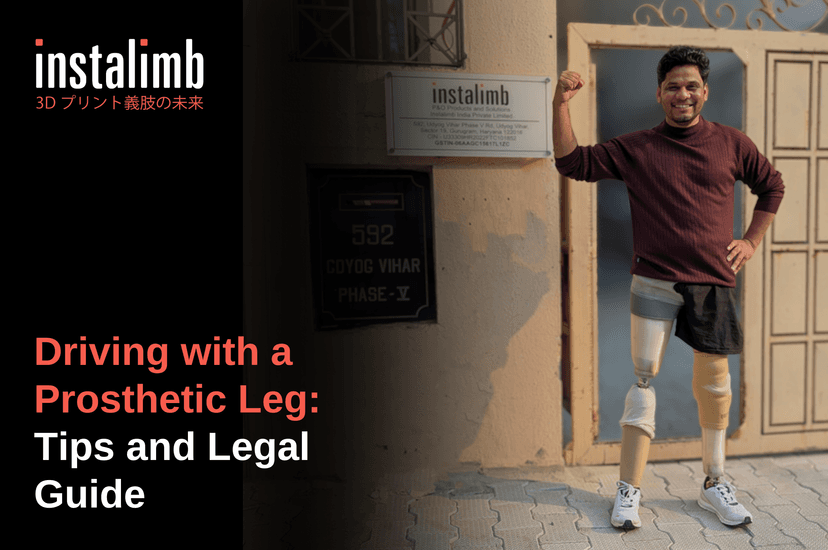
Driving with a Prosthetic Leg: Tips and Legal Guide
If you use a prosthetic leg, one question comes up sooner than you might expect: "Can I still drive?" The good news is that yes, most amputees can drive safely, and in India, thousands already do every day.
Driving with a prosthetic leg takes understanding three things: which leg is affected, what type of prosthetic you use, and whether your car needs any modifications. Once you have those answers, the road ahead looks a lot clearer. In cities like Delhi, Hyderabad, Bangalore, and Mumbai, our patients regularly ask us about this, and this guide covers everything you need to know.
Is Driving with a Prosthetic Leg Legal in India?
Driving with a prosthetic leg is legal in India. Under the Motor Vehicles Act 1988 (amended 2019), persons with disabilities can obtain a driving licence for an adapted vehicle. You need a medical fitness certificate from a government-approved doctor and, in most cases, an RTO assessment. Your licence will carry an LMV-ADAP (adapted vehicle) endorsement.
Under Rule 15 of the Central Motor Vehicles Rules, your regional transport office (RTO) can issue a licence for "Motor Vehicle with Adaptation." To apply:
-
Visit your regional RTO and request the disability accommodation form
-
Submit Form 1 (medical fitness certificate) from an authorized medical officer
-
Request an LMV or MCWG licence with the hand-control or other adaptation endorsement
-
Undergo a supervised assessment drive if required by your RTO
Right-leg amputees typically need hand controls or an automatic transmission. Left-leg below-knee amputees who have good prosthetic function can often qualify to drive an automatic vehicle with no major modification, depending on socket fit and functional ability.
Right Leg vs. Left Leg: What Changes for Drivers?
This is the most important factor in planning your return to driving. Think of it like writing with your non-dominant hand: it takes adjustment, but it becomes natural with practice.
Right-leg amputees: The right foot controls the accelerator and brake in most Indian vehicles. If you have a below-knee prosthetic with good sensory feedback and ankle function, your prosthetist may clear you to use your prosthetic foot for pedal control. Above-knee amputees or those with limited prosthetic control almost always need hand controls fitted to the vehicle.
Left-leg amputees: In a standard Indian vehicle, the left foot works the clutch in manual-transmission cars. Many left-leg amputees adapt well to automatic vehicles or have the clutch substituted with a hand-operated device. Below-knee prosthetic users often manage automatic cars with little or no structural modification.
Vehicle Modifications That Make Driving Safer
Driving aids are more accessible and affordable than most people realise. A certified automobile adaptation centre can assess your needs and fit:
-
Hand controls (accelerator and brake levers) - suited for right-leg amputees
-
Left-foot accelerator pedal - for right-leg amputees in automatic vehicles
-
Automatic transmission conversion - the single biggest ease-of-driving upgrade for most amputees
-
Extended brake pedal or pedal guards - to prevent accidental contact from a prosthetic foot
-
Spinner knob for steering - useful if one arm is also affected
The Rehabilitation Council of India and the National Institute for the Orthopaedically Handicapped (NIOH) have both published guidelines on assistive technology for drivers with disabilities. Research published by NIOH found that properly fitted vehicle adaptations reduce collision risk for amputee drivers to levels comparable with the general driving population.
How Your Prosthetic Socket Fit Affects Driving Safety
This is where your prosthetic choice really matters. A poorly fitted socket creates unpredictable movement inside the socket, which is dangerous at the wheel. If your residual limb shifts even a centimetre while you apply the brake, your reaction time and accuracy suffer.
At Instalimb, our 3D-printed sockets are designed with 1 mm-level precision using AI-assisted CAD modelling and Japanese technology. Over 500 patients across Delhi, Hyderabad, Bangalore, Mumbai, Gurugram, and Vizag have experienced the difference that a digitally precise socket makes in daily activities, including driving. A socket that fits like a second skin gives you the proprioceptive confidence to operate pedals or hand controls naturally and reliably.
If you notice your socket shifting, loosening, or causing discomfort during drives, those are signs the fit needs to be reviewed. Never ignore a poorly fitting socket, especially when driving.
7 Practical Tips Before You Start Driving Again
1. Get clearance from both your prosthetist and your doctor before getting behind the wheel
2. Practice in a safe, empty space like a car park before entering traffic
3. Start with short, low-traffic routes before attempting highway or peak-hour driving
4. Inform your car insurer: failing to disclose a relevant disability can void your policy
5. Carry your disability certificate and adaptation inspection report in the car at all times
6. Consider refresher lessons with an instructor experienced in adaptive driving
7. Use monsoon-season caution: wet, slippery roads require extra stopping distance for all drivers, especially while you are recalibrating with a new prosthetic or hand controls
Managing Long Drives and Limb Volume Changes
Limb volume can fluctuate during extended time in a car seat. India's heat and humidity, particularly during the monsoon season, can cause your residual limb to swell or sweat inside the socket, affecting the fit mid-drive.
-
Use prosthetic socks or a liner to help manage minor volume changes
-
Take short breaks every 60 to 90 minutes to stand, stretch, and let your residual limb breathe
-
Keep a small dry cloth or tissue in the car to wipe down the socket interior during stops
-
Have your socket fit reviewed if you are planning a long road trip
Instalimb's 3D-printed sockets are engineered to accommodate minor volume fluctuations better than traditional plaster-cast sockets because the digital design process accounts for the natural variations in your residual limb shape throughout the day.
Frequently Asked Questions
Do I need a special driving licence if I use a prosthetic leg?
Yes, in most cases. Under Rule 15 of the Central Motor Vehicles Rules, your licence should specify the vehicle type and any adaptations required. A left-leg below-knee amputee driving an automatic car with no modifications may only need a medical fitness endorsement. A right-leg amputee using hand controls will need the LMV-ADAP category. Check with your local RTO for the latest requirements in your state.
Can I drive a manual transmission car with a prosthetic leg?
It depends on which leg is amputated and your prosthetic function. Left-leg below-knee amputees with a well-fitted socket sometimes manage a clutch with practice. Right-leg amputees are generally advised to switch to an automatic transmission or use hand controls, as operating the brake with a prosthetic foot introduces safety risks that most clinicians recommend avoiding.
How long after amputation can I start driving again?
Most rehabilitation guidelines suggest waiting until your residual limb has stabilised (typically 3 to 6 months post-surgery), you have been fitted with a prosthetic, and your prosthetist confirms functional independence. Always get written clearance from your surgeon and physiotherapist before attempting to drive.
Does insurance cover vehicle modifications for amputees in India?
Standard vehicle insurance policies in India do not automatically cover adaptive modifications. Some insurers offer add-on cover for assistive devices. Check with your insurer and explore the PM-DAKSH scheme, which provides assistive technology support for persons with disabilities. Certain state-level schemes also offer financial assistance for vehicle adaptations.
Will my socket loosen during a long drive?
Limb volume can fluctuate with temperature, activity, and extended sitting. Long drives in India's heat or monsoon humidity can cause your residual limb to swell slightly or sweat inside the socket. Use prosthetic socks to manage volume, take regular breaks, and ensure your socket is regularly checked for fit. Instalimb's precision 3D-printed sockets are designed to manage minor volume changes better than traditional moulded sockets.
Getting back behind the wheel is not just about convenience: it is about independence, employment, and the freedom to move through life on your own terms. With the right legal clearance, appropriate vehicle modifications, and a well-fitted prosthetic socket, driving with a prosthetic leg is completely achievable. You have already shown incredible resilience in adapting to life with a prosthetic. The open road is just one more challenge you are ready for.
Check out our blog section for more!

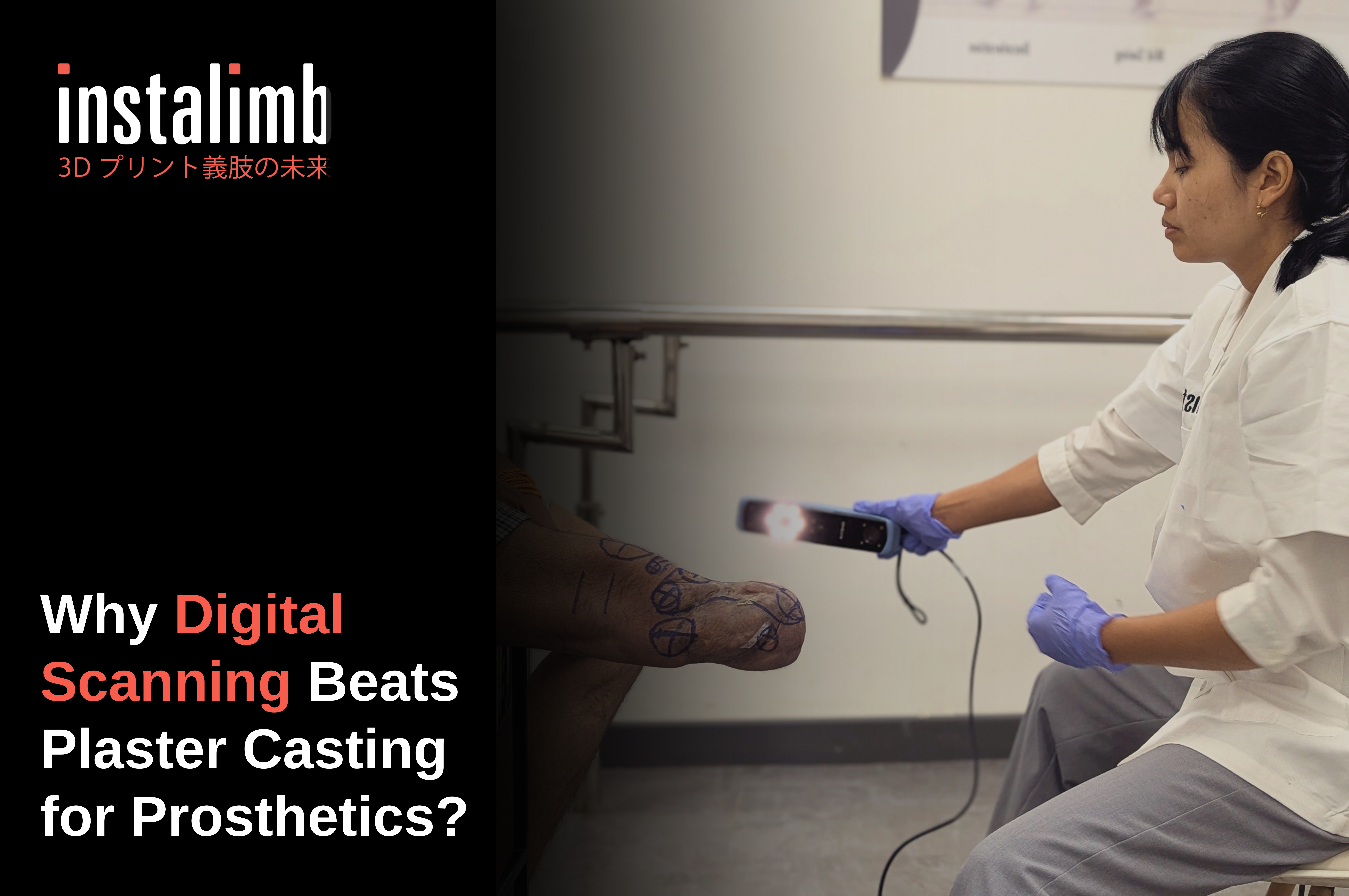
Why 3D Digital Scanning Beats Plaster Casting for Prosthetics?
If you have ever had a traditional prosthetic made, you probably remember the plaster casting process: a messy, time-consuming session where your residual limb was wrapped in wet bandages and left to set. For decades, this was the only way to capture the shape of a stump. Today, digital scanning for prosthetics has changed the game entirely, and clinics across India, including Instalimb's centres in Delhi, Hyderabad, Bangalore, and Mumbai, are making the switch fast. Here is why.
How Traditional Plaster Casting Works
In brief: Traditional plaster casting captures a static, single-moment impression of a residual limb using wet plaster bandages. It is a manual process that depends heavily on the skill of the individual prosthetist and can introduce distortions. The resulting mould is used to fabricate a socket, but it cannot be revised without repeating the entire process.
Plaster casting has been the standard in prosthetics for over a century. The process works like this: the prosthetist wraps wet plaster-of-Paris bandages around your residual limb and holds it in position while the plaster sets. Once it hardens, the cast is carefully removed and used to create a positive model of your limb, which is then used to form the socket.
The method is not without merit. Experienced prosthetists can produce good results with plaster, and for resource-limited settings it remains accessible. But it has well-documented limitations. The cast only captures your limb at a single moment in time. It is sensitive to how much pressure was applied during the wrapping, the angle your limb was held, and even how quickly or slowly the plaster set. Small errors at this stage become embedded in the final socket.
How 3D Digital Scanning Works
3D digital scanning replaces the wet plaster step entirely. A handheld or desktop 3D scanner uses structured light or laser technology to capture thousands of surface data points from your residual limb in a matter of minutes. The result is a precise digital mesh of your limb's exact shape, stored as a 3D CAD file that can be viewed, measured, and modified on a computer screen.
At Instalimb, this digital file becomes the foundation of your socket design. Our prosthetists use AI-assisted CAD tools to refine the scan, add relief zones for sensitive areas, and adjust socket geometry at 1mm precision before a single component is printed. The entire design process happens digitally, meaning changes take minutes rather than days.
According to a study published in Prosthetics and Orthotics International, digital scanning achieves dimensional accuracy within 0.3 to 0.5 millimetres on average, compared to 2 to 4 millimetres with manual plaster casting. For a socket that needs to distribute body weight evenly across soft tissue, that difference is significant.
Plaster Casting vs Digital Scanning: A Direct Comparison
Here is how the two approaches compare across the factors that matter most to you as a patient:
Accuracy: Digital scanning captures your limb geometry at sub-millimetre precision. Plaster casting introduces human variability at every step, from bandage tension to holding position.
Speed: A 3D scan takes 5 to 10 minutes. A plaster cast takes 30 to 45 minutes and then needs several hours to dry before the prosthetist can work with it.
Patient comfort: No wet bandages, no smell, no mess. Digital scanning is completely non-contact for most systems, which is especially important for patients with sensitive or recently healed residual limbs.
Revisability: If your limb changes shape, a digital file can be updated quickly without repeating a full casting session. A plaster mould must be remade from scratch.
Documentation: A digital scan is a permanent, shareable record of your limb geometry. It can be accessed by any Instalimb centre across Delhi, Hyderabad, Bangalore, Mumbai, or Vizag, so you are never starting over if you move cities or need a replacement socket.
Storage: A physical plaster mould takes up space and degrades over time. A digital file is stored in the cloud indefinitely.
Why India's Prosthetic Clinics Are Making the Switch
For many years, 3D scanning equipment was expensive and out of reach for most prosthetic clinics in India. That has changed. The cost of quality handheld scanners has fallen significantly, and the software needed to process scans and design sockets is now more accessible than ever.
The other driver is patient expectations. Amputees in Indian cities are more informed than they were a few years ago. They are researching their options online, comparing clinics, and asking better questions. When patients understand that a digital scan produces a more accurate socket in less time, they choose clinics that offer it.
There is also a supply-chain benefit. A clinic that stores socket designs digitally can reprint a replacement in days, not weeks. For a patient who cracks a socket during the monsoon season or whose limb volume shifts during recovery, that responsiveness matters enormously.
What This Means for Your Socket Fit
The practical benefit of digital scanning for you as a patient comes down to one thing: a socket that fits better on day one and can be adjusted faster when your body changes.
At Instalimb, we have designed over 500 prosthetics across Delhi, Hyderabad, Bangalore, Mumbai, and Vizag using our digital scan-to-socket workflow. The precision of the scan feeds directly into our AI-assisted CAD design, which lets our prosthetists model contact pressure, adjust trim lines, and refine socket geometry before printing. Patients who have previously worn plaster-cast sockets consistently report improved initial fit and fewer early adjustments with a digitally designed socket.
We also offer a Free Test Socket Fitting at every Instalimb centre. This means you wear a test version of your socket before the final one is made, so any fit issues are caught before they become a problem. Digital design makes this step faster and more precise because our team can modify the digital file between fittings in real time.
FAQs About Digital Scanning for Prosthetics
Is digital scanning more accurate than plaster casting for prosthetics?
Yes. Research published in Prosthetics and Orthotics International shows digital scanning achieves accuracy within 0.3 to 0.5 millimetres on average, compared to 2 to 4 millimetres for manual plaster casting. This improved precision translates directly to a better-fitting socket with fewer pressure points and adjustments.
Does digital scanning hurt or feel uncomfortable?
No. Digital scanning is a completely non-contact process for most systems. The scanner captures the surface of your residual limb using light or laser projection without touching your skin. It is particularly suitable for patients with sensitive, recently healed, or post-surgical residual limbs who find plaster wrapping uncomfortable or painful.
Can I get a replacement socket if my limb shape changes?
Yes, and this is one of the biggest advantages of digital scanning. Your limb geometry is stored as a digital file that can be updated and reprinted without a full re-casting session. If your residual limb volume changes due to weight fluctuation, activity level, or seasonal swelling, your Instalimb prosthetist can modify the existing file and produce a revised socket quickly.
Are all prosthetic clinics in India switching to digital scanning?
Not all, but the trend is clear. Clinics serving informed, urban patients in Delhi, Mumbai, Hyderabad, and Bangalore are increasingly adopting digital workflows. Traditional plaster casting is still used in some rural and lower-cost settings where scanning equipment is not yet accessible, but technology costs have fallen significantly and adoption is accelerating across India.
What is the difference between 3D scanning and 3D printing in prosthetics?
3D scanning captures the shape of your residual limb as a digital file. 3D printing uses that file, after design refinement, to manufacture the physical socket. They are two separate steps in the same digital workflow. Instalimb uses all three: scanning for measurement, AI-assisted CAD for design, and 3D printing for fabrication.
The Future Is Already Here
Plaster casting served the prosthetics field well for generations, but digital scanning does everything it does, faster, more accurately, and with a far better patient experience. If you have been fitted with plaster casts before and found the process uncomfortable or the results imperfect, it is worth asking your next clinic whether they use digital scanning. At Instalimb, it is part of every fitting from day one.
Check out our blog section for more!
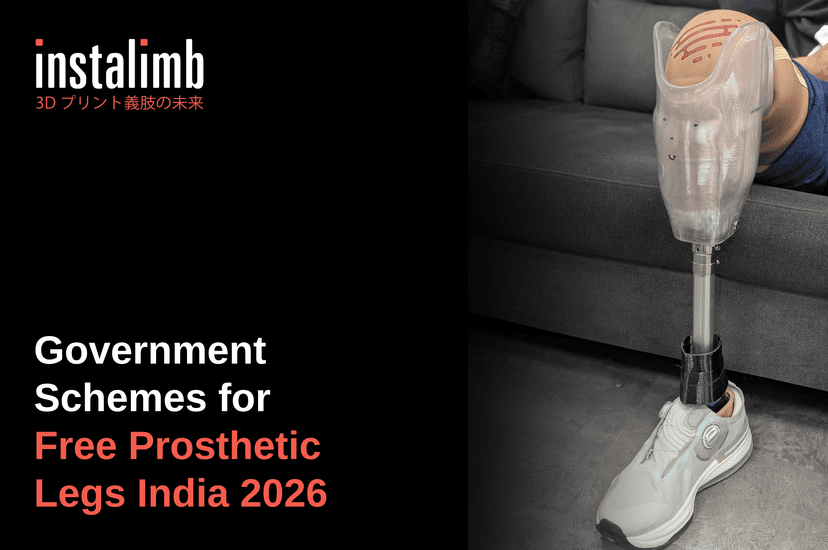
Government Schemes for Free Prosthetic Legs India 2026
If you or someone in your family needs an artificial leg and you are wondering whether the government will help pay for it, you are not alone. This is one of the most common questions amputees across India ask. The answer is yes: there are three central government programmes that can cover or subsidise your prosthetic leg in India and several state-level options on top of those. Here is exactly what each one offers and how to access it.
The ADIP Scheme: The Strongest Option for Most Amputees
The ADIP Scheme (Assistance to Disabled Persons for Purchase and Fitting of Aids and Appliances) has been in operation since 1981. It covers all types of prosthetic and orthotic devices and remains the most widely accessible government scheme for prosthetic legs in India.
Eligibility (Section 6.0 of the revised guidelines, applicable from 26 September 2024):
-
Disability: Certified disability of 40% or more from a government-recognised authority
-
Income: Monthly household income from all sources not exceeding Rs. 30,000
-
Support: Free device for income up to Rs. 22,500 per month; 50% subsidy for income between Rs. 22,501 and Rs. 30,000
-
High-end prosthesis: For locomotor disabilities with 40%+ disability, a dedicated subsidy of up to Rs. 30,000 is available under Section 8.01 of the scheme. Amputees without a disability certificate can also access this with a recommendation from an RCI-registered Rehabilitation Professional.
-
UDID card: Holding a UDID card issued by the Ministry, or enrollment number of the UDID card, along with a Disability Certificate showing at least 40% disability
-
Citizenship: Indian citizen with a valid Aadhaar
-
Re-assistance gap: Not received assistance for the same purpose from any source in the past 3 years. For children below 18 years of age, the minimum gap is 1 year for customised items like prosthesis and orthosis.
Who implements the scheme?
-
ALIMCO, National Institutes (NIs), Composite Regional Centres (CRCs), District Disability Rehabilitation Centres (DDRCs), and the National Trust, under the Ministry of Social Justice and Empowerment or the Ministry of Health and Family Welfare
-
Registered Societies and their branches under the Societies Registration Act, 1860
-
Registered Charitable Trusts
-
Indian Red Cross Societies and other Autonomous Bodies headed by the District Collector, the CEO, or the District Development Officer
-
National and State Corporations in the field of Disabilities
-
Local Bodies, Zila Parishad, Municipalities, District Autonomous Development Councils, Panchayats
-
Hospitals registered as separate entities, as recommended by the State/UT/Central Government
-
Nehru Yuva Kendras
-
Any other organisation deemed fit by the Department of Empowerment of Persons with Disabilities (DEPwD)
This means your nearest government rehabilitation centre, an empanelled NGO, your District Disability Rehabilitation Centre, or even a qualifying Panchayat can distribute benefits; you do not have to wait for an ALIMCO camp.
How to apply:
You have four official channels:
-
ARJUN Portal (online): adip.depwd.gov.in, apply online for aids and assistive devices; device delivered within 6 months of registration
-
Mobile App: The Department's mobile app lets you register for a new device or repair of an existing one; the request is forwarded to the nearest implementing agency
-
Distribution Camps: Implementing agencies hold regular camps at the district level. Contact your District Collector's office or any implementing agency for camp schedules
-
Headquarters/Walk-in: Approach any National Institute, CRC, ALIMCO regional office, or empanelled NGO directly
Income proof accepted: BPL card, MGNREGA card, Disability Pension Card, certificate from MP/MLA/Councillor/Gram Pradhan, Revenue Agency certificate, or a notarised affidavit, whichever you can obtain most easily.
CGHS: For Central Government Employees and Pensioners
The Central Government Health Scheme (CGHS) covers approximately 47- 48 lakh beneficiaries across 80 cities (as of 2023-24, per Ministry of Health data), including central government employees, pensioners, and their dependent family members. CGHS does include reimbursement for artificial limbs and assistive devices.
You can use CGHS either cashlessly at an empanelled hospital or through reimbursement at a non-empanelled facility. A referral from a CGHS Wellness Centre Medical Officer is required before fitting. For devices costing above Rs. 50,000, prior permission must be obtained from the CGHS Additional Director of your city; for items below Rs. 50,000, three quotations and approval from your Head of Department are required. CGHS-approved reimbursement rates are published by the Ministry of Health and may not cover the full cost of a premium device, so confirm the approved rate for your specific prosthetic category with your CGHS Wellness Centre before committing.
ESIC: For Workers in the Organised Private Sector
If your salary slip shows an ESI deduction, you are covered under ESIC. Here is what that means for prosthetics:
-
Who qualifies: Employees earning up to Rs. 21,000/month. If you have a disability, the limit is Rs. 25,000/month.
-
What is covered: Artificial limbs, aids, and appliances for both you and your dependent family members.
-
No cost ceiling: ESIC does not cap the cost of treatment. You are not limited to a fixed reimbursement amount.
-
For work injuries: If you lost a limb due to a workplace accident, the physical rehabilitation benefit kicks in automatically.
-
For other causes: If the amputation was not work-related, coverage still exists under general medical care, but you will need extra documentation and approval from an ESIC Medical Board.
How to start: Walk into any ESIC hospital near you and ask for a referral to begin the prosthetic fitting process.
State-Level Schemes Worth Knowing
Every state and union territory in India has its own disability welfare infrastructure on top of central schemes. Here is what exists across the country:
What every state offers (all 28 states + 8 UTs)?
-
District Social Welfare Office: Present in every district. This is your first stop; they will tell you which state schemes you qualify for and help with ADIP applications.
-
District Disability Rehabilitation Centre (DDRC): Operates in most districts and directly implements ADIP. Can assess your disability, assist with certification, and connect you to devices.
-
Disability pension (IGNDPS): The central government contributes Rs. 300/month; most states add a top-up. Delhi pays Rs. 2,500/month total; Maharashtra adds Rs. 1,200/month on top of the central amount. Check your state Social Welfare portal for your state's rate.
States with verified prosthetic-specific schemes:
-
Tamil Nadu: Chief Minister's Comprehensive Health Insurance Scheme (CMCHIS) covers prosthetic devices for families with annual income below Rs. 5 lakh, up to Rs. 5 lakh per family per year. Covers 1.48 crore families across the state.
-
Jammu & Kashmir: Prosthetic Aid Scheme (PAS) the state Social Welfare Department provides artificial limbs, wheelchairs, crutches, and hearing aids directly to persons with disabilities.
-
Uttar Pradesh: State-level prosthetic limb subsidy scheme for persons with disabilities, implemented through district welfare offices and regular distribution camps.
All other states: how to find your scheme?
-
Visit myscheme.gov.in, search "prosthetic," and filter by your state; it lists all active central and state schemes you are eligible for
-
Visit your state government's e-governance or Social Welfare portal (e.g., Karnataka: sw.kar.nic.in, Maharashtra: sjsa.maharashtra.gov.in, Andhra Pradesh: apewalfare.ap.gov.in, Telangana: wdcw.telangana.gov.in, Rajasthan: sje.rajasthan.gov.in, West Bengal: wbswasthyasathi.gov.in, Gujarat: swd.gujarat.gov.in)
-
Call or visit the office of your District Collector or District Magistrate they coordinate all disability welfare camps and distributions at the ground level
Note: Benefit amounts and eligibility criteria are updated periodically. Always confirm the current figures with your District Social Welfare Office before applying.
Documents You Will Need for Any Application
Gather these before visiting any office or camp:
-
Disability certificate from a government-recognised authority (showing minimum 40% disability), or UDID card / UDID enrollment number
-
Income proof- BPL card, MGNREGA card, revenue authority certificate, or MP/MLA/Gram Pradhan certificate are all accepted under ADIP
-
Aadhaar card or Aadhaar enrollment ID
-
Medical referral from a registered practitioner recommending a prosthetic limb
-
Recent passport-size photographs
-
Bank account details for subsidy transfer where applicable
Getting these ready in advance saves repeated trips and delays.
How 3D Printing Makes Your Support Go Further
Government schemes like ADIP cover standard approved devices, which can be limited in quality and fit. If your subsidy covers part of the cost, a 3D-printed prosthetic helps close that quality gap for a manageable top-up.
At Instalimb, we use AI-assisted CAD design and 3D printing to achieve 1mm-level socket precision. We have designed over 500 prosthetics for patients across Delhi, Gurugram, Hyderabad, Bangalore, Mumbai, and Vizag. Our free Test Socket Fitting means you experience the fit before any financial commitment. Our team regularly helps patients understand how to use their government entitlements alongside an Instalimb prosthetic.
Frequently Asked Questions
Does PMJAY cover prosthetics in India?
No. As of 2026, PMJAY does not cover prosthetic limbs. It covers hospitalisation and amputation surgery but not the prosthetic device. OPAI petitioned the government in 2025 to include prosthetic and orthotic care under PMJAY, but this was not in effect at the time of publishing. The ADIP Scheme is currently the primary government route for prosthetic funding.
How do I apply for a free prosthetic leg under the ADIP Scheme?
You have four options: apply online via the ARJUN Portal at adip.depwd.gov.in, use the Department mobile app, attend a district-level distribution camp, or walk into any ALIMCO regional office, National Institute, CRC, DDRC, or empanelled NGO near you. You need a UDID card or enrollment number along with a disability certificate (40% or more disability), an income proof document, Aadhaar, and a doctor referral. Those with a monthly income up to Rs. 22,500 receive the device free of cost; income between Rs. 22,501 and Rs. 30,000 qualifies for a 50% subsidy. For a prosthetic leg specifically, Section 8.01 of the scheme provides a dedicated high-end prosthesis subsidy of up to Rs. 30,000.
I work in a private company. Can ESIC fund my prosthetic leg?
Yes, if your employer deducts ESI contributions and your salary is within the ESIC limit (up to Rs. 21,000/month, or Rs. 25,000/month for persons with disabilities). ESIC covers artificial limbs under its medical care benefit with no ceiling on treatment cost. Coverage is most straightforward for work-related injuries. For amputation from other causes, additional documentation and approval from an ESIC Medical Board is required. Visit your nearest ESIC hospital to begin.
What if I do not qualify for any of these schemes?
Explore your state government disability welfare board, NGOs registered under ADIP (there are hundreds across India), and crowdfunding platforms. Instalimb also offers a free Test Socket Fitting and flexible options, so reach out and let our team help you understand what is available for your specific situation.
Can I combine a government subsidy with a 3D-printed prosthetic from Instalimb?
ADIP subsidies apply to devices on their approved catalogue. However, you can use the subsidy as a partial contribution and pay a differential for an Instalimb 3D-printed prosthetic. Our team will walk you through the cost breakdown and the process, starting with a free consultation.
Getting a prosthetic leg in India does not have to mean paying the full cost out of pocket. The ADIP Scheme, CGHS, and ESIC together form a real safety net that can significantly reduce your expenses. Start by identifying which scheme applies to you, gather your documents early, and find a clinic that understands both the technology and the process. The right support is available, and you deserve to access it.
Check out our blog section for more!