Our Blog
Bone Health After Amputation: Why Osteoporosis Risk Rises
If you've had a leg amputated, chances are you've talked plenty about your socket fit, your gait, and your daily routine, but rarely about what's happening inside the bone itself. Bone health after amputation changes in ways that few patients or caregivers are ever warned about, and understanding why can help you take simple, practical steps to protect it before problems set in without warning.
Bone Health After Amputation: What Actually Happens to Your Bones
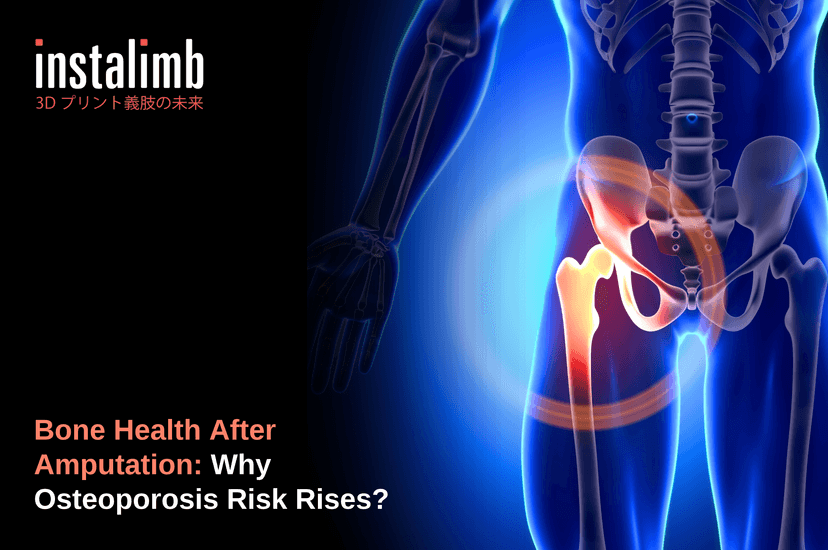
After amputation, bone loss concentrates in the residual limb, especially the hip and femoral neck, because that bone is no longer bearing regular weight. Research shows this bone loss can begin within the first year, and more than half of amputees assessed beyond five years show osteoporosis or osteopenia.
Osteopenia and osteoporosis both describe bone that has become less dense and more fragile than normal, with osteopenia being the earlier, milder stage. Ordinary age-related bone loss affects the whole skeleton gradually, but this pattern stays localised to the residual limb, rather than spreading evenly across the body.
Why Does Osteoporosis Risk Rise After Limb Loss?
The Mechanical Loading Connection
Bone is living tissue: it constantly breaks down and rebuilds itself, taking its cues from the forces placed on it. Much like a path across a field stays compact and well-defined only as long as feet keep walking over it, steady weight-bearing is what keeps bone dense. Take away that regular loading on one leg, and the body reads it as a signal to stop reinforcing bone there, a process doctors call disuse osteoporosis. It's why the residual limb, rather than the rest of the skeleton, tends to lose density first and fastest.
Diabetes, Age, and Nutrition Stack the Risk
In India, this mechanical risk rarely arrives alone. Diabetic foot complications were the leading cause of lower-limb amputation in a 2023 to 2024 study from Saveetha Medical College, Chennai, accounting for 42% of cases, with peripheral arterial disease (PAD) responsible for a further 22%. Diabetes is also widely understood to affect bone quality, though this hasn't yet been measured directly in Indian amputees.
Add an average amputation age already in the mid-fifties, average daily calcium intake sitting below recommended levels, and vitamin D deficiency affecting over half the population in some regions, and these risk factors compound rather than act alone. Simple daily routines matter here too. See [daily habits for diabetes-related amputation care] for a practical starting point.
What the Research Shows About Bone Loss in Amputees
Bone Density Studies, the Numbers
The clearest evidence so far comes from outside India, though the pattern is one worth checking against your own situation. A UK study of military personnel, the ADVANCE study published in the Journal of Bone and Mineral Research (2023), followed 153 lower-limb amputees against 562 uninjured controls. McMenemy et al. found amputees had roughly twelve times higher odds of pathology in the femoral neck, the narrow part of the thighbone just below the hip joint. Bone loss was also significantly greater after above-knee (transfemoral) amputation than below-knee (transtibial) amputation, so your own amputation level matters here. A 2024 Pakistan Armed Forces Medical Journal study, a relevant South Asian proxy rather than Indian data, measured femoral-neck Z-scores, a score that compares bone density with what's typical for someone's age and sex, where a more negative number means weaker bone. Yasmeen and Younas et al. recorded scores of -2.62 in transtibial amputees and -3.32 in transfemoral amputees, well below the near-normal scores seen in each patient's remaining leg.
Why India Needs Its Own Data
No published Indian study has yet measured bone density loss directly in lower-limb amputees, which means nobody is routinely tracking this for you yet. What India does have is solid data on amputation causes, including the Saveetha cohort above, confirming how heavily diabetes features in this population. If you're also navigating a related concern, heterotopic ossification, [another bone-related complication amputees should know about] is worth understanding too, since it works quite differently from the disuse-related bone loss discussed here.
Walking, Prosthetic Fit, and Bone Loading
Here's the practical link: your bones need consistent weight-bearing to stay strong, and your prosthetic is what makes consistent weight-bearing possible day to day. If a socket pistons, slips, or creates pressure points, most people respond sensibly by cutting back on wear time or leaning on a wheelchair more often, a completely understandable response to discomfort, but one that also means less loading on the bone that needs it most.
At Instalimb, our sockets are 3D-printed and designed using 3D-CAD, 3D printing, and AI/ML to reach roughly 1mm fit precision, aimed at reducing the pressure points and slippage that often push people to shorten their walking time. This isn't a treatment for bone density, and nothing about a socket is. What a comfortable, well-fitting prosthetic does support is the kind of consistent, active daily use your bones benefit from, something worth keeping in mind as [how prosthetic needs change with age].
Across our clinics in Delhi, Gurugram, Hyderabad, Bangalore, Mumbai, and Vizag, we have designed over 500 prosthetics, and fit is one of the first conversations we have with nearly every patient who walks through our doors.
Is Anyone Screening for This? Bone Density Testing in India
What a DEXA Scan Involves
If you're wondering what this actually involves, a DEXA (or DXA) scan is a low-dose X-ray that measures bone density, usually at the hip and spine, and takes only a few minutes. It's available in India's major cities, including the metros where Instalimb operates, with private-sector results often ready within zero to three days. Insurance reimbursement for the scan is limited in many cases, a structural access gap separate from whether the scan itself is available to you.
Why It Isn't Yet Routine Post-Amputation Care
Despite the risk, a DEXA scan isn't automatically offered after a lower-limb amputation in India. The International Osteoporosis Foundation's 2025 Asia-Pacific audit found that India generally under-recognises and undertreats osteoporosis, and hasn't yet designated it a national health priority. If nobody raises it, it's worth raising yourself with your doctor or prosthetist, particularly if you have diabetes, are over 50, or are several years post-amputation.
What You Can Do: Practical Steps for Stronger Bones
Diet and Vitamin D
Calcium and vitamin D are the building blocks your bones use to rebuild themselves, and both tend to run low in Indian diets. Dairy, ragi, sesame seeds, and leafy greens are accessible calcium sources, while a short, regular spell of morning sunlight supports vitamin D production. For more detail, see [foods that support bone health].
Staying Active Safely
Weight-bearing movement, including walking, standing exercises, and supervised strength work, is one of the few modifiable factors for bone density after amputation. Start gradually and build up, ideally with guidance from your physiotherapist or prosthetist, especially if you're also managing joint stiffness or swelling in the residual limb.
When to Raise a Bone Scan With Your Doctor
If you're due a prosthetic review, that's a natural moment to also ask about bone density, especially if your socket fit hasn't been checked in a while. Instalimb's test-fitting process gives you and your prosthetist a low-barrier way to catch fit problems early, before discomfort gradually reduces how much you walk.
A Note for Caregivers
If you support someone who has had an amputation, you're often the first to notice changes: a new limp, reduced walking, reluctance to wear the prosthetic, or complaints of hip or residual-limb discomfort. These are worth mentioning at the next medical appointment, since they can be early signs of reduced activity, which matters for bone health too. For broader guidance, see how caregivers can help without overstepping.
Frequently Asked Questions (FAQ)
Here are direct answers to the questions amputees and caregivers in India ask most often about bone health after amputation.
1. Does having a leg amputated increase osteoporosis risk?
Yes, amputation is linked to a significant rise in osteoporosis risk, concentrated in the residual limb rather than across the whole skeleton. A UK study of military amputees (the ADVANCE study, Journal of Bone and Mineral Research, 2023) found roughly twelve times higher odds of femoral-neck bone density pathology compared with uninjured controls. More than half of amputees assessed beyond five years post-amputation had osteoporosis or osteopenia.
2. Why does bone density drop specifically in the amputated limb?
Bone loss concentrates in the femoral neck of the amputated limb because reduced weight-bearing removes the mechanical loading bone needs to stay dense, a pattern known as disuse osteoporosis. A 2024 Pakistan Armed Forces Medical Journal study (not Indian data, but a relevant regional proxy) found femoral-neck Z-scores of -2.62 in below-knee and -3.32 in above-knee amputated limbs, versus near-normal scores in each patient's sound limb.
3. How soon after amputation does bone loss begin, and does it get worse over time?
Bone loss can begin within the first year after amputation and tends to worsen over time and with more proximal amputation levels. The ADVANCE study found bone loss was significantly greater after above-knee than below-knee amputation, and that over half of amputees assessed beyond five years post-surgery had osteoporosis or osteopenia. A Pakistan study similarly linked more proximal amputation to greater bone loss.
4. Does wearing a prosthetic and staying active actually protect bone density, or is it just pushing through discomfort for nothing?
Consistent standing and walking help bone maintain density because bone responds to mechanical loading, while immobility and reduced weight-bearing are established contributors to disuse-related bone loss, so staying active is one of the few modifiable factors for bone health after amputation. Comfort matters here: a socket that causes pressure points or slippage is a common reason people cut back on daily wear time, working against this.
5. What can amputees, especially in India, do to protect their bones, and should they ask for a DEXA scan?
Protective steps include staying as active as comfortably possible, meeting calcium and vitamin D needs, and asking a doctor about bone density (DEXA) screening, since it is not routinely offered to amputees unless raised. This matters in India, where osteoporosis is under-recognised, average daily calcium intake runs below recommended levels (around 429mg), and vitamin D deficiency exceeds 50% in some regions. DXA scans are available in major cities within 0 to 3 days, though insurance reimbursement is limited.
Conclusion
Your bones are quietly affected by amputation in ways that are easy to miss amid everything else you're managing, but the response can be just as straightforward: consistent movement, decent nutrition, and one honest conversation with your doctor about a bone scan. None of this asks you to give up comfort or capability; it simply means bringing bone health into a conversation that, in India, almost nobody is having yet. With World Diabetes Day falling on 14 November 2026, and diabetes playing such a central role in both amputation and bone health here, it's a fitting moment to ask your own care team where your bones stand.
Check out our blog section for more!

Bilateral Amputee Mobility: 7 Daily Adjustments That Help
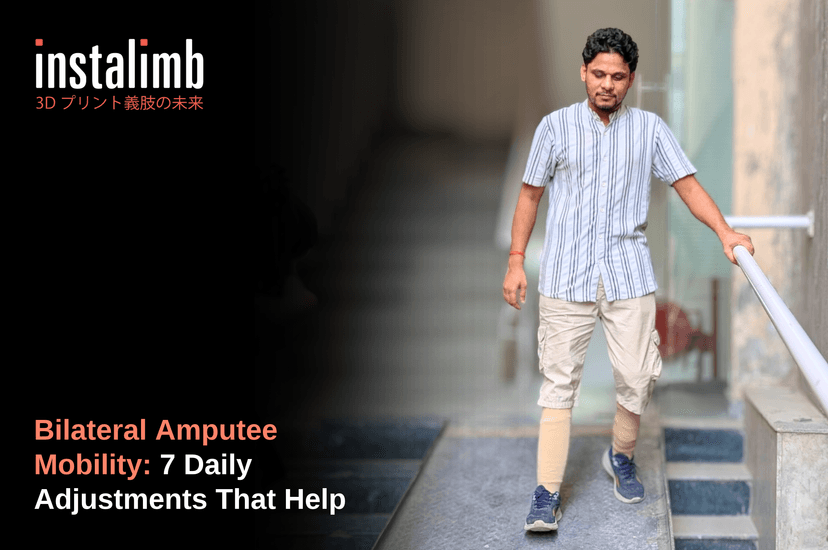
When you lose one leg, you learn to adapt. When you lose both, the rules change again. Bilateral amputee mobility asks more of your body, your home, and the people around you, all at once. If you or someone you love is navigating life on two prosthetic limbs, you are not alone, and there is a clear, practical way forward. Below, you will find the seven daily adjustments at the heart of this guide, spanning home safety, socket care, and caregiving, that genuinely help.
Understanding Bilateral Amputee Mobility: What to Expect
Bilateral amputee mobility refers to how a person moves, balances, and functions daily after losing both legs. This demands more energy, sharper balance, and precise socket fit on both sides compared with single-limb loss. Recovery generally takes longer and progresses in stages, with function and confidence, not speed, as the real markers of success.
Losing one leg changes how you move. Losing both changes how you move, balance, and plan your entire day.
With a single prosthetic limb, your sound leg still carries much of the load and gives you a stable reference point. With two prosthetic limbs, that reference point is gone, so your body has to relearn balance, weight shift, and rhythm from scratch on both sides at once.
Bilateral lower-limb amputation is uncommon in India, but it is still clinically significant. In a 12-year review of patients at the Artificial Limb Centre in Srinagar (Journal of Clinical and Diagnostic Research, 2023), researchers found that only about 3% of lower-limb amputees had lost both legs, while the rest had lost one.
The causes behind limb loss vary widely. Diabetic foot disease (long-term nerve and blood vessel damage from high blood sugar) causes an estimated 42% of amputations in India, according to 2026 research from Saveetha Medical College and Hospital in Chennai. Peripheral arterial disease (reduced blood flow to the limbs) is responsible for another 22%. The remainder splits across trauma, infection, and other causes.
Diabetic foot disease is widely regarded as one of the leading drivers of lower-limb amputation in India, though there is no single national registry that confirms exactly how it ranks. For context, India has an estimated 101 million people living with diabetes and another 136 million with prediabetes, according to the ICMR-INDIAB study published in The Lancet Diabetes & Endocrinology (2023). If you have lost one leg to diabetes or poor circulation, your risk of losing the other leg is higher too, which is part of why World Diabetes Day on 14 November is a fitting moment to raise this connection.
The 7 Daily Adjustments for Bilateral Amputee Mobility
Think of these as your quick-reference double amputee mobility tips, the seven small changes that make the biggest difference day to day. Each one is explained in more depth in the sections that follow.
-
Track volume changes in each leg separately, rather than assuming both heal at the same pace.
-
Fit grab rails on both sides of stairways and in the bathroom, not just one side.
-
Switch to a raised, Western-style toilet seat where possible.
-
Use a sturdy chair or stool for meals instead of floor seating, at least in the early months.
-
Choose non-slip mats and footwear, especially during festival and monsoon seasons.
-
Adjust your prosthetic sock ply more frequently as the weather cools, and check both limbs.
-
Share transfer and support duties across family members to protect the caregiver's own body.
The Energy and Balance Demands of Walking on Two Prosthetic Limbs
Walking on two prosthetic limbs takes substantially more cardiovascular effort than walking on one. Every limb and amputation level you add increases the energy your body has to spend on each step, a pattern researchers have tracked back to Waters' foundational 1992 work on amputee gait (the pattern and rhythm of your walk). If you are a bilateral transfemoral amputee, meaning you have lost both legs above the knee, you work considerably harder than someone with a single transtibial or below-knee limb. This is one reason many bilateral transfemoral users rely on shorter training prostheses or a wheelchair for longer distances while they build strength.
Balance adds another layer. Researchers at Coimbra University Hospital found in 2025 that on the Timed-Up-and-Go test, a standard timed balance and mobility check, transfemoral amputees took noticeably longer to complete it than transtibial amputees did. Fall risk in lower-limb prosthesis users is well documented, and past research suggests that over half fall at least once a year, so it helps to know this upfront rather than be caught off guard. Most of this research focuses on single-limb amputees rather than bilateral ones, which is exactly why supervised, professional gait training built around two prosthetic limbs is so valuable for you.
Getting the Fit Right, Twice Over: Sockets for Two Limbs
A single socket, the custom-fitted component connecting your residual limb (the part of your leg remaining after amputation) to the prosthetic leg, is already the biggest variable in comfortable walking. Two sockets double that complexity. Your residual limbs rarely heal or change volume at the same rate, especially when the original causes differed, for example, one leg lost to trauma and the other to diabetic complications.
Managing Asymmetric Healing and Volume Changes
It is common for one residual limb to shrink or swell faster than the other in the months after surgery. A socket that fits well in week three can feel loose or tight by week six, on one side only. Tracking managing volume changes in your residual limb on each leg separately, rather than assuming both follow the same timeline, helps you flag problems early instead of pushing through discomfort.
Why Socket Precision Matters More for Bilateral Fittings
Socket-fit precision matters twice as much for bilateral amputees, since two residual limbs, often of different lengths or amputation levels, must each be shaped for a safe, symmetrical gait. Many bilateral patients also manage an asymmetric pair, one below-knee and one above-knee limb, which makes matched components even more important. At Instalimb, we use AI-assisted 3D scanning and CAD design to capture each limb's exact contours to within 1mm, then 3D print each socket to match, so both limbs can be adjusted and retested through a trial-socket fitting process before final delivery. If something still feels off, learning how to tell if your socket isn't fitting right is a useful first step before any adjustment.
Everyday Adjustments at Home: India-Specific Considerations
Most Indian homes were not designed with two prosthetic limbs in mind. Multi-storey houses without lifts, squat-style toilets, and floor seating at mealtimes all ask more of your balance than a single flight of stairs in a Western-style home.
Floor Seating, Festivals, and Monsoon-Season Terrain
Diwali celebrations bring extended standing for rituals, plus oil and rangoli powder that make courtyards and entrances slippery, so this time of year calls for extra caution. Staying safe on festival terrain this Diwali is worth reading before the celebrations begin.
Monsoon season brings a different hazard: wet, uneven ground outdoors that is just as unforgiving on two prosthetic limbs. Then, as North and Central India cool through November and December, your residual limb volume often shifts again. Expect to adjust your prosthetic sock ply (the thickness of the sock worn between limb and socket) more frequently during this period, and check both limbs, since managing two sockets means twice the adjustments to track.
Supporting a Bilateral Amputee: The Caregiver's Role
Caring for a bilateral amputee often means more physical labour than caregivers expect: lifting, carrying, steadying, and catching, sometimes several times a day in the early months. This load falls disproportionately on family members in India, where paid home-health support is far less common than family caregiving. That effort is real, and it deserves recognition, not silent endurance.
Moving From Constant Support to Sustainable Partnership
The goal is not for you to carry this alone indefinitely. Learning proper transfer techniques from a physiotherapist, using grab bars and transfer aids, and sharing duties across family members all reduce strain on your own body. As your loved one's balance and transfer skills improve, your role can shift from constant physical support towards steady encouragement. Helping without overstepping as a caregiver explains how to find that balance.
Building Mobility and Confidence Over Time
Confidence on two prosthetic limbs builds in stages, not overnight. Most bilateral amputees in India begin with wheelchair or parallel-bar practice, move to supported standing, and then progress to short, assisted walks before building independent distance. Staged rehabilitation like this does not mean you are behind; it means you are progressing safely.
Physiotherapy and Gait-Training Milestones
Structured physiotherapy is central to this progress, and your first steps in prosthetic physiotherapy is a good place to begin if you haven't already. At Instalimb, we have designed over 500 prosthetics across Delhi, Gurugram, Hyderabad, Bangalore, Mumbai, and Vizag, and across that work we have seen that a precisely 3D-printed, well-matched pair of sockets, paired with consistent gait training, makes the biggest difference to how quickly someone regains confident, independent movement. Mental health matters here too. Frustration with a slower pace is normal, and it passes with steady practice.
Frequently Asked Questions (FAQ)
How long does recovery take after a bilateral amputation?
Recovery after bilateral amputation generally takes longer than after a single amputation, since both limbs need to heal, be fitted with sockets, and go through gait training before confident walking begins. Timelines vary with amputation level, overall health, and access to structured physiotherapy. Many bilateral amputees in India progress through staged rehabilitation, starting with wheelchair or parallel-bar practice before moving to prosthetic walking, with consistent practice shaping the pace of progress.
Is walking with two prosthetic legs harder than walking with one?
Yes, walking on two prosthetic legs requires substantially more cardiovascular effort than walking on one, because energy cost compounds with each limb and amputation level involved. Bilateral transfemoral users often rely on shorter training prostheses or a wheelchair for longer distances while building strength and endurance. With structured gait training and well-matched sockets, many bilateral amputees still achieve confident, independent mobility for daily tasks over time.
Why is prosthetic socket fitting harder for bilateral amputees?
Socket fitting is harder for bilateral amputees because two residual limbs, often differing in shape, length, or amputation level, must each reach a precise, comfortable fit at the same time. A poor fit on either side throws off balance and gait on both. This is why trial sockets and iterative adjustment matter more here, and why scanning technology that captures each limb's exact contours can shorten the path to a well-matched pair.
How can caregivers support a bilateral amputee without straining their own bodies?
Caregivers protect their own bodies by learning proper transfer and support techniques from a physiotherapist rather than relying on lifting strength alone, and by using grab bars, transfer boards, or raised seating to cut physical strain. Encouraging the bilateral amputee to build their own standing balance and transfer skills early reduces how much physical support they need long term. Sharing caregiving duties across family members also helps sustain support over time.
Can a bilateral amputee manage a multi-storey Indian home without a lift?
Yes, with planning: reorganising daily life around ground-floor rooms, adding grab rails and raised seating, and switching from squat-style to Western-style toilets make everyday movement safer in homes without lifts. Many bilateral amputees in India adapt existing multi-storey or joint-family homes with targeted changes rather than relocating. Occupational therapy guidance helps identify which specific modifications make the biggest difference for a particular home's layout.
What is daily life like for a bilateral amputee in India?
Daily life after bilateral amputation in India usually involves a mix of home adjustments, such as grab rails, raised seating, and non-slip flooring, staged physiotherapy to rebuild balance and endurance, and extra hands-on caregiver support in the early months. As fit and strength improve, most people return to work, family routines, and social life, though the pace depends on amputation level, overall health, and access to structured rehabilitation. With the right support, an independent daily routine is a realistic goal, not just an aspiration.
Moving Forward
Life after bilateral amputation asks a lot of you, physically, mentally, and practically, but it does not ask the impossible. With well-fitted sockets on both limbs, structured physiotherapy, sensible adjustments at home, and a caregiver who knows when to step in and when to step back, confident movement is realistic, not just hoped for. Progress may be slower than you expected, and that is normal, not a setback. Each steady step, literally and otherwise, is building towards a fuller, more independent daily life.
Check out our blog section for more!
Diabetic Foot Care After Amputation: 5 Daily Habits
You already know what it took to get through your first amputation, and the quiet fear that follows is real: could the other leg be next? The honest answer is that diabetic foot care after amputation is something you can act on starting today, with simple habits that genuinely lower your risk. This guide walks you and your caregivers through exactly what to check, when to worry, and how the fit of your prosthetic limb plays into the whole picture.
Why Your Remaining Leg Is at Higher Risk After a Diabetic Amputation?
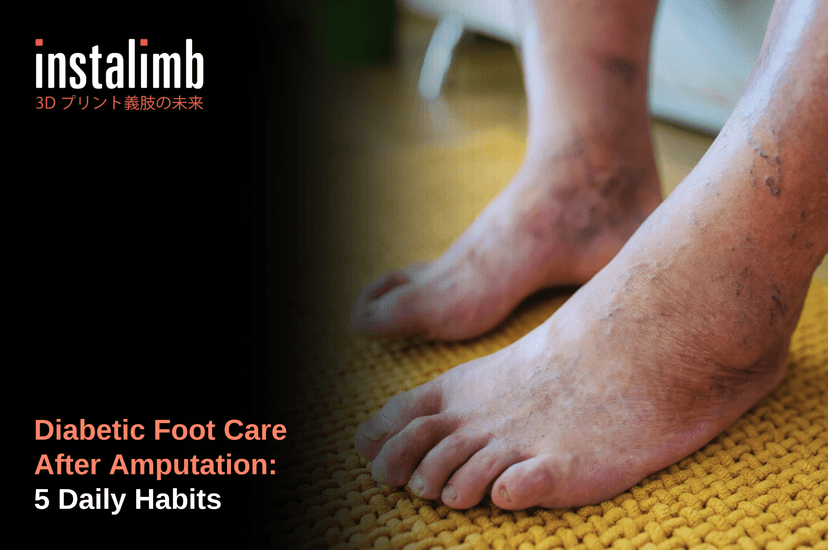
After an amputation, your remaining leg suddenly carries a job it never had before: bearing your entire body weight, step after step, every day. Combined with diabetes, that extra load changes the stakes for your sound foot considerably, since healing is slower and small injuries can turn into ulcers or infections far more easily than before.
Your remaining foot now carries your full body weight, which sharply raises its risk of developing a diabetic foot ulcer (DFU). Diabetic amputees face roughly a 19.9% chance of losing the other leg too, compared with 7.1% in non-diabetic amputees, and about 1 in 10 faces a major second amputation within five years.
This isn't only about weight. Diabetic peripheral neuropathy, nerve damage caused by prolonged high blood sugar, often means you cannot feel a blister, a stone in your shoe, or a cracked heel forming until it is already a wound. Poor circulation then slows healing once skin does break.
Contralateral amputation is the medical term for losing the second, remaining leg after an earlier amputation. It happens to diabetic amputees at roughly double the rate seen in non-diabetic amputees.
According to the Indian Journal of Endocrinology and Metabolism (November 2024), around 25% of people with diabetes in India develop a DFU at some point, and about 20% of those cases need some level of amputation.
A prior ulcer is the single strongest predictor of another one, which is exactly why daily vigilance matters more now than ever. In a separate finding, research from CMC Vellore (Christian Medical College, Vellore) found that the risk of a repeat amputation roughly triples after the first procedure.
The World Health Organization's South-East Asia Region estimates around 77 million adults living with diabetes across the region, many undiagnosed until complications like these appear.
Diabetic Foot Care After Amputation: 5 Daily Habits That Protect Your Sound Foot
Protecting your other leg does not require anything complicated, just consistency. These five habits, practised daily, target the exact failure points that lead to ulcers and further amputation in people living with diabetes.
1. Check your feet every day, even when they feel fine. Neuropathy makes pain an unreliable warning system, so look, or have someone look, at the top, sole, heel, and between every toe, regardless of how your foot feels that day.
2. Wash and dry properly, especially between the toes. Use lukewarm water, never hot, since reduced sensation makes it easy to scald yourself without realising, and dry thoroughly between each toe to prevent the damp conditions fungal infections thrive in. These everyday stump care habits apply just as much to your remaining foot as they do to your residual limb.
3. Moisturise the skin, but never between the toes. Dry, cracked skin on the heel or sole is an open door for infection, so moisturise daily while keeping the webbing between your toes dry to avoid fungal growth.
4. Trim nails safely, or get help from a professional. Cut straight across, never into the corners, and if your eyesight or dexterity makes this risky, ask a podiatrist or a trained caregiver to do it instead.
5. Choose footwear that protects, and never walk barefoot. Even indoors, an unfelt step onto something sharp or hot can go unnoticed for hours and turn into a serious wound before you realise it happened.
How Caregivers Can Check a Foot They Can't Fully See?
If you're living with diabetes, you may also have diabetic retinopathy, eye damage from diabetes that blurs or dims vision. This can make visually inspecting your own sole, heel, and the spaces between your toes genuinely difficult, and limited mobility after an amputation can make bending down to check even harder.
A small mirror propped on the floor lets you see the sole without bending. A phone camera works even better: take a photo daily and zoom in to compare it with yesterday's. The most reliable tool, though, is a second pair of eyes. Ask a caregiver or family member to do a quick visual check once a day as a shared routine, not a hovering inspection. Keep a simple limb-care checklist for caregivers on hand so checks stay quick and purposeful.
Caregivers should never ignore new redness, swelling, warmth, odour, or any wetness staining a sock, even if the person reports feeling no pain at all.
Is Your Walk Hurting Your Good Leg? Gait, Socket Fit and Pressure Points
A loose or poorly aligned prosthetic socket can quietly put your sound foot at risk, even though the problem technically starts on the other side. When a socket is too loose, your residual limb moves slightly inside it with every step, a motion called pistoning, much like a foot sliding inside an oversized shoe.
To compensate, you may unconsciously shorten your stride on the prosthetic side and shift more weight onto your sound leg for longer during each step. Over months, that uneven loading concentrates pressure and shear on specific spots of your sound foot, and it can turn a minor callus into a serious wound wherever neuropathy has already dulled your sense of pain.
Fit should never be treated as a one-time event. At Instalimb, we've designed over 500 prosthetics across Delhi, Gurugram, Hyderabad, Bangalore, Mumbai, and Vizag. We adjust sockets with 1mm precision using 3D-CAD design, 3D printing, and AI-powered scanning, so even subtle shifts in your gait or weight get caught and corrected before they turn into pressure damage. That experience has taught us to treat fit as an ongoing variable, not something you sort out once and forget.
Watch for signs your socket isn't fitting right, and remember how fit and skin health are connected. If your activity level, weight, or walking pattern has changed recently, get your socket reassessed rather than waiting for pain to tell you something is wrong.
Seasonal Risks for Indian Amputees: Diwali, Winter and Monsoon Aftermath
With World Diabetes Day falling on 14 November and Diwali just before it this year, this season deserves extra care. Diwali brings its own risks: barefoot rituals on cold marble or stone floors, and diyas, candles, and firecrackers near a foot that can't feel heat or sharp objects. Closed, protective footwear is essential even during the celebrations.
Festive sweets can also spike blood sugar, which slows wound healing exactly when a minor nick or burn needs your body's best healing response.
Geography matters too. In Delhi and Gurugram, dry winter air is setting in, raising the risk of cracked heels and fissures that can become entry points for infection. In Hyderabad, Bangalore, Mumbai, and Vizag, the still-humid post-monsoon stretch keeps fungal infection risk high between the toes.
Wherever you are in India, adjust your routine to the season rather than assuming last month's care habits still cover you.
When to See a Doctor Immediately?
Do not wait and watch if you notice any break in the skin that weeps fluid, a red or darkening patch that does not fade, swelling or warmth in one area, an unusual odour, or a fever alongside any foot change. Because diabetic peripheral neuropathy can hide pain, these signs matter more than discomfort does. Contact your doctor the same day, not after a few days of waiting, since early treatment is what keeps a small problem from becoming a second amputation.
Frequently Asked Questions (FAQ)
Q1: Will I lose my other leg too if I already had a diabetic amputation?
A1: Not necessarily, but the risk is real: diabetic amputees face roughly double the risk of losing their remaining leg compared with non-diabetic amputees, with contralateral amputation rates around 19.9% versus 7.1%. Globally, about 1 in 10 diabetic amputees loses the remaining limb within five years of the first amputation, making daily foot checks, proper prosthetic fit, and prompt wound care essential to lowering that risk.
Q2: How do I check my remaining foot for problems if I can't see it well?
A2: Use touch, smell, and a mirror or a caregiver's eyes instead of relying on your own eyesight alone, since diabetic retinopathy (the eye damage diabetes can cause) and limited mobility after amputation make visual self-checks unreliable. Run your hands over the entire foot daily, feeling for heat, swelling, or wetness, check between toes for fungal infection, and ask a caregiver or family member to visually inspect the sole and heel at least once a day.
Q3: Can my prosthetic leg cause ulcers on my other foot?
A3: Yes, indirectly: a poorly fitted or loose prosthetic socket causes abnormal gait patterns like pistoning and compensatory limping, which shift extra pressure and shear onto the sound foot over weeks and months. In someone with diabetic neuropathy who cannot feel this building pressure, that compensation can lead to calluses, blisters, and eventually ulcers on the remaining foot, which is why periodic socket refitting matters as much as foot care itself.
Q4: What are the first signs of a diabetic foot ulcer on the remaining leg?
A4: Early signs include a red or discoloured patch, a callus that feels harder or looks darker than usual, warmth or swelling in one area, and any break in the skin that weeps fluid, even painlessly. Because neuropathy can mask pain, amputees and caregivers should treat any skin colour change, odour, or wetness in a sock as reason to inspect the foot immediately and contact a doctor if it doesn't resolve within a day.
Q5: What can a caregiver do to help an amputee protect their other foot without being overbearing?
A5: Caregivers can set a daily foot-check routine together, rather than inspecting the foot without asking, so it becomes a shared habit instead of supervision. They should learn the specific warning signs (new redness, swelling, warmth, odour, or wetness in a sock or shoe) ahead of time so checks are quick and purposeful, and agree in advance on when a change is serious enough to call the doctor, which reduces both hovering and missed ulcers.
Protecting Your Other Leg Starts Today
You have already shown enormous strength in rebuilding your life after one amputation, and that same strength is exactly what protecting your other leg takes: daily attention, not perfection. Every foot check, every properly dried toe, and every socket adjustment you book is a small act that adds up to real protection.
If it has been a while since you last had your socket fit checked, getting your socket fit checked is a simple, no-pressure way to find out whether your walk could be doing your sound foot any favours. Your other leg deserves the same care and commitment you've already shown.
Check out our blog section or more!


