Bone Health After Amputation: Why Osteoporosis Risk Rises
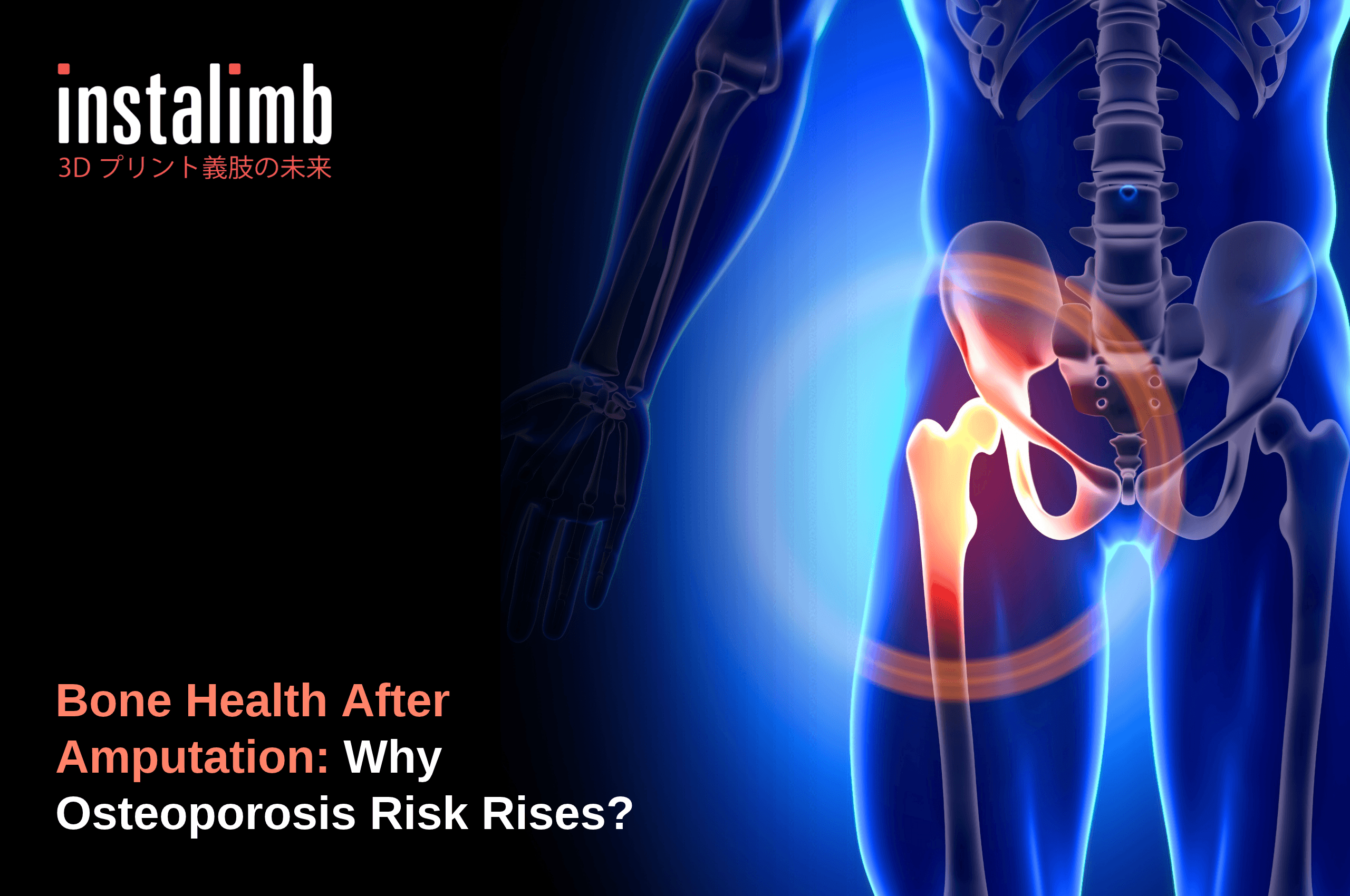
If you've had a leg amputated, chances are you've talked plenty about your socket fit, your gait, and your daily routine, but rarely about what's happening inside the bone itself. Bone health after amputation changes in ways that few patients or caregivers are ever warned about, and understanding why can help you take simple, practical steps to protect it before problems set in without warning.
Bone Health After Amputation: What Actually Happens to Your Bones
After amputation, bone loss concentrates in the residual limb, especially the hip and femoral neck, because that bone is no longer bearing regular weight. Research shows this bone loss can begin within the first year, and more than half of amputees assessed beyond five years show osteoporosis or osteopenia.
Osteopenia and osteoporosis both describe bone that has become less dense and more fragile than normal, with osteopenia being the earlier, milder stage. Ordinary age-related bone loss affects the whole skeleton gradually, but this pattern stays localised to the residual limb, rather than spreading evenly across the body.
Why Does Osteoporosis Risk Rise After Limb Loss?
The Mechanical Loading Connection
Bone is living tissue: it constantly breaks down and rebuilds itself, taking its cues from the forces placed on it. Much like a path across a field stays compact and well-defined only as long as feet keep walking over it, steady weight-bearing is what keeps bone dense. Take away that regular loading on one leg, and the body reads it as a signal to stop reinforcing bone there, a process doctors call disuse osteoporosis. It's why the residual limb, rather than the rest of the skeleton, tends to lose density first and fastest.
Diabetes, Age, and Nutrition Stack the Risk
In India, this mechanical risk rarely arrives alone. Diabetic foot complications were the leading cause of lower-limb amputation in a 2023 to 2024 study from Saveetha Medical College, Chennai, accounting for 42% of cases, with peripheral arterial disease (PAD) responsible for a further 22%. Diabetes is also widely understood to affect bone quality, though this hasn't yet been measured directly in Indian amputees.
Add an average amputation age already in the mid-fifties, average daily calcium intake sitting below recommended levels, and vitamin D deficiency affecting over half the population in some regions, and these risk factors compound rather than act alone. Simple daily routines matter here too. See [daily habits for diabetes-related amputation care] for a practical starting point.
What the Research Shows About Bone Loss in Amputees
Bone Density Studies, the Numbers
The clearest evidence so far comes from outside India, though the pattern is one worth checking against your own situation. A UK study of military personnel, the ADVANCE study published in the Journal of Bone and Mineral Research (2023), followed 153 lower-limb amputees against 562 uninjured controls. McMenemy et al. found amputees had roughly twelve times higher odds of pathology in the femoral neck, the narrow part of the thighbone just below the hip joint. Bone loss was also significantly greater after above-knee (transfemoral) amputation than below-knee (transtibial) amputation, so your own amputation level matters here. A 2024 Pakistan Armed Forces Medical Journal study, a relevant South Asian proxy rather than Indian data, measured femoral-neck Z-scores, a score that compares bone density with what's typical for someone's age and sex, where a more negative number means weaker bone. Yasmeen and Younas et al. recorded scores of -2.62 in transtibial amputees and -3.32 in transfemoral amputees, well below the near-normal scores seen in each patient's remaining leg.
Why India Needs Its Own Data
No published Indian study has yet measured bone density loss directly in lower-limb amputees, which means nobody is routinely tracking this for you yet. What India does have is solid data on amputation causes, including the Saveetha cohort above, confirming how heavily diabetes features in this population. If you're also navigating a related concern, heterotopic ossification, [another bone-related complication amputees should know about] is worth understanding too, since it works quite differently from the disuse-related bone loss discussed here.
Walking, Prosthetic Fit, and Bone Loading
Here's the practical link: your bones need consistent weight-bearing to stay strong, and your prosthetic is what makes consistent weight-bearing possible day to day. If a socket pistons, slips, or creates pressure points, most people respond sensibly by cutting back on wear time or leaning on a wheelchair more often, a completely understandable response to discomfort, but one that also means less loading on the bone that needs it most.
At Instalimb, our sockets are 3D-printed and designed using 3D-CAD, 3D printing, and AI/ML to reach roughly 1mm fit precision, aimed at reducing the pressure points and slippage that often push people to shorten their walking time. This isn't a treatment for bone density, and nothing about a socket is. What a comfortable, well-fitting prosthetic does support is the kind of consistent, active daily use your bones benefit from, something worth keeping in mind as [how prosthetic needs change with age].
Across our clinics in Delhi, Gurugram, Hyderabad, Bangalore, Mumbai, and Vizag, we have designed over 500 prosthetics, and fit is one of the first conversations we have with nearly every patient who walks through our doors.
Is Anyone Screening for This? Bone Density Testing in India
What a DEXA Scan Involves
If you're wondering what this actually involves, a DEXA (or DXA) scan is a low-dose X-ray that measures bone density, usually at the hip and spine, and takes only a few minutes. It's available in India's major cities, including the metros where Instalimb operates, with private-sector results often ready within zero to three days. Insurance reimbursement for the scan is limited in many cases, a structural access gap separate from whether the scan itself is available to you.
Why It Isn't Yet Routine Post-Amputation Care
Despite the risk, a DEXA scan isn't automatically offered after a lower-limb amputation in India. The International Osteoporosis Foundation's 2025 Asia-Pacific audit found that India generally under-recognises and undertreats osteoporosis, and hasn't yet designated it a national health priority. If nobody raises it, it's worth raising yourself with your doctor or prosthetist, particularly if you have diabetes, are over 50, or are several years post-amputation.
What You Can Do: Practical Steps for Stronger Bones
Diet and Vitamin D
Calcium and vitamin D are the building blocks your bones use to rebuild themselves, and both tend to run low in Indian diets. Dairy, ragi, sesame seeds, and leafy greens are accessible calcium sources, while a short, regular spell of morning sunlight supports vitamin D production. For more detail, see [foods that support bone health].
Staying Active Safely
Weight-bearing movement, including walking, standing exercises, and supervised strength work, is one of the few modifiable factors for bone density after amputation. Start gradually and build up, ideally with guidance from your physiotherapist or prosthetist, especially if you're also managing joint stiffness or swelling in the residual limb.
When to Raise a Bone Scan With Your Doctor
If you're due a prosthetic review, that's a natural moment to also ask about bone density, especially if your socket fit hasn't been checked in a while. Instalimb's test-fitting process gives you and your prosthetist a low-barrier way to catch fit problems early, before discomfort gradually reduces how much you walk.
A Note for Caregivers
If you support someone who has had an amputation, you're often the first to notice changes: a new limp, reduced walking, reluctance to wear the prosthetic, or complaints of hip or residual-limb discomfort. These are worth mentioning at the next medical appointment, since they can be early signs of reduced activity, which matters for bone health too. For broader guidance, see how caregivers can help without overstepping.
Frequently Asked Questions (FAQ)
Here are direct answers to the questions amputees and caregivers in India ask most often about bone health after amputation.
1. Does having a leg amputated increase osteoporosis risk?
Yes, amputation is linked to a significant rise in osteoporosis risk, concentrated in the residual limb rather than across the whole skeleton. A UK study of military amputees (the ADVANCE study, Journal of Bone and Mineral Research, 2023) found roughly twelve times higher odds of femoral-neck bone density pathology compared with uninjured controls. More than half of amputees assessed beyond five years post-amputation had osteoporosis or osteopenia.
2. Why does bone density drop specifically in the amputated limb?
Bone loss concentrates in the femoral neck of the amputated limb because reduced weight-bearing removes the mechanical loading bone needs to stay dense, a pattern known as disuse osteoporosis. A 2024 Pakistan Armed Forces Medical Journal study (not Indian data, but a relevant regional proxy) found femoral-neck Z-scores of -2.62 in below-knee and -3.32 in above-knee amputated limbs, versus near-normal scores in each patient's sound limb.
3. How soon after amputation does bone loss begin, and does it get worse over time?
Bone loss can begin within the first year after amputation and tends to worsen over time and with more proximal amputation levels. The ADVANCE study found bone loss was significantly greater after above-knee than below-knee amputation, and that over half of amputees assessed beyond five years post-surgery had osteoporosis or osteopenia. A Pakistan study similarly linked more proximal amputation to greater bone loss.
4. Does wearing a prosthetic and staying active actually protect bone density, or is it just pushing through discomfort for nothing?
Consistent standing and walking help bone maintain density because bone responds to mechanical loading, while immobility and reduced weight-bearing are established contributors to disuse-related bone loss, so staying active is one of the few modifiable factors for bone health after amputation. Comfort matters here: a socket that causes pressure points or slippage is a common reason people cut back on daily wear time, working against this.
5. What can amputees, especially in India, do to protect their bones, and should they ask for a DEXA scan?
Protective steps include staying as active as comfortably possible, meeting calcium and vitamin D needs, and asking a doctor about bone density (DEXA) screening, since it is not routinely offered to amputees unless raised. This matters in India, where osteoporosis is under-recognised, average daily calcium intake runs below recommended levels (around 429mg), and vitamin D deficiency exceeds 50% in some regions. DXA scans are available in major cities within 0 to 3 days, though insurance reimbursement is limited.
Conclusion
Your bones are quietly affected by amputation in ways that are easy to miss amid everything else you're managing, but the response can be just as straightforward: consistent movement, decent nutrition, and one honest conversation with your doctor about a bone scan. None of this asks you to give up comfort or capability; it simply means bringing bone health into a conversation that, in India, almost nobody is having yet. With World Diabetes Day falling on 14 November 2026, and diabetes playing such a central role in both amputation and bone health here, it's a fitting moment to ask your own care team where your bones stand.
Check out our blog section for more!
So, if you‘re looking for a new artificial leg, interested in a free consultation, confused if your socket is the right fit, or have any other queries, now is the time to reach out to us and try a test socket free of cost. Step it up with Instalimb - Contact us today!
Recent Posts
November 5, 2026
November 5, 2026
October 30, 2026
October 23, 2026
October 22, 2026
October 14, 2026
October 13, 2026
October 8, 2026
October 6, 2026
