Right Time to Get a Prosthetic Leg: Know the Signs
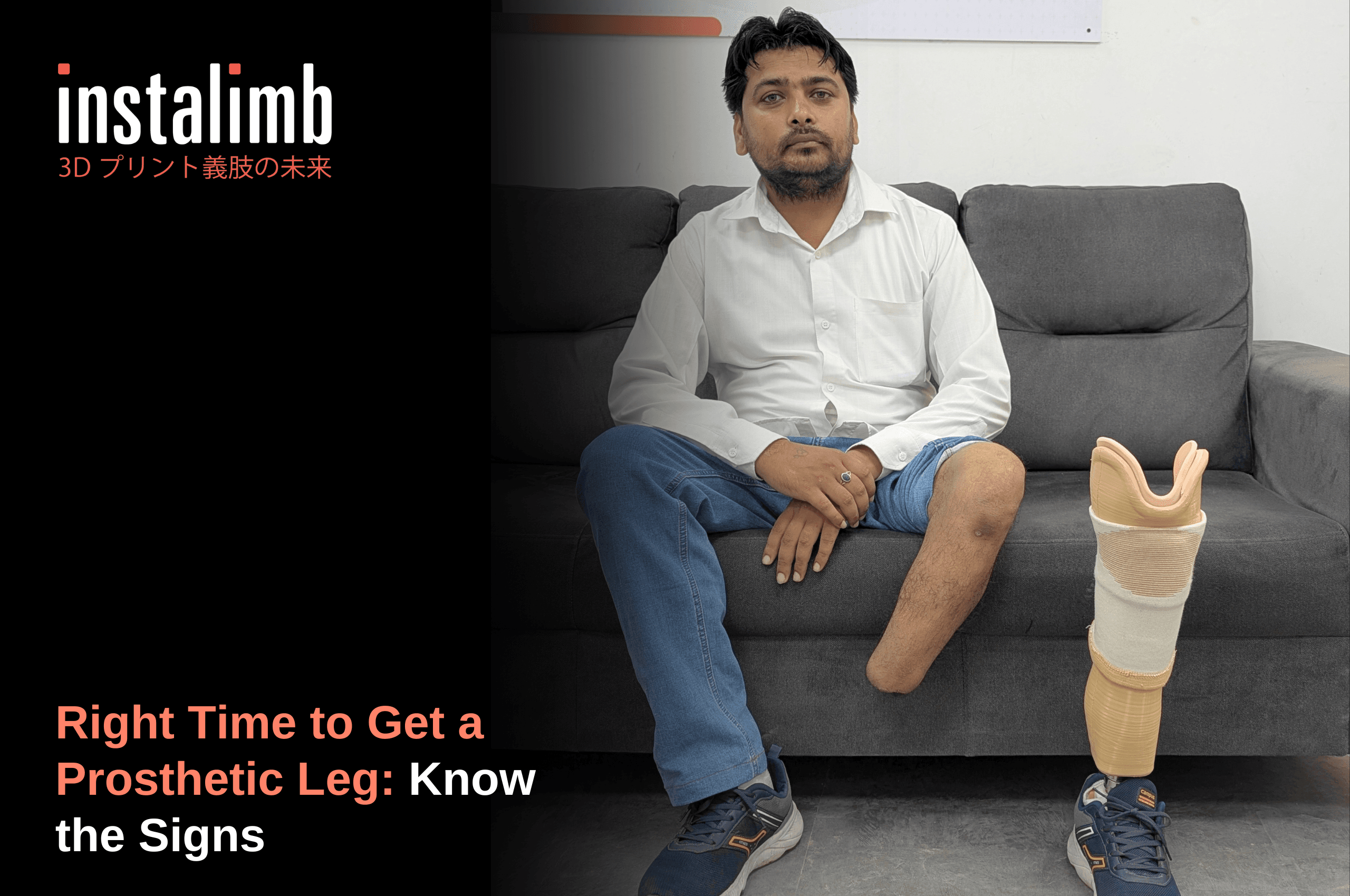
If you or someone you love has recently had an amputation, one question tends to arrive before almost any other: when is the right time to get a prosthetic leg? It's a fair question.
In India today, diabetic foot disease is fast overtaking accidents as a cause of limb loss. That shift means the answer looks a little different than it used to.
The good news is simple. Readiness has far less to do with a calendar date than with the signs your body gives you. This guide walks you through exactly what to look for.
What Is the Right Time to Get a Prosthetic Leg?
It's natural to want a straightforward answer, a date you can circle and wait for. But prosthetic rehabilitation rarely works like that. Understanding why can take a good deal of pressure off you and your family.
There is no single fixed date for the right time to get a prosthetic leg. Clinicians instead look for signs of readiness.
These include a healed incision, swelling that has settled into a manageable pattern, stable skin, and sign-off from both your surgeon and your prosthetist. Straightforward below-knee cases are usually fitted 6 to 12 weeks after surgery.
Above-knee (transfemoral) amputations, or wounds that healed with complications, often need longer. That is not a setback. It's simply a different starting point on the same path. Your care team will tell you where you stand.
Modern socket-making includes Instalimb's use of 3D-CAD design and 3D printing. This means even an "early" fitting can be revisited and refined as your limb settles. It isn't a one-time, make-or-break event.
Why India's Amputees Face a Different Timeline
Road Traffic Accidents vs Diabetic Foot Disease
For years, road traffic accidents drove most prosthetic needs in India. That picture is changing quickly. Recent South Indian hospital data found that diabetic foot disease now causes 42% of amputations.
That's ahead of peripheral arterial disease (22%) and trauma (16%). Below-knee amputations made up 70% of cases (Dwaarakesh MS et al., 2026).
This shift matters. Diabetic amputees are often older and manage other health conditions alongside their amputation. They may need a slightly different, more gradual rehabilitation plan than a younger trauma patient.
What the Indian Rehabilitation Data Shows
A tertiary rehabilitation centre study in Northern India covered 106 unilateral lower-limb amputees. It found road traffic accidents still account for 68.87% of cases there.
Diabetes and cancer were each responsible for 8.49% (Deepak K et al., Cureus 2023). Whatever the cause, the same question follows every patient: when is it my turn to be fitted?
The Three Stages of Residual Limb Healing
Your residual limb, often called the stump, does not stop changing the moment your wound closes. Research shows it continues reshaping for at least 100 days after surgery. It moves through three recognised stages (Sanders & Fatone, 2011).
Acute Stage (Weeks 4 to 8)
This is the wound-healing phase. Swelling is at its highest and the incision is still closing. Your care focuses on protecting the limb, not on fitting anything permanent.
How this stage is managed matters. One study found elastic bandaging got patients to fitting in 34 days, versus 64 days with a semi-rigid dressing.
Intermediate Stage (Months 4 to 6)
You typically receive your first formal prosthesis here. Expect frequent socket adjustments, though, as volume keeps shifting. This is completely normal. It doesn't signal that anything has gone wrong with your healing.
Stable or Mature Stage (Months 12 to 18)
By this point, most residual limbs have settled into a fairly consistent shape and volume. Clinically, a limb under twelve months old is still considered "immature", which is simply a description of its healing stage, not a verdict.
Signs You Are Ready for a Prosthetic Fitting
Counting weeks isn't the point. Your surgeon and prosthetist look for a combination of practical signs instead. Readiness is defined by what your limb and body are doing, not by a date on the calendar. Broadly, you are likely ready when you notice:
-
Your surgical wound has fully healed, with no open areas or drainage
-
Swelling has settled into a predictable, manageable pattern, not something that changes day to day
-
Your skin can tolerate gentle pressure and contact without breaking down
-
You have clear functional goals, whether that is walking to the bathroom unaided or returning to work
-
Your surgeon and prosthetist both agree, independently, that you are ready to proceed
If you are unsure which of these apply to you, a quick clinical assessment can usually answer it within minutes.
Does a Changing Residual Limb Mean You Have Missed Your Window?
If your limb still looks swollen or seems to change shape from morning to evening, you have not missed anything. This is one of the most common worries we hear. It is almost always a sign of normal healing, not a problem.
Residual limb volume genuinely keeps changing for months. That's precisely why early sockets are built to be adjusted, not fixed in place [why residual limb swelling keeps changing in the early months].
There is no hidden deadline that closes a door on you. As long as you are progressing through healing, the window stays open. Your care team can guide pacing from here.
What Happens If Fitting Is Delayed Too Long?
Waiting too long, especially without any clinical check-in, can carry real risk. In the Northern Indian cohort mentioned earlier, 20.75% of unilateral lower-limb amputees reported stump-related problems.
They attributed these directly to delayed prosthetic fitting (Deepak K et al., Cureus 2023). The same study recorded the lowest WHOQOL-BREF quality-of-life scores in the physical domain, at just 47.91 out of 100.
Delayed fitting is linked to measurable, preventable problems, not just inconvenience. These can include skin changes, muscle weakness from disuse, and joint stiffness.
All of this can make later fitting harder than it needed to be. The fix is not necessarily rushing into a prosthesis. It is simply not letting weeks turn into many months without anyone checking in on your progress.
A Note for Caregivers: Starting the Conversation
If your parent or elderly relative has recently had an amputation, you may be wondering when, or even whether, to raise the subject of a prosthetic limb.
In many Indian households, this conversation happens within a large joint family, often with several opinions in the room at once.
Age and diabetes do not automatically rule a prosthetic fitting out. What matters is wound healing, blood sugar control, and overall strength. A prosthetist can assess these directly, instead of guessing from age alone.
It also helps to give your relative space to process the emotional side of amputation before focusing purely on logistics [coping with grief after amputation].
A gentle way to start is simply asking your relative's surgeon when a prosthetic assessment might reasonably be considered, rather than assuming either a yes or a no in advance.
Why Does Modern Socket Making Make Timing Less Stressful?
One reason timing feels less high-stakes than it used to is how sockets are made today. Digital scan-based socket fabrication, the kind of process Instalimb uses it to let a prosthetist capture your residual limb's exact shape.
The socket can then be reshaped as healing progresses, instead of waiting for the limb to fully mature before fitting can even begin [how digital scanning beats plaster casting].
This approach combines 3D-CAD design, 3D printing and AI-assisted adjustments to achieve socket customisation down to 1mm. Small week-to-week changes in your limb do not mean starting from scratch each time.
At Instalimb, we have designed over 500 prosthetics across Delhi, Gurugram, Hyderabad, Bangalore, Mumbai, and Vizag. That volume of iterative fitting experience shapes how we think about timing: less as a single decision, more as an ongoing, adjustable process.
Planning Around Festivals, Travel and Winter
Festival season brings its own pressure. Around Navratri, Dussehra and Diwali, extended family gathering for the occasion often means well-meaning but pointed questions like "have you been fitted yet?" It helps to remember that your timeline belongs to you, not to the festival calendar.
Practically speaking, fitting access in India is still concentrated in city centres and periodic partner camps. It's worth planning travel ahead of your appointments, not around them.
Winter also brings its own considerations. Cooler, drier air can affect skin and socket comfort, so regular check-ins are even more useful during these months.
Incidentally, International Prosthetics & Orthotics Day falls on November 5 each year. It's a fitting moment to start the conversation, if you've been putting it off.
Frequently Asked Questions
1. How soon after amputation can I get a prosthetic leg?
Most people with a straightforward below-knee (transtibial) amputation are ready for their first fitting around 6 to 12 weeks post-surgery, once the incision has healed and swelling is manageable.
Above-knee or complicated wounds often take longer. Readiness is judged by clinical signs, not a countdown of weeks, and is confirmed jointly by the surgeon and prosthetist.
2. Is it normal for my residual limb to still be swollen or changing shape weeks after surgery?
Yes, this is normal. It doesn't mean the window has closed on you.
Residual limb volume keeps changing for at least 100 days after amputation, as swelling resolves and tissue remodels. This is why early sockets are adjusted frequently, instead of being built once and left unchanged.
3. What are the signs that someone is ready for their first prosthetic fitting?
Readiness is marked by a fully healed incision, swelling that has stabilised enough for a consistent socket fit, and healthy, stable skin over the residual limb.
Sign-off from both the surgeon and prosthetist confirms it. These signs matter more than counting weeks since surgery, because healing speed varies by person and amputation level.
4. Can elderly diabetic patients still get a prosthetic limb fitted?
Yes, age and diabetes alone don't rule out a prosthetic fitting. What matters is wound healing, blood sugar control, and overall health, which prosthetists assess individually.
In India, diabetic foot disease is now the leading cause of amputation. Clinics increasingly plan fitting timelines and rehabilitation goals around older, comorbid patients, not just younger trauma patients alone.
5. What happens if prosthetic fitting is delayed too long after amputation?
Prolonged delay can lead to preventable complications.In an Indian study of unilateral lower-limb amputees, over a fifth reported stump-related problems attributed to delayed fitting, alongside lower physical quality-of-life scores. Timely assessment, even if full fitting isn't yet possible, helps catch and manage these issues early.
Check out our blog section for more!
So, if you‘re looking for a new artificial leg, interested in a free consultation, confused if your socket is the right fit, or have any other queries, now is the time to reach out to us and try a test socket free of cost. Step it up with Instalimb - Contact us today!
Recent Posts
October 6, 2026
October 1, 2026
September 29, 2026
September 26, 2026
September 24, 2026
September 22, 2026
September 10, 2026
September 8, 2026
September 3, 2026