Our Blog
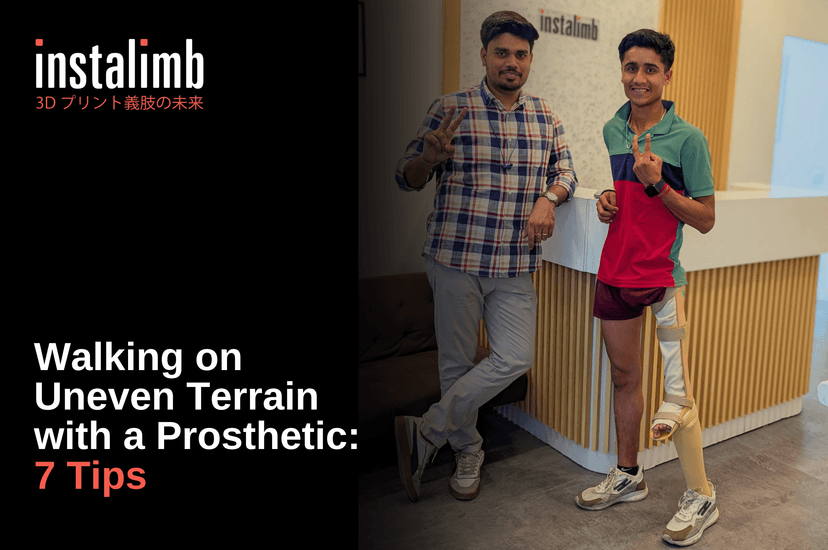
Walking on Uneven Terrain with a Prosthetic: 7 Tips
Sand, wet grass, uneven cobblestones, muddy paths, the sloping shoulder of a road. For most people, these are just part of getting around. For an amputee, walking on uneven terrain with a prosthetic leg can feel like a skill that takes months to master. The good news is that it absolutely can be mastered. And with India's monsoon season well underway, there has never been a better time to build your confidence on the ground beneath your feet.
Why Uneven Terrain Feels So Different
On a flat, smooth floor, your prosthetic foot responds predictably. But the moment the ground tilts, softens, or becomes unpredictable, your residual limb, socket, and entire posture have to compensate in real time.
The challenge isn't just mechanical. Research published in the Journal of NeuroEngineering and Rehabilitation (2019, PMID: 31340834) found that amputees expend significantly more energy navigating uneven surfaces compared to non-amputees, primarily because of the extra cognitive and muscular effort required to maintain balance. That energy cost drops dramatically with practice and the right technique.
Here is what is working against you: a standard prosthetic ankle does not self-adjust to slopes the way a biological ankle does. Understanding this helps you compensate correctly, rather than fighting your device.
The 7 Tips: Prosthetic Walking on Uneven Ground
For amputees, safe and confident walking on uneven terrain comes down to seven core techniques: slowing down and looking ahead, leading with the sound limb on downhill slopes, keeping the knee slightly bent, shortening your stride, using a wider base of support, choosing the right footwear, and practising on progressively harder surfaces.
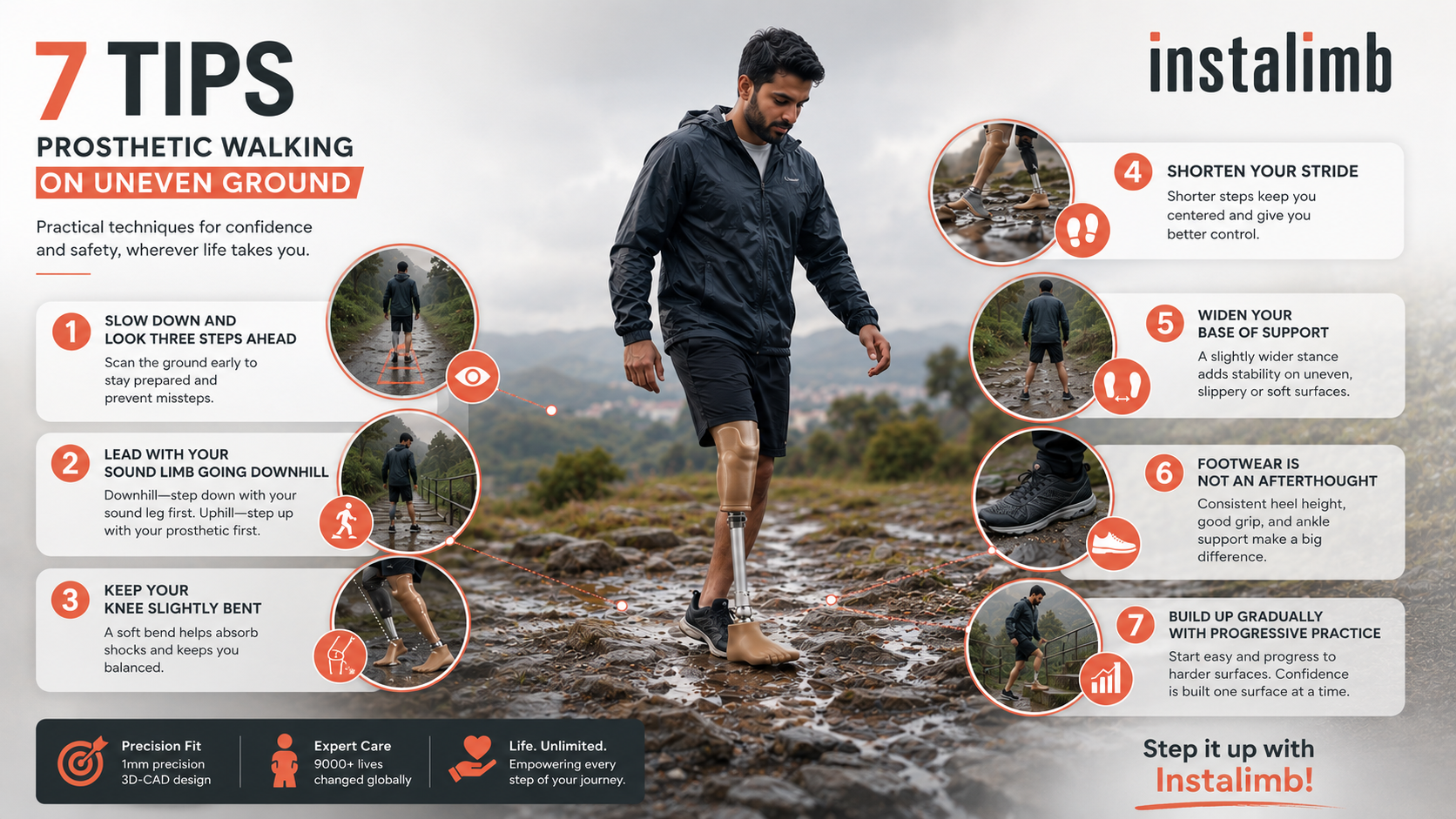
Disclaimer: This is an AI generated image
Tip 1: Slow Down and Look Three Steps Ahead
Speed is your biggest enemy on uneven ground. When you rush, your brain does not have enough time to process what is coming and relay instructions to your hip, residual limb, and core muscles.
Train yourself to scan the ground three steps ahead, not just where your foot is about to land. On busy Delhi streets or a Bangalore footpath that turns from smooth concrete to broken tiles without warning, this habit can prevent a fall before it starts.
Slow and deliberate beats fast and reactively every time.
Tip 2: Lead with Your Sound Limb Going Downhill
On a downhill slope, step down first with your intact leg. This gives you a stable base before your prosthetic foot contacts the surface. Going uphill, do the opposite: step up first with your prosthetic leg, then bring the sound limb to meet it.
This approach, sometimes called the "up with the good, down with the bad" rule, is taught in most prosthetic rehabilitation programmes and remains one of the most practical habits you can build.
Tip 3: Keep Your Knee Slightly Bent
Locking your knee straight on uneven ground reduces your ability to absorb sudden changes in height. A slightly flexed knee acts as a natural shock absorber, the way a car's suspension keeps you from feeling every bump in the road.
This applies to both your intact knee and, for above-knee amputees, to the way you load your prosthetic at mid-stance. Practice this micro-bend consciously until it becomes automatic.
Tip 4: Shorten Your Stride
Taking longer strides on uneven ground increases the amount of time your weight is unsupported between steps. Shorter steps keep you more centered over your base and give you more control.
At Instalimb, we have helped design and fit over 500 prosthetics across Delhi, Gurugram, Hyderabad, Bangalore, Mumbai, and Vizag, and stride length adjustment is one of the first things we guide patients on during gait training. A shorter stride is not a sign of weakness; it is smart mechanics.
Tip 5: Widen Your Base of Support
On flat ground, most people walk with their feet roughly hip-width apart. On challenging surfaces, temporarily widening your stance by even 5 to 10 centimeters gives you a much more stable platform.
Think of how you naturally spread your feet apart when standing on a moving bus. The same instinct applies here. Combine a wider base with a shorter stride and you will feel noticeably more stable on grass, gravel, and wet surfaces.
Tip 6: Footwear Is Not an Afterthought
The shoe on your prosthetic foot can make or break your experience on difficult terrain. Key things to look for:
-
Heel height consistency: Your prosthetic is calibrated for a specific heel height. Switching to a shoe with a very different heel can throw off your gait and increase fall risk.
-
Grip: A rubber-soled shoe with good tread is significantly safer on wet monsoon paths than smooth synthetic soles.
-
Ankle support: On your sound limb, a shoe with lateral ankle support adds an extra layer of stability on uneven ground.
If you are unsure which footwear works best with your specific prosthetic foot, ask your prosthetist. Our team at Instalimb uses 1mm-precision 3D-CAD design to ensure your socket and foot unit work together, and footwear is part of that conversation.
Tip 7: Build Up Gradually with Progressive Practice
Do not jump straight from your living room floor to a rocky hiking trail. Progression is the safest path to confidence. A practical sequence:
-
Start on slightly uneven indoor surfaces, such as a thick carpet or a yoga mat.
-
Progress to flat outdoor surfaces, such as a smooth park path.
-
Move to mild outdoor variability: a grassy lawn, a gentle incline.
-
Tackle harder surfaces: gravel, wet tiles, soft mud, uneven pavement.
-
Advance to complex terrain: slopes, crowded footpaths, stairs with no railing.
Each stage builds muscle memory, confidence, and the neural pathways that make the next stage easier.
A Monsoon-Season Note for Indian Amputees
India's monsoon brings specific challenges: waterlogged paths, slippery tiles, muddy construction zones, and uneven kerbs made worse by poor drainage. Cities like Mumbai and Hyderabad can see heavily flooded footpaths for weeks at a time.
A few extra precautions for the season:
-
Carry a dry cloth or small towel to wipe down your socket sleeve if it gets wet during suction suspension.
-
Inspect the sole of your prosthetic shoe weekly; monsoon puddles accelerate wear.
-
If your socket uses pin-locking, check the pin more frequently, as humidity can affect the mechanism.
-
Consider waterproof prosthetic covers if you are regularly caught in rain.
Every Step Forward Is a Win
Uneven terrain does not have to be a barrier. With the right technique, the right prosthetic fit, and a gradual approach to building confidence, your world gets bigger with every surface you conquer. Whether it is a muddy monsoon lane in Hyderabad or a gravel path in a Bangalore park, you can get there. Take it one step at a time.
Check out our blog section for more!
Frequently Asked Questions
How long does it take to get comfortable walking on uneven terrain with a prosthetic?
Most new prosthetic users gain basic confidence on uneven ground within 3 to 6 months of consistent practice and gait training. Factors like socket fit, the type of prosthetic foot, your activity level, and the quality of your rehabilitation all play a role. Working with a prosthetist for periodic gait assessments speeds up progress considerably.
Is it safe to walk on wet or slippery surfaces with a prosthetic leg?
Yes, with the right precautions. Grip-soled footwear, a slightly wider stance, shorter strides, and reduced speed are the key adjustments. Some prosthetic feet are specifically designed for dynamic terrain and offer better grip and ankle articulation. Ask your prosthetist whether your current foot is suited to your activity level.
Can I walk on the beach or in sand with a prosthetic?
Sand is one of the most challenging surfaces because it shifts under load and offers no firm resistance. Use a wider base, shorter steps, and significantly reduced speed. Dry, compact sand close to the waterline is easier than deep, loose sand. After beach walks, clean your prosthetic thoroughly; sand is highly abrasive to components and liners.
Does the type of prosthetic foot affect performance on uneven terrain?
Yes, significantly. Dynamic response feet (also called energy-return feet) handle terrain variability much better than basic SACH feet, offering better push-off and ankle articulation. Multi-axial feet allow the ankle to move in multiple planes, which is particularly useful on slopes and uneven ground. Your K-level and activity needs should guide which foot is prescribed for you.
What should I do if I feel unstable on a surface I am not used to?
Stop, find a stable support point (a wall, railing, or companion), and reassess. There is no shame in choosing a safer route. If instability is recurring on surfaces you used to manage well, it may signal a change in your socket fit, which warrants a check-up with your prosthetist.


AI Prosthetic Socket Fit: Predicting Limb Volume
Your residual limb is not static. It swells in the heat, shrinks when you rest, and shifts with your weight, hydration, and activity level. If your prosthetic socket was made six months ago, there is a real chance it no longer fits you the way it should. That is where AI prosthetic socket fit technology is changing everything.
Why Your Residual Limb Volume Changes Every Day
Direct answer: Residual limb volume fluctuates daily due to temperature, hydration, activity level, and body weight changes. In India's monsoon months (June to September), humidity and heat cause tissue swelling that can expand limb circumference by 3 to 8%, making a previously well-fitted socket feel tight and uncomfortable within days.
Think of your residual limb like a balloon that is never quite the same size twice. Mornings are often leaner; afternoons after walking are fuller. Summer heat and monsoon humidity amplify this. A socket designed for your limb in March may feel like a different device entirely by July.
According to a study published in the Journal of Rehabilitation Research and Development, up to 74% of lower-limb amputees report significant socket fit problems within the first year of prosthetic use, with most attributing the issue to limb volume change rather than socket damage.
The traditional fix was to add prosthetic socks to compensate for the gap. But socks are an imprecise solution. They address the symptom, not the cause.
How AI Predicts Limb Volume Changes Before They Happen
AI-powered socket design does something a plaster cast never could: it learns. By analysing scan data, historical fit records, and patient activity patterns, machine learning models can predict how a limb is likely to change over time and design the socket to accommodate that range of variation.
The core innovation is predictive modelling. Rather than designing for your limb as it is today, an AI system designs for your limb as it is likely to behave across a range of conditions: morning vs evening, rest day vs active day, winter vs monsoon.
Here is how the process works in practice:
-
Digital 3D scanning: A structured-light or photogrammetry scan captures your residual limb geometry at sub-millimetre precision.
-
Data processing: The AI analyses geometry, soft-tissue distribution, and pressure-sensitive zones to identify where the limb is most likely to change volume.
-
Adaptive socket geometry: The socket design builds in calculated relief zones and pressure gradients that remain comfortable across your predicted volume range.
-
Iterative learning: Fit feedback from follow-up appointments is used to refine future designs for similar limb profiles.
The 1mm Difference: Why Precision Changes Everything
You might wonder why 1mm matters. After all, we are talking about a fraction of the width of a coin. But in prosthetic socket design, 1mm of misfit translates directly into pressure points, pistoning, skin abrasion, and, over time, falls and injury.
The single most common complaint from patients is, "It fits in the clinic but not when I walk." That gap between clinical fit and real-world fit is the 1mm problem.
Conventional plaster casting captures a static impression of your limb at one moment in time. It cannot account for the dynamic changes that happen the moment you start walking, sweating, or sitting for long periods. Our 3D-CAD design process, powered by Japanese technology and AI-assisted geometry, builds that dynamic range directly into the socket geometry from day one.
The result is a socket that does not just fit in the clinic. It fits on the train to work, at the end of a long day, and in the middle of a Mumbai monsoon afternoon when humidity has your limbs swelling.
AI Socket Fit vs. Traditional Fitting: A Direct Comparison
Understanding the difference helps you make a more informed decision when choosing a provider.
-
Traditional plaster casting: One-time static impression. No ability to model volume variation. Fitting adjustments are manual and iterative, often taking weeks of callbacks.
-
AI-assisted 3D design: Digital scan processed through machine learning. Volume variation is modelled before the socket is printed. Fit is validated with a free test socket before the final device is made.
-
Turnaround time: Traditional casting typically requires 4 to 6 clinic visits over several weeks. Instalimb's 3D process compresses this to a test socket fitting on the first visit and a final device within days.
-
Adjustability: If your limb changes significantly, a new traditional socket means starting over. With digital design, your scan data is stored and a modified socket can be reprinted from the existing file at significantly lower cost.
Signs Your Socket Is Not Adapting to Limb Volume Changes
Many amputees tolerate a poor-fitting socket for far longer than they should, often assuming discomfort is just part of life with a prosthetic. It is not. Here are the signs that your socket is no longer matching your limb:
-
The socket feels loose in the morning but tight by afternoon.
-
You hear a sucking or clicking sound when you walk (pistoning).
-
You develop new redness, blisters, or abrasions on your residual limb.
-
Your gait has changed: you are leaning, compensating, or taking shorter steps.
-
You need to add multiple prosthetic socks just to get a snug fit.
-
The socket feels noticeably different in summer or monsoon versus winter.
If you recognise two or more of these signs, your limb has changed and your socket has not kept up. The good news is that with digital socket design, refitting does not mean starting from scratch. Your scan data is already on file.
Getting an AI-Designed Socket at Instalimb: What to Expect
The process is simpler than most people expect. You do not need a referral, a long waiting list, or an existing prosthetic. Here is what a first visit looks like:
-
Consultation: A trained prosthetist reviews your residual limb, activity level, K-level, and goals.
-
3D scan: A non-invasive digital scan captures your limb geometry in minutes, with no plaster, no mess, and no discomfort.
-
AI-assisted design: Your scan data is processed through our CAD/CAM system to generate a socket geometry that accounts for your specific soft-tissue distribution and likely volume range.
-
Free test socket fitting: A trial socket is printed and fitted before any commitment to the final device. You walk in it, test it, and give feedback.
-
Final device: Once the fit is confirmed, the final socket is printed and assembled. You leave with a prosthetic that was designed specifically for how your body actually moves.
Your Limb Changes. Your Prosthetic Should Too.
The best prosthetic socket is not the one that fits perfectly on the day it is made. It is the one that stays comfortable as your body goes through its daily and seasonal changes. AI-powered socket design is the first technology that actually solves this problem, moving prosthetic fitting from a one-time event to a living, adaptive process.
If you are dealing with a socket that no longer fits the way it once did, or if you are getting your first prosthetic and want to do it right from the start, Instalimb's AI-assisted 3D fitting process is the most precise option available in India today.
Check out our blog section for more!
Frequently Asked Questions
How does AI improve prosthetic socket fit compared to traditional methods?
AI improves prosthetic socket fit by analysing 3D scan data to model how your residual limb volume changes across different conditions: temperature, activity, and time of day. This allows the socket to be designed with the right pressure gradients and relief zones upfront, rather than relying on manual trial-and-error adjustments over weeks of clinic visits.
How much does my residual limb volume actually change in a day?
Residual limb volume typically varies by 2 to 8% across a single day, depending on activity, hydration, and temperature. In India's monsoon season, heat and humidity can push this higher. Most of this change happens in the soft tissue of the residual limb, which is why the socket's internal contour matters far more than its outer shell.
Can Instalimb refit my socket if my limb changes after I get my prosthetic?
Yes. Because your limb geometry is stored as a digital file, Instalimb can produce a modified socket without a full re-scan in many cases. If your limb has changed significantly, a new scan takes only a few minutes. This is one of the biggest advantages of digital prosthetic design over traditional casting: refitting is faster and more affordable.
Why does my socket feel different in summer and monsoon than in winter?
Heat and humidity cause soft tissue to swell, which temporarily increases your residual limb volume. A socket designed for your winter limb will feel tight in June or July. Conversely, a socket designed in summer may feel loose in December. AI-assisted design accounts for this seasonal variation by modelling your limb across its likely volume range, not just at one point in time.
What is a test socket and why does Instalimb offer it free?
A test socket is a trial version of your prosthetic socket, printed in a transparent or low-cost material, that lets you walk in your actual design before the final device is made. Instalimb offers this free because we believe you should never pay for a socket that does not fit. It is our quality guarantee, and it is the step most traditional providers skip.
Monsoon Prosthetic Care: Mumbai Survival Guide
Mumbai's monsoon is legendary. The city comes alive with heavy downpours, flooded streets, and that unmistakable petrichor in the air. But if you are an amputee using a prosthetic leg, the monsoon season brings a unique set of challenges that go far beyond getting wet. From slippery roads to sweat-soaked sockets, your prosthetic leg monsoon care routine needs a serious upgrade before June hits full force.
The good news? With the right knowledge and a few practical habits, you can stay safe, comfortable, and mobile throughout the rainy season. This guide covers everything you need to know.
Why the Monsoon Is Tough on Prosthetic Legs
Most people think rain is the main problem. In reality, it is a combination of factors working together that make monsoon hard on prosthetic users.
Direct featured-snippet answer: The monsoon season affects prosthetic leg users because persistent humidity causes skin maceration and bacterial growth inside the socket, water infiltration damages mechanical components, and wet surfaces dramatically increase the risk of slipping. For Mumbai residents, waterlogged footpaths and crowded local trains add extra variables that require specific preparation.
Here is what you are actually dealing with:
-
Humidity: Even when it is not raining, 85-95% humidity in Mumbai means your residual limb sweats more, softening skin and loosening the socket fit.
-
Water ingress: Most standard prosthetic feet and pylons are not fully waterproof. Water inside metal components leads to corrosion over months.
-
Skin breakdown: A sweaty, damp socket creates the perfect environment for fungal infections and pressure sores.
-
Slippery terrain: Mumbai's uneven footpaths, flooded underpasses, and tiled surfaces become genuinely dangerous in the rain.
Waterproofing Your Prosthetic Leg This Monsoon Season
You do not need to buy an entirely new prosthetic for monsoon. A few targeted upgrades make a big difference.
-
Waterproof prosthetic cover: A silicone or thermoplastic cover protects the pylon and foot from direct water exposure. Ask your prosthetist about waterproof cosmetic covers.
-
Water-resistant liners: Standard silicone liners do handle moisture reasonably well, but check for cracks or tears before monsoon begins. A compromised liner lets water and bacteria in.
-
Stainless or titanium components: If you are due for a replacement, ask specifically about corrosion-resistant hardware.
-
Sealed connectors: The junction between your socket and the pylon is a common entry point for water. A prosthetist can apply waterproof sealant to vulnerable connections.
At Instalimb, our 3D-printed sockets are designed with precision that reduces gaps and weak points. The 1mm-level customisation means your socket fits so snugly that water infiltration is far less likely than with a loose conventional socket. We have designed over 500 prosthetics across Delhi, Hyderabad, Bangalore, Mumbai, and Vizag, and our Mumbai patients regularly ask about monsoon prep during their fitting consultations.
Skin and Stump Care During the Mumbai Rains
Your residual limb skin is your first line of defence. In monsoon, it needs extra attention.
Daily inspection is non-negotiable. Look for redness, blisters, rashes, or any unusual odour. These are early warning signs of infection or skin breakdown that can spiral quickly in humid conditions.
Follow this simple daily routine during monsoon:
-
Wash your residual limb with mild antibacterial soap every morning and evening.
-
Dry thoroughly, especially in skin folds, before putting on your liner.
-
Apply a light, non-greasy moisturiser at night (not before wearing the prosthetic, as slippery skin affects fit).
-
Use an antifungal powder if you notice any itching or redness.
-
Change your prosthetic sock more frequently, ideally every 4-6 hours during heavy humidity.
A 2022 study published in Prosthetics and Orthotics International found that amputees in tropical and humid climates report significantly higher rates of skin complications compared to those in temperate regions. Proactive skin hygiene is the most effective intervention.
Choosing the Right Footwear for Wet Mumbai Streets
Your prosthetic foot is only as safe as the shoe it sits in. Monsoon demands a different approach to footwear.
-
Avoid smooth-soled shoes entirely. Leather soles, flat sandals, and worn-out rubber become skating rinks on wet tiles.
-
Choose rubber-soled shoes with deep treads. Sports shoes or trekking sandals with aggressive grip are ideal.
-
Consider waterproof shoes. They do not just keep your foot dry; they protect the prosthetic foot and ankle mechanism from water damage.
-
Check shoe height consistency. Your prosthetic is calibrated for a specific heel height. Switching between flat chappals and heeled shoes without adjustment can misalign your gait and increase fall risk.
One practical tip for Mumbai specifically: keep a dry pair of shoes at your workplace. Walking in wet shoes all day accelerates both skin problems and component wear.
How 3D-Printed Sockets Handle Humidity Better
Traditional plaster-cast sockets often have slight imperfections: micro-gaps, uneven pressure points, and areas where moisture can pool. These problems are magnified in humid conditions.
Instalimb's AI-assisted 3D-printed sockets address this directly. The digital design process maps your residual limb at 1mm precision, eliminating the gaps that conventional casting misses. The result is a socket that maintains consistent contact with your limb even as it expands slightly in heat and humidity.
Consistent socket fit is especially important in monsoon because a loose socket causes pistoning (the limb moving up and down inside the socket), which creates friction, blisters, and falls. A well-fitted 3D-printed socket dramatically reduces pistoning even when humidity affects limb volume slightly.
Our free test socket fitting offer is particularly valuable ahead of monsoon: come in, try the socket in Mumbai's real conditions, and confirm the fit before committing. No other prosthetic provider in India offers this.
Your Monsoon Emergency Kit: What to Carry
Think of this as your monsoon go-bag. Keep these items in a waterproof pouch:
-
One spare prosthetic sock (in a zip-lock bag to keep it dry)
-
Small microfibre towel for drying the socket and limb quickly
-
Antifungal powder or wipes
-
Waterproof bandage or blister patches
-
Prosthetist's contact number (and Instalimb's: +918447740697)
-
A small tube of silicone lubricant if your liner uses a locking pin mechanism
If you are caught in heavy rain, find a dry spot as soon as possible. Remove the prosthetic, dry your residual limb, dry the socket interior, and refit. A 10-minute drying break is far better than hours of discomfort or a skin infection that takes weeks to heal.
Getting Around Mumbai Safely in the Rain
Mumbai's infrastructure is not exactly amputee-friendly in the best of weather. During monsoon, extra planning goes a long way.
-
Use a folding cane or walking stick. Even if you do not normally need one, a cane gives you a third point of contact on slippery surfaces. It is not a sign of weakness; it is just good physics.
-
Avoid peak waterlogging hours. In Mumbai, waterlogging peaks between 8-10am and 6-8pm during heavy rain. If you can shift your commute by 30 minutes, do it.
-
Choose your route, not just your destination. Tiled underpasses, steep ramps, and waterlogged alleys are high-risk. Spending 5 extra minutes on a drier, more even surface is worth it.
-
Inform one trusted person. Let a colleague or family member know your route, especially if you are travelling alone during heavy rain.
The Brihanmumbai Municipal Corporation (BMC) publishes real-time flood alerts during monsoon. Bookmark the BMC disaster management page or follow their official handles to stay ahead of waterlogging in your area.
Take on Mumbai's Monsoon with Confidence
The rains do not have to slow you down. With the right preparation, your prosthetic leg can carry you through every flooded street, every crowded platform, and every monsoon adventure Mumbai throws at you. Good skin care, smart footwear choices, a waterproofed socket, and a solid emergency kit are all you need to own the season.
If you are unsure about your current fit or want a monsoon-ready socket, Instalimb's Mumbai team is here to help. Book your free test socket fitting and walk into this monsoon with a prosthetic that truly fits.
Check out our blog section for more!
Frequently Asked Questions
1. Can I wear my prosthetic leg in the rain?
Yes, you can wear your prosthetic in the rain, but you should protect it and inspect it carefully afterwards. Most modern prosthetic components can tolerate incidental water exposure, but prolonged soaking, especially in metal parts, increases corrosion risk. Dry the socket interior, liner, and foot mechanism thoroughly after any significant water exposure.
2. How do I stop my prosthetic socket from slipping in humidity?
Socket slipping in humidity is usually caused by sweating, which reduces suction. Use a suspension sleeve over the top of the socket for extra grip, switch to a more moisture-wicking prosthetic sock, and consider a liner with a locking pin rather than relying on suction alone. If slipping persists, a re-fit may be needed, as your residual limb volume may have changed.
3. What are signs of a skin infection on my residual limb?
Watch for persistent redness, warmth, swelling, unusual odour, discharge, or blisters that do not heal within 2-3 days. A rash that spreads or itches intensely may indicate a fungal infection. Any open wound or broken skin on the residual limb in monsoon conditions should be assessed by a doctor promptly, as infections can progress quickly in humid weather.
4. Is the Instalimb prosthetic waterproof?
Instalimb's 3D-printed sockets are designed with tight-tolerance fits that minimise water entry compared to traditional sockets. However, no prosthetic is fully submersible. The socket itself is made from durable polymers that are moisture-resistant. For the best guidance on waterproofing your specific Instalimb prosthetic, call us at +918447740697 or visit our Mumbai clinic for a monsoon-prep check.
5. Should I get my prosthetic serviced before monsoon?
Yes, absolutely. A pre-monsoon service check is one of the smartest things you can do. Ask your prosthetist to inspect all joints and connectors for early corrosion, check the liner for cracks, assess your socket fit, and confirm your foot component is functioning correctly. Catching a small problem in May is far easier than dealing with a breakdown during a July downpour.


