Mirror Therapy for Phantom Limb Pain: Try It at Home
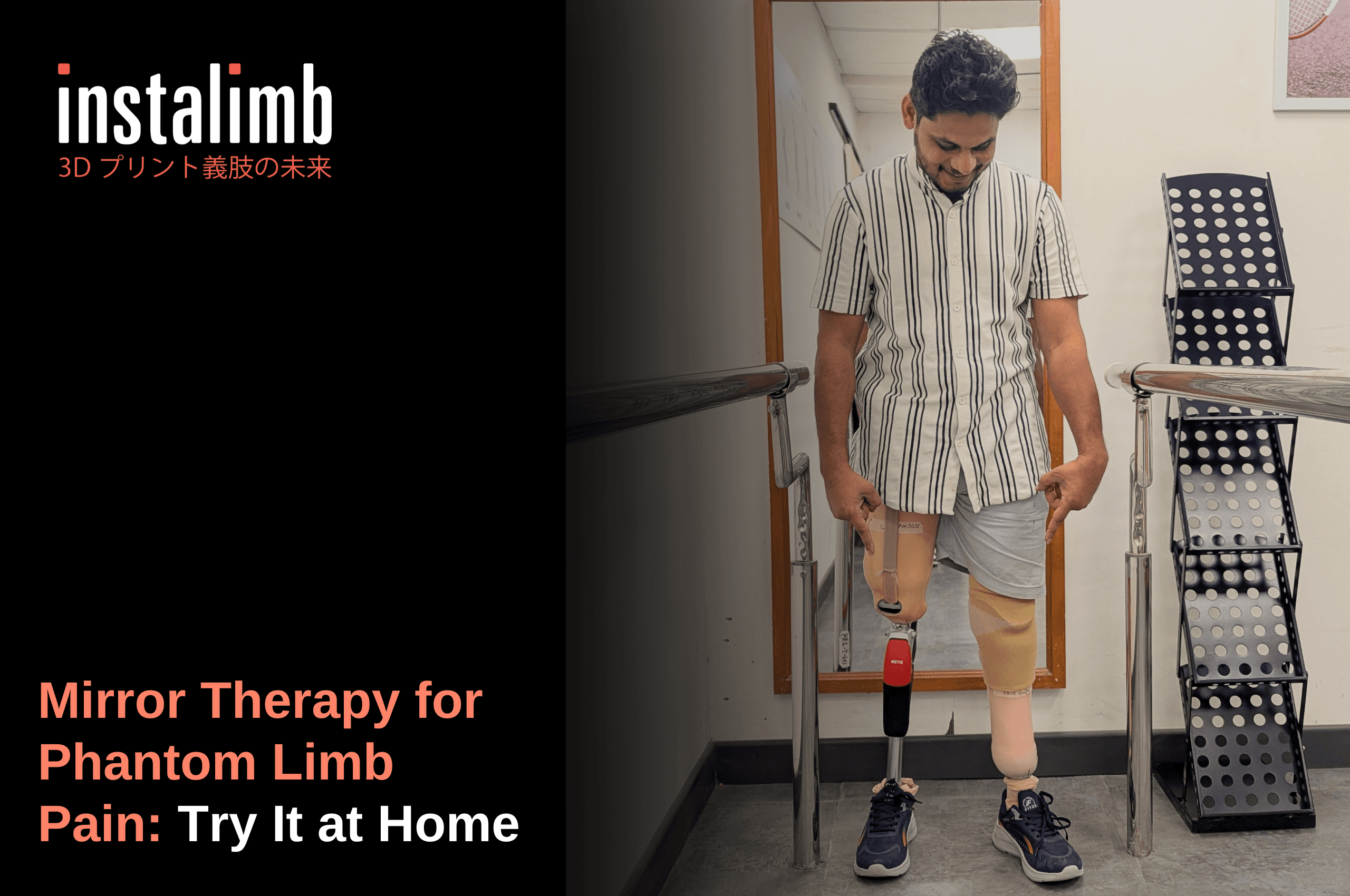
Your foot itches, but there is no foot to scratch. If you have felt this since your amputation, you are dealing with phantom limb pain, and you are far from alone. Mirror therapy for phantom limb pain is a simple, drug-free technique you can start today, using nothing more than a mirror and ten quiet minutes.
What Is Phantom Limb Pain, and Why Does It Happen?
Phantom limb pain is the sensation of pain, cramping, burning, or itching that seems to come from a limb that is no longer there. It happens because your brain keeps a detailed body map, built over decades, and that map does not update the moment a limb is removed. Nerve endings at the residual limb keep firing signals, and the brain, still expecting input from a foot or hand, interprets the confusion as pain. Common triggers include an ill-fitting socket, cold weather, stress, and pressure on a nerve bundle called a neuroma. At Instalimb, our team often sees patients whose phantom pain flares up right alongside socket discomfort, which is one reason a precise, well-fitted socket matters as much for comfort as for walking.
Phantom limb pain is nerve and brain-based pain felt in a limb that has been amputated. It affects a large share of amputees, especially in the first year, and is caused by the brain's body map continuing to expect signals from the missing limb even after surgery. It is treatable, not permanent by default.
Mirror Therapy for Phantom Limb Pain: How the Trick Works
Mirror therapy for phantom limb pain works on a simple idea: sight can override a confused nerve signal. A mirror is placed so the reflection of your intact limb appears exactly where the missing limb would be. When you move the intact limb, your brain sees two limbs moving in sync, even though only one exists. It is a bit like a GPS that trusts a visual landmark over a shaky signal; once the brain sees the moving limb, it recalculates the body map and often eases the pain signal. First described for arm amputees in the 1990s, the technique has since been adapted for legs, with amputees at Instalimb clinics in Delhi, Hyderabad, and Mumbai often trying it as a first, no-cost addition to their care plan.
Try Mirror Therapy at Home: A Step-by-Step Routine
You do not need special equipment, just a plain mirror and a quiet corner. Here is a routine physiotherapists commonly recommend:
-
Sit at a table with a full-length mirror placed perpendicular to your body.
-
Position the mirror so the reflection of your intact limb appears where the missing limb used to be.
-
Look only at the reflection, never at the residual limb itself.
-
Slowly move your intact limb through simple actions: point, flex, circle the ankle or wrist, wiggle the toes or fingers.
-
Practice for 10 to 15 minutes, once or twice daily, for at least two to four weeks before judging results.
-
Keep a one-line pain diary each night, noting intensity from 0 to 10, so you can spot real patterns instead of guessing.
Consistency over four weeks matters more than any single session, so resist the urge to judge the technique after just two or three tries.
When Virtual Reality Takes Mirror Therapy Further
Standard mirror therapy has one limitation: it only works if you still have one matching limb to reflect. For bilateral amputees, or people who find a physical mirror awkward to set up, virtual reality (VR) and augmented reality (AR) versions recreate the same illusion digitally. A headset or screen shows an avatar limb moving in real time, driven by sensors on the residual limb or the sound limb, giving the brain the same visual proof a mirror provides without needing symmetry.
Virtual reality does not replace mirror therapy; it extends it, particularly for above-knee amputees who struggle to angle a physical mirror correctly. Some rehabilitation centres in India have started piloting VR-based pain therapy alongside standard physiotherapy, and Instalimb's own digital design process, built on 3D-CAD scanning and AI-based fit prediction, reflects the same broader shift toward screen-based, precision tools in prosthetic care.
What the Research Actually Shows
The evidence on mirror therapy for phantom limb pain is real but mixed, and it is worth knowing this before you try it. A randomised controlled trial published in PubMed found that mirror therapy significantly reduced pain scores in upper-limb amputees compared to covered-mirror and mental visualisation control groups in earlier work, though the larger multicentre PACT study found no significant difference at four weeks. It did note that mirror therapy shortened the total duration of phantom pain over six months compared to controls.
In India, a study of lower-limb amputees at a tertiary care hospital found phantom limb pain affecting a large majority of patients in the first year, underscoring how common this experience is, not a sign that something has gone wrong.
Mirror therapy carries no real medical risk, so it is worth trying even where evidence is mixed, ideally alongside, not instead of, guidance from your prosthetist or pain specialist.
When a Prosthetist Visit Matters More Than a Mirror
Mirror therapy helps many people, but it is not a fix for every kind of pain. If your phantom pain flares up specifically when you put on your prosthetic, worsens with certain positions, or comes with visible redness or swelling at the residual limb, the cause may be mechanical, not neurological.
Persistent pain despite therapy often points to a socket fit problem, not a mystery. A socket that shifts even slightly can irritate nerve endings and trigger the exact burning or shooting sensations people mistake for untreatable phantom pain. At Instalimb, we have designed over 500 prosthetics across Delhi, Gurugram, Hyderabad, Bangalore, Mumbai, and Vizag, using 1mm-level socket customisation to correct exactly this kind of nerve irritation, and we offer a free test socket fitting so you can check whether your current socket is the real source of the pain before assuming it is permanent.
Frequently Asked Questions
How long does mirror therapy take to reduce phantom limb pain?
Most people need two to four weeks of consistent practice, about 10 to 15 minutes once or twice a day, before noticing a real change. Some studies show pain intensity dropping within the first two weeks, while others find the biggest benefit is a shorter overall duration of pain episodes over several months, not instant relief.
Does mirror therapy work for below-knee and above-knee amputees equally?
Mirror therapy was first studied in arm amputees, but it has since been adapted for both below-knee and above-knee leg amputations. Below-knee amputees often find it easier to angle the mirror correctly, while above-knee amputees may get better results from a seated setup or a virtual reality version instead.
Is virtual reality phantom limb pain therapy available in India?
Yes, a small but growing number of rehabilitation centres and prosthetic clinics in India are piloting VR and augmented reality-based phantom limb pain therapy alongside standard physiotherapy. Availability varies by city, so ask your prosthetist or rehabilitation team whether a VR-based option exists near you.
Can I do mirror therapy without a prosthetist's supervision?
Yes, mirror therapy is safe to try on your own since it uses only visual feedback and simple limb movements. That said, tell your prosthetist or doctor you are trying it, especially if pain is new, worsening, or paired with swelling or redness, since these can point to a fit problem instead.
Does mirror therapy replace pain medication for amputees?
No, mirror therapy is a complementary technique, not a replacement for medication prescribed by your doctor. Many amputees use it alongside standard pain management, and some are able to reduce their reliance on medication over time, but any change in medication should be discussed with your physician first.
The Bottom Line
Phantom limb pain can feel strange and isolating, but it is common, explainable, and often manageable with simple tools you already have at home. Mirror therapy will not work the same way for everyone, and that is normal, not failure. Pair it with an honest check on your socket fit, patience over several weeks, and support from people who understand the journey, and you give yourself the best chance at real relief.
Check out our blog section for more!
So, if you‘re looking for a new artificial leg, interested in a free consultation, confused if your socket is the right fit, or have any other queries, now is the time to reach out to us and try a test socket free of cost. Step it up with Instalimb - Contact us today!
Recent Posts
September 10, 2026
September 8, 2026
September 3, 2026
September 1, 2026
August 29, 2026
August 25, 2026
August 20, 2026
August 18, 2026
August 11, 2026