Balance Training After Amputation: 90 Days to Safer Steps
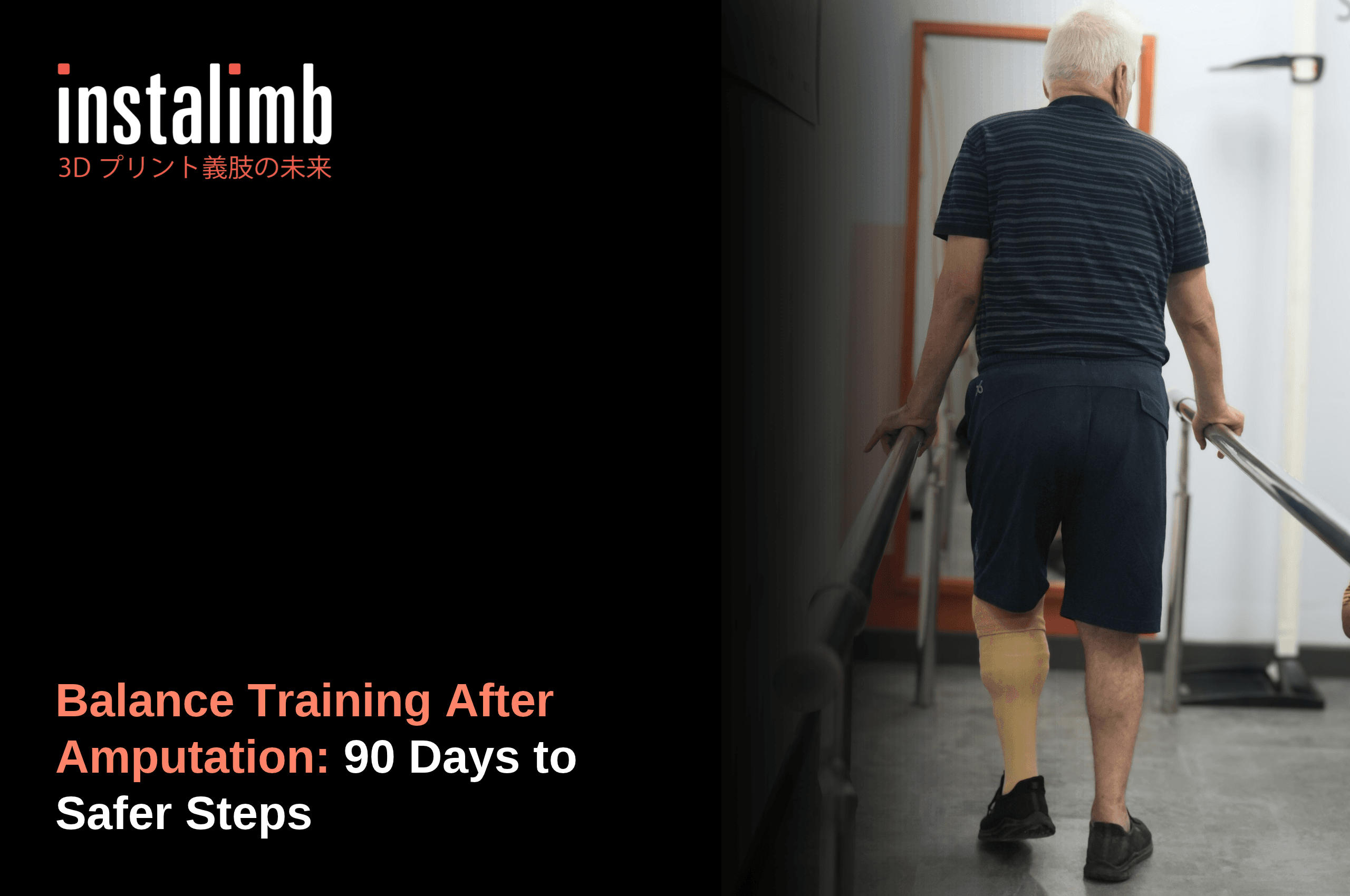
If you've started flinching at uneven pavement or gripping the handrail a little tighter than you used to, you're not imagining it, and you're not failing at this. Nearly half of all lower-limb amputees report falling at least once, and most of those falls happen while balance, muscle memory, and prosthetic fit are all still settling into place.
Balance training after amputation isn't something you either have a knack for or don't; it's a skill you build in a predictable order, and the first 90 days are where most of that groundwork gets laid.
Why New Prosthetic Users Fall More Often?
Research published in the journal Prosthetics and Orthotics International found that 46% of lower-limb amputees had fallen at least once, with tripping over an object responsible for 62.5% of those falls. If that sounds like your own experience, you're far from alone in this.
Above-knee (transfemoral) amputees fall significantly more often than below-knee (transtibial) amputees, so if you're adjusting to a higher amputation level, the extra caution you're feeling right now makes sense.
Physiotherapists sometimes use two simple timed tests to get an early sense of who is most at risk, though it's worth noting the evidence behind them is thin: it comes from a single small study of just 21 new unilateral lower-limb amputees followed for six months. Treat the numbers below as a useful signal to raise with your own team, not a fixed prediction about you.
The Timed Up and Go (TUG) test times how long it takes to stand from a chair, walk three metres, turn around, and sit back down. In that study, every transfemoral amputee who took 9.44 seconds or longer went on to fall within six months.
The Four Square Step Test (FSST), which times quick steps in and out of a small square pattern, predicted fallers among transtibial amputees with 83% accuracy at a threshold of 12.83 seconds. If your prosthetist or physiotherapist runs either test with you, think of it as an early check-in rather than a judgement on your progress.
This matters even more if you're going through this in India, which recorded an estimated 2 million traumatic amputations in 2019, the highest burden of any country studied, with road traffic injuries causing 85.4% of cases. You're part of a very large, very real population here, not a rare exception.
A 2026 pooled review of Indian studies in the International Journal of Community Medicine and Public Health looked at 7,272 patients with major limb amputations, 90.8% of whom were lower-limb amputees. Across that whole group, the average age was around 45.4 years.
In other words, most people working through this early stretch alongside you are working-age adults rebuilding their mobility for careers and families, not easing quietly into retirement.
Balance Training After Amputation: A Week-by-Week First 90 Days Timeline
Balance training after amputation generally follows a predictable arc, even though everyone's pace differs slightly. Here's roughly what the first three months tend to look like.
Weeks 1-4: Building Confidence on a Stable Base
The first month is about relearning the basics on solid, predictable ground, usually inside a clinic or at home with support nearby. You'll practise shifting your weight evenly between both legs, standing unsupported for short periods, and taking slow, deliberate steps between parallel bars or with a walker.
This is also when your prosthetist checks your gait and socket fit closely, using tools like 3D scanning to catch a shift of even a millimetre before it becomes a habit. Following [a structured physiotherapy plan] during these early weeks, rather than improvising exercises alone, is one of the strongest predictors of how smoothly the next two months go.
Weeks 5-8: Progressing to Uneven Surfaces and Dynamic Movement
By the second month, most new users move from flat, familiar ground to gentler challenges: grass, gravel, ramps, and short flights of stairs. Exercises now add movement while standing, like turning your head while walking, catching a light ball, or practising single-leg stance on a cushion.
This is where proprioception, your body's sense of where your limb is in space without looking at it, starts rebuilding through repetition. It's normal for confidence to dip here even as your physical ability improves, since your brain is managing more variables at once.
Weeks 9-12: Real-World Terrain and Independence
The final stretch is about testing everything in real conditions: crowded markets, public transport, uneven footpaths, and the specific layout of your own home. You'll likely start walking longer distances without a companion close by and navigating stairs without a handrail on both sides.
Fatigue becomes the bigger variable now, since tired muscles and a tired mind both react slower to the unexpected. Most new users reach a meaningfully more independent gait by the end of month three, though the exact timeline depends on amputation level, fitness, and how early any socket-fit issue gets caught and corrected.
Is it you, or is it your socket? The Hidden Cause of Instability
If you're doing every exercise correctly and still losing your balance more than expected, it's worth asking a different question: is this about effort, or is it about fit? Balance instability in this early window is frequently a socket-fit problem rather than a training failure.
Your residual limb's volume keeps changing during early rehabilitation as post-surgical swelling reduces, and even a shift of one or two millimetres inside the socket forces unconscious micro-corrections with every step you take. Multiply that by thousands of steps a day, and it's easy to see why you'd feel unsteady without knowing why.
This is exactly the gap a well-fitted socket is meant to close. A well-fitted socket is the foundation that all your balance training sits on, not an afterthought, for once the exercises are mastered.
At Instalimb, we have designed over 500 prosthetics across Delhi, Gurugram, Hyderabad, Bangalore, Mumbai, and Vizag, using Japanese-engineered 3D printing and AI-assisted scanning to check and adjust socket fit to within roughly 1mm as your limb changes shape, through a test-socket fitting process built for exactly this early, unstable stage. If something feels off, it usually isn't you.
Making an Indian Home Fall-Safe: Squat Toilets, Stairs, and Floor-Seating
Making your home safer doesn't have to mean rearranging your whole life or feeling like a burden on your family. Most Indian homes have specific pinch points that generic fall-prevention advice overlooks entirely: squat toilets, floor-seating, and stairs without a rail on both sides.
[The squat-to-stand transition] asks your prosthetic knee and socket to manage a deep, less-stable single-leg load, which makes it one of the highest-risk movements in the first 90 days. A few practical changes go a long way:
-
Install a raised toilet seat, a Western-style commode attachment, or a sturdy grab rail near the squat toilet
-
Swap floor seating for a stable chair with armrests during the first few weeks, even if it isn't your usual habit
-
Add non-slip strips or mats to marble flooring, bathroom tiles, and stair edges, which become genuinely dangerous when even slightly wet
-
Keep walkways clear of loose footwear, wires, and low furniture, especially in dim light
-
Ask for a grab rail on both sides of any staircase you use daily
None of this is about becoming dependent. It's about removing unnecessary risk while your balance is still building, so your energy goes into training, not tripping.
Seasonal and Terrain Risk Factors Across India
Where you live changes what fall risk looks like during these three months. In Delhi-NCR and Gurugram, winter brings cold mornings that stiffen joints and reduce sensation in your residual limb, plus fog that cuts visibility on your usual walking route. Dry winter skin also cracks more easily, which can affect how your socket sits against your skin.
If you notice [a socket that feels loose in cold weather], it's worth a fit check rather than just tightening a strap and carrying on.
This is also a good moment to use Instalimb's test-socket process, which checks and adjusts fit to within about 1mm using 3D-printed test sockets, so a seasonal change in limb volume doesn't quietly undo weeks of balance training.
Further south, in Hyderabad, Bangalore, and Vizag, winters are milder, but monsoon-damaged pavements and uneven kerbs remain a year-round hazard. Mumbai's humidity and monsoon-cracked walkways create similar footing problems even outside the coldest months.
[Walking safely on uneven terrain], wherever you are, means shorter steps, a slightly wider stance, and extra caution at kerb edges and surface transitions.
The WHO's Falls Fact Sheet notes that South-East Asia and the Western Pacific together account for roughly 62% of the world's 842,000 annual fall deaths, and ICMR data shows winter hospital admissions among seniors in India rise by 15 to 20%, so this isn't a minor seasonal footnote.
The Caregiver's Role: Supporting Without Overprotecting
In many Indian households, several generations share a home, and everyone from a spouse to a parent to an adult child often wants to help. That instinct is valuable, but there's a real difference between support and overprotection, and finding that line is its own skill for a caregiver to learn.
Hovering nearby during every step, finishing tasks before they're attempted, or insisting on an arm that isn't actually needed can quietly slow down balance training, even when it comes from love.
[How to support without overstepping] usually means staying close enough to help during the hardest moments, like the first few weeks of stairs or squat-toilet transitions, while stepping back once a task has been practised safely.
Ask what kind of help is actually wanted, rather than assuming. The goal for everyone in the household is the same: independence, not distance.
When to Worry, and When Fear of Falling Is Normal
Some fear of falling in the first weeks is normal, and even useful, since it makes you more careful on genuinely risky terrain. This fear typically eases as your balance training progresses through the first 90 days, not because the risk disappears overnight, but because your body and your confidence start moving at the same pace.
What's worth flagging to your prosthetist or physiotherapist is fear that isn't easing, or the opposite: a sudden drop in caution paired with repeated near-falls, which research links to higher actual fall risk.
If you find yourself avoiding normal daily movement altogether, or if a specific activity like stairs or squat toilets consistently triggers a stumble rather than just nerves, that's a signal worth acting on rather than pushing through alone. You don't have to white-knuckle your way through this.
Frequently Asked Questions
Q1: How common are falls after a lower-limb amputation?
Falls are common after lower-limb amputation. One widely cited study found 46% of lower-limb amputees had fallen, most often by tripping over an object (62.5% of cases). Above-knee (transfemoral) amputees fall more frequently than below-knee (transtibial) amputees, and risk is highest in the first few months after amputation, while balance, gait, and socket fit are still being established.
Q2: What is the Timed Up and Go test and why does it matter for amputees?
The Timed Up and Go (TUG) test times how long it takes to stand from a chair, walk 3 metres, turn, walk back, and sit down, and it is used clinically to predict fall risk in new amputees. In one study, every transfemoral amputee who took 9.44 seconds or longer went on to fall within 6 months, making it a useful early warning sign worth discussing with a prosthetist or physiotherapist.
Q3: Why do I keep losing my balance even though I'm doing my exercises?
Balance problems in the first 90 days are often not about effort. They can be a sign that the prosthetic socket no longer fits correctly. Limb volume changes significantly during early rehabilitation as swelling reduces, so a socket that fitted well three weeks ago can become loose or misaligned, forcing small unconscious corrections with every step that feels like "bad balance". A test-socket fit check can rule this out as the real cause.
Q4: How do I make an Indian home safer for a new amputee (squat toilets, stairs, floor-seating)?
Home safety for a new lower-limb amputee in India should start with the transitions that carry the most fall risk: squat toilets, getting up from floor-seating, and climbing stairs, since these involve a deep, less-stable single-leg load that standard advice often skips. Install a raised toilet seat or grab rail, keep a stable chair nearby instead of floor-seating in the first weeks, and add non-slip strips to marble flooring and stair edges.
Q5: Does cold winter weather increase fall risk for prosthetic users?
Yes. Cold weather raises fall risk for lower-limb amputees in several ways: it stiffens joints and reduces sensation in the residual limb, dry winter skin is more prone to cracking (which can affect socket fit), and in northern India, fog reduces outdoor visibility. ICMR data cited by Business Today also notes winter hospital admissions among seniors rise 15 to 20%, so early morning caution and a cold-weather socket check are worth the extra few minutes.
Conclusion
Balance after amputation isn't something you either have or don't have; it's something you rebuild, deliberately, over roughly 90 days, with the right exercises, the right home adjustments, and a socket that actually fits the limb you have today, not the one you had a month ago.
Falls in the first 90 days are common, predictable, and largely preventable, which means the fear around them doesn't have to run the show. With International Day of Persons with Disabilities approaching on 3 December, it's a fitting moment to recognise how far steady, well-supported rehabilitation can take you.
Check out our blog section for more!
So, if you‘re looking for a new artificial leg, interested in a free consultation, confused if your socket is the right fit, or have any other queries, now is the time to reach out to us and try a test socket free of cost. Step it up with Instalimb - Contact us today!
Recent Posts
November 19, 2026
November 12, 2026
November 10, 2026
November 5, 2026
November 5, 2026
October 30, 2026
October 23, 2026
October 22, 2026
October 14, 2026
