Prosthetic for Sports: A Guide to Cricket, Cycling and Climbing
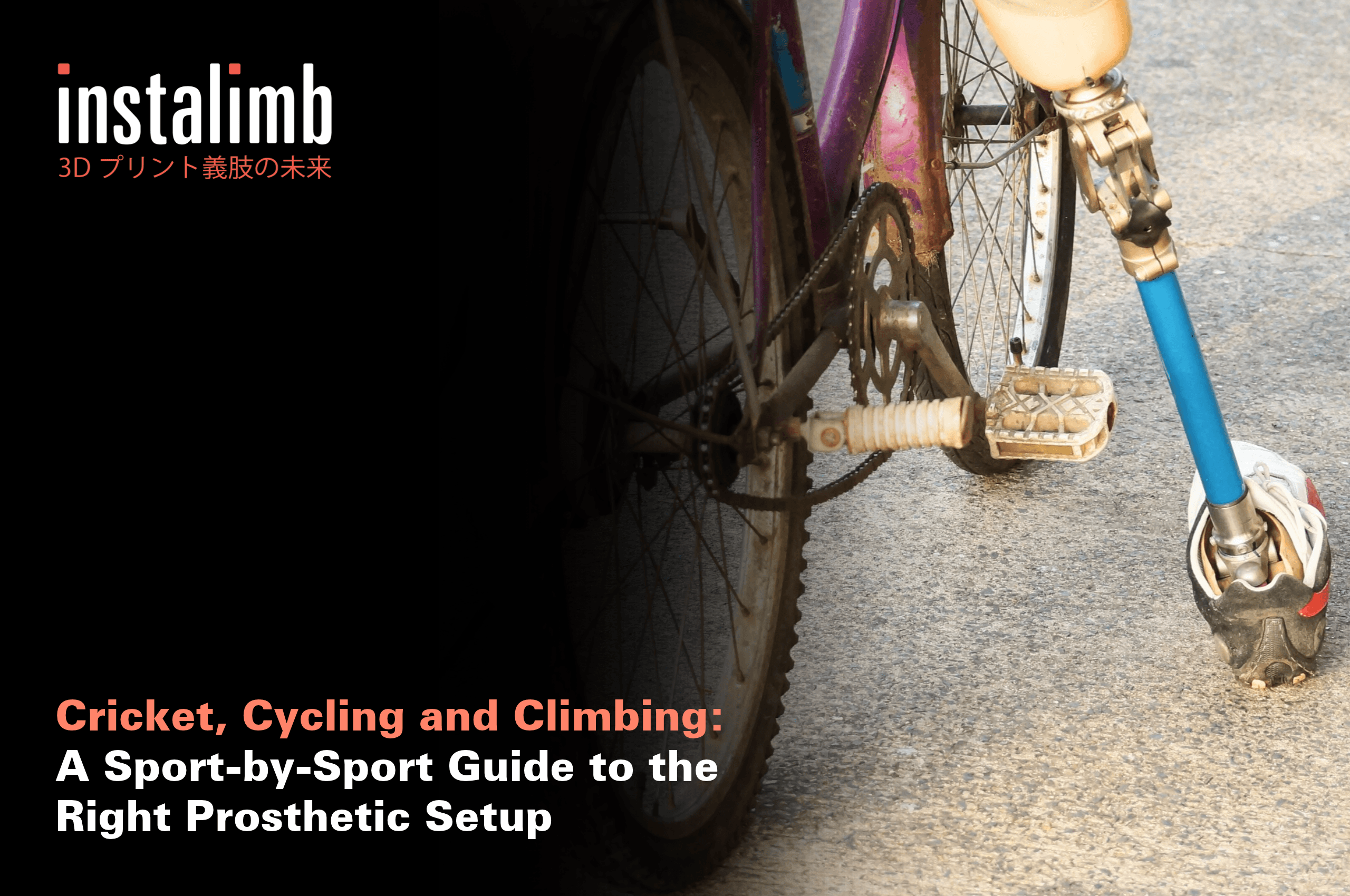
Getting back to a sport you love after limb loss isn't about owning one magic leg; it's about matching the right setup, the right foot, and sometimes a different socket adjustment to the sport you actually want to play.
Prosthetic setups for sport aren't one-size-fits-all, and cricket, cycling, and climbing each ask something different of your leg, your socket, and your confidence.
Why One Prosthetic Setup Doesn't Fit Every Sport?
Your everyday walking prosthetic is built for steady, predictable loading: one foot in front of the other, all day long. Cricket asks for sudden sprints and sharp turns, cycling asks for smooth, repetitive pedalling, and climbing asks for grip and stability on uneven rock, so each sport puts very different stress through your leg.
That's why many active amputees eventually add a sport-specific foot, a firmer liner, or a quick-change attachment, rather than expecting one leg to do everything equally well. Just as you wouldn't wear the shoes from a five-day cricket match on a Himalayan trek, the setup that gets you through your commute isn't necessarily the one you want on the pitch or the trail.
Cricket: Building a Setup That Can Take a Hit
Cricket in India has a real, organised home for players with disabilities. By April 2022, more than 2,500 cricketers with disabilities had registered to play organised cricket across the country, and that number has almost certainly grown since. If you're picturing yourself back at the crease, you're joining a genuinely large community, not starting from scratch.
Batting and fielding both demand quick changes of direction, short sprints between wickets, and the odd sudden stop; loads your everyday walking foot usually isn't designed to absorb. A sturdier, more responsive foot and a snug, well-aligned socket matter here more than almost anywhere else, since a loose socket during a run between wickets is both uncomfortable and genuinely risky.
Local clubs in cities such as Bengaluru, Delhi, and Hyderabad now run regular matches and nets sessions for players with limb differences, so the easiest way to test a cricket-specific setup is usually to find [a nearby para-cricket club] and simply turn up for a session. Give your socket and your confidence a few matches to settle in together.
Cycling: Pedalling With Confidence
Cycling tends to be one of the friendlier sports to return to after limb loss, because pedalling is a smooth, repetitive, low-impact motion rather than the sudden loading of running or cricket. Aditya Mehta, a below-knee amputee and one of India's best-known para-cyclists, has shown just how far that can go: he became the first Indian para-cyclist to medal at the Asian Paralympic Games, and later cycled the length of India, roughly 1,450 kilometres, on one leg.
The main decision for cycling is usually the pedal attachment rather than the foot itself. A dedicated pedal-compatible foot, or a simple toe-clip setup, keeps your prosthetic foot securely positioned through every rotation, which matters far more over a long ride than it might seem on a short test lap. Above-knee amputees often find a slightly stiffer knee setting helps with pedalling stability, so it's worth discussing [choosing the right prosthetic foot for cycling] specifically with your prosthetist rather than assuming your everyday walking settings will carry over.
Climbing and Trekking: Grip, Stability, and Altitude
Climbing and trekking put different demands on your legs again: grip on uneven, often unpredictable surfaces, ankle flexibility to adapt to each footing, and extra stability on slopes rather than flat ground. October and November are generally the prime trekking months in the Indian Himalayas, once the monsoon clears and before the heaviest winter snow arrives, which makes this a good season to start planning a trip.
You don't need to plan this alone, either. Treks for All, an initiative that organises accessible Himalayan treks for amputees and wheelchair users, has helped prove that a disability doesn't rule out the mountains. Read more about [planning an accessible Himalayan trek] before you go. A rugged, multi-axis foot with more ankle give usually serves climbing and trekking far better than a smooth walking foot, and a well-fitted, properly broken-in socket matters even more at altitude, where cold and swelling can both affect how your limb sits inside it.
The Quick-Change Adapter: One Socket, Several Sports
You don't necessarily need an entirely separate leg for every sport you play. Many active users rely on a single well-fitted socket paired with a quick-change adapter, a fitting that lets you swap the foot or attachment at the bottom of your leg in minutes, rather than owning several complete prosthetics.
A walking foot is built for all-day comfort and steady, even loading. A running blade, by contrast, is built to store and release energy with each stride, which makes it better suited to sprinting between wickets or on a running track, but less comfortable for standing around for hours. Understanding [walking foot vs running blade] helps you choose the right attachment for each sport, rather than relying on your everyday foot for everything you do.
Managing Sweat and Friction During Active Play
Any extended match, ride, or climb brings more sweat than an ordinary day, and sweat is usually what causes socket slippage and skin irritation, rather than the activity itself. Three things make the biggest difference: a moisture-wicking liner rather than a standard one, a spare liner or sock to change into at half-time or a rest stop, and a quick skin check once you're done, looking for redness, rubbing, or blistering before it becomes a bigger problem.
If your socket feels looser by the end of a match or a trek than it did at the start, that's usually sweat and swelling rather than a fault in the fitting itself, though it's worth mentioning at your next check-up if the pattern repeats. Our [guide to prosthetic liner care and sweat management] covers this in more detail. Keeping a change of liner in your kit bag is a small habit that prevents a surprising number of avoidable problems.
What the Research Actually Shows?
A 2024 review in Frontiers in Rehabilitation Sciences looked specifically at running-specific prosthetic feet and how their stiffness and energy return relate to athletic performance. Its honest conclusion was that the evidence is still too varied for one blanket rule, which in practice means a setup chosen with your own prosthetist, based on your own sport, body, and goals, matters more than following generic advice online.
India's para-athletes are proving what the right setup and serious training can achieve on the biggest stages. At the 2025 World Para Athletics Championships, India recorded its best-ever medal haul, 22 medals including six golds, and Indian athletes also competed at the 2026 Asian Para Games this year. None of that happens with an ill-fitting, one-size-fits-all leg; it happens with equipment matched carefully to the sport and the athlete.
Khelo India and the Rise of Grassroots Para Sports
You don't have to be chasing a national medal for any of this to matter. The Khelo India Para Games, run under the government's wider Khelo India scheme, have steadily expanded access to organised para sports at the grassroots level, giving far more amputees across the country a genuine route into competitive and recreational sport than existed even a few years ago.
That growing access matters because sport-specific equipment only helps if you actually get to play. Local clubs, state-level para sports associations, and programmes like Khelo India are collectively making it easier to find teammates, coaching, and a place to simply try a sport again: cricket nets on a Sunday morning, a cycling club, or a local trekking group.
Getting Your Sport-Specific Setup Right
Getting any of this right starts with an accurate socket, since every sport-specific foot or attachment only performs as well as the fit it's built on. At Instalimb, our 3D-printing and AI-assisted scanning check and adjust your socket to within roughly 1mm, so a cricket-ready, cycling-ready, or trekking ready setup starts from a base that actually matches your limb, not a generic mould.
The smartest first step is usually to try a test socket fitting and talk through which sport, or sports, you're aiming to get back to, so your prosthetist can recommend the right foot, liner, or attachment for exactly that goal.
Frequently Asked Questions
Q1: Can someone with a prosthetic leg play competitive cricket in India?
Yes. Organised cricket for players with disabilities has grown substantially in India, with more than 2,500 cricketers with disabilities registered to play by April 2022, and the number has likely grown since. Local clubs in cities such as Bengaluru, Delhi, and Hyderabad run regular matches, and a sturdier, more responsive prosthetic foot alongside a snug, well-aligned socket makes the sudden sprints and direction changes of batting and fielding considerably safer and more comfortable.
Q2: What's the difference between a walking foot and a running blade?
A walking foot is designed for steady, all-day comfort during ordinary walking, while a running blade is designed to store and release energy with each stride, which suits sprinting or running but feels less comfortable for long periods of standing or walking. Many active amputees use a quick-change adapter to swap between the two depending on what they're doing that day, rather than relying on one foot for every activity.
Q3: How often should I switch prosthetic feet or attachments for different sports?
There's no fixed rule, since it depends on how often you play and how different your sports are from one another. If you play one sport regularly, a dedicated foot or attachment for it, swapped in with a quick-change adapter before each session, is usually worth the small extra effort. If you only play occasionally, your prosthetist can help you decide whether a dedicated attachment is worth it or whether your everyday foot will do for now.
Q4: Is it safe to trek or climb with a prosthetic leg?
Yes, with the right preparation. A rugged, multi-axis foot with better ankle flexibility handles uneven ground far better than a standard walking foot, and a well-broken-in, properly fitted socket matters even more at altitude, where cold and swelling can affect fit. Programmes such as Treks for All have organised accessible Himalayan treks for amputees and wheelchair users, and October and November are generally the best months to go, once the monsoon clears and before heavy winter snow sets in.
Q5: How do I stop my socket slipping or causing skin irritation during sport?
Sweat, not the sport itself, usually causes slipping and irritation. A moisture-wicking liner, a spare liner or sock to change into at a break, and a quick skin check straight after your match, ride, or climb will catch most problems early. If your socket consistently feels looser by the end of an activity than it did at the start, mention the pattern to your prosthetist at your next check-up rather than just tightening a strap and carrying on.
Your Next Step
Getting back to cricket, cycling, or climbing after limb loss isn't about finding one perfect leg that does everything; it's about matching the right foot, socket adjustment, or attachment to the sport you actually want to play, and giving yourself a few sessions to let your setup and your confidence settle in together.
The right sport-specific setup, built on an accurately fitted socket, often makes the difference between forcing your way through a match or trek and genuinely enjoying it again.
Check out our blog section for more!
So, if you‘re looking for a new artificial leg, interested in a free consultation, confused if your socket is the right fit, or have any other queries, now is the time to reach out to us and try a test socket free of cost. Step it up with Instalimb - Contact us today!
Recent Posts
November 18, 2026
November 12, 2026
November 10, 2026
November 5, 2026
November 5, 2026
October 30, 2026
October 23, 2026
October 22, 2026
October 14, 2026
