Diwali Safety Tips for Prosthetic Leg Users
Includes AI-assisted content
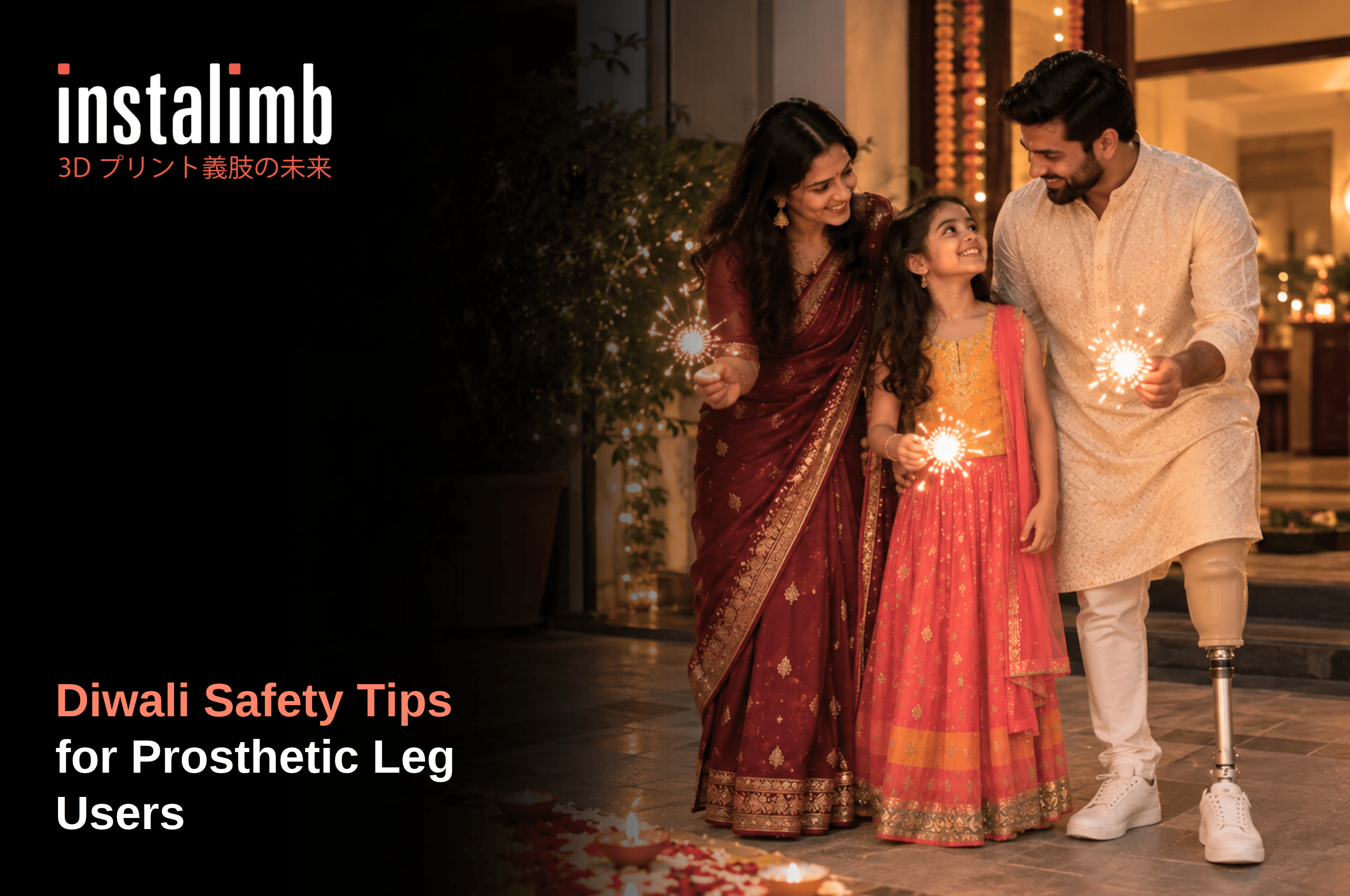
Diwali is meant to be about light, family and celebration, not about wondering whether your socket will hold up through a long evening of puja and family gatherings. If you're looking for Diwali safety tips for prosthetic leg users, you're probably picturing yourself lighting diyas with the kids.
Maybe that means standing through aarti without shifting your weight every few minutes or walking across a flower and rangoli lined courtyard without a second thought. With a little preparation, all of that is well within reach this year.
Diwali Safety Tips for Prosthetic Leg Users: Quick Answer
Celebrating Diwali safely with a prosthetic leg means checking your socket fit before long puja sessions, keeping liners and cosmetic covers away from diyas and sparklers, wearing stable closed or strapped footwear instead of loose sandals and taking seated breaks to prevent sweat related socket slip during extended standing and walking.
Diwali brings long hours on your feet, open flames and crowded, poorly lit spaces, often within a few packed days. If you wear a below-knee or above-knee prosthetic leg, connected to your body through a socket (the custom-moulded shell around your residual limb, the remaining part of the leg after amputation), these conditions call for a little more planning. The risks that matter most are predictable and largely preventable, so here's exactly what to check before Dhanteras, Lakshmi Puja and the days around them.
Standing Through Puja and Long Gatherings Without Socket Pain
Why heat and standing time change how your socket fits
When you stand for long stretches, during aarti, while greeting guests or through a long Lakshmi Puja, your residual limb naturally swells a little and sweats more. Because the socket is a snug fit around that limb, even small changes in volume change how it feels.
This is one of the most common sources of socket discomfort reported by prosthesis users generally, not unique to Diwali. A well-fitted, precisely contoured socket reduces this risk more than footwear or posture changes alone, which is why socket fit is worth checking first if you're expecting a long evening on your feet.
A socket built with precise 3D-printed contouring, shaped to within a millimetre of your limb's exact measurements, naturally handles these small shifts better than a generic fit.
Simple mid-event checks
-
Build in a seated break every one to two hours if the evening runs long.
-
Loosen and reseat the socket, and let your skin breathe for a minute.
-
Check for any new pressure points before you stand again.
-
If slipping starts partway through the night, [common fixes for sweat-related socket slip] can help you adjust quickly without leaving the gathering.
Diyas, Sparklers and Flame Safety Near a Prosthetic Limb
Diwali burn injuries in India are not limited to firecrackers. According to hospital data reported by The Tribune after Delhi's Diwali 2025, diyas accounted for roughly 1 in 10 of the burn cases treated at Safdarjung Hospital, one of Delhi's largest. For anyone who lights diyas up close, that's worth taking seriously.
Why your liner and cosmetic cover deserve extra care near flame
Your liner (the soft sleeve worn over the residual limb, inside the socket) and cosmetic cover (the shell giving a prosthetic limb its natural shape) aren't the same material as a kurta or saree, so it's worth being just as careful, if not more, about keeping them clear of open flame. Wiping away soot or wax residue afterwards, as part of [keeping your socket and liner clean], also helps prevent skin irritation.
Reduced sensation and why a visual check matters
If you have reduced sensation in your residual limb, you may not feel a spark or rising heat near your prosthesis as quickly as you would on intact skin, which is why a quick visual check matters more than waiting to feel something.
Safe lighting posture and distance basics
-
Keep at least an arm's length between any open flame and your prosthetic leg.
-
Use a lighting wand or incense stick rather than bending in close.
-
Avoid letting your prosthetic side lean towards the diya tray or sparkler box.
Footwear and Festive Wear: Balancing Tradition and Fall Prevention
Sandals, juttis and kolhapuris vs closed or strapped shoes
Festive footwear is part of the fun, and there's no need to give up juttis or kolhapuris altogether. But open, backless or loosely fitted sandals give your foot less to hold onto than closed or strapped shoes, which matters more when you're navigating a crowded room or an unfamiliar courtyard on a prosthetic leg.
How festive footwear changes alignment and fall risk
Heel height changes how your prosthetic foot and socket align with the rest of your leg, even by a small amount. A pair you haven't worn before, especially with a different heel height to your everyday shoes, can shift your balance in ways you won't notice until you're already on an uneven floor.
If you're planning to wear something new for Diwali, try it at home first, ideally with input from your prosthetist (the clinician who fits and adjusts your prosthesis), and keep a backup pair of closed shoes nearby for later in the evening when fatigue sets in.
Navigating Crowded, Uneven or Poorly Lit Spaces on a Prosthetic Leg
Rangoli-lined floors, loose rugs and raised thresholds
Rangoli powder, flower petals and diya trays often sit right where people walk, and loose rugs or raised thresholds are easy to miss in a crowded room. None of this is specific to festival nights, but festive decorating adds more of it, in more places, for more hours than an ordinary evening. [Tips for walking on uneven terrain] are worth revisiting before a night of courtyard-hopping or temple visits.
Unfamiliar homes and staircases after dark
Visiting relatives or friends means navigating a layout you don't know, often with dimmer lighting than you're used to once the diyas take over from the main lights. Ask where the steps are before it gets dark, use handrails where they exist, and don't hesitate to ask someone to walk ahead of you on unfamiliar stairs.
A slower, steadier pace on unfamiliar ground beats rushing to keep up, and it's a sensible habit for a crowded festival night, prosthetic leg or not.
Managing Sweat, Skin and Socket Fit Across a Long Festive Day
A prosthetic socket creates a warm, enclosed interface against your residual limb. According to Merck Manuals' guidance on residual limb skin care, sweat during long festive activity can cause skin breakdown faster than on unaffected skin.
Hydration and skin checks between events
Drink water through the day, not just at mealtimes, since dehydration changes how your limb swells and sweats. Check your residual limb for redness, warmth or blistering between events: Merck Manuals recommends checking several times a day if you have reduced sensation, and at least once daily otherwise.
If you notice irritation, remove the prosthesis and have a prosthetist recheck the fit rather than pushing through. [Skin care tips for warm, sweat-prone days] cover this in more detail.
Carrying a spare liner or sock
A spare liner or prosthetic sock in your bag is a small thing that solves a real problem: if sweat builds up partway through the day, swapping it out restores comfort and fit without cutting your celebrations short.
When to Get Your Socket Checked Before Diwali
If your socket has felt even slightly off before Diwali (looser by evening, a new pressure point that wasn't there last year, or new rubbing after a change in weight or activity), this is the moment to get it checked. Don't wait until after the lights go out. Several of the [signs your socket may not be the right fit anymore] show up exactly during long, hot, high-activity days like Diwali.
At Instalimb, we've designed over 500 prosthetics across Delhi, Gurugram, Hyderabad, Bangalore, Mumbai and Vizag, and festival season is when socket fit questions peak.
Our 3D-printed sockets use AI-assisted scanning for a precise, custom fit, built to hold through heat, sweat and a long day on your feet. As the world's first 3D-printed prosthetic leg and socket provider, we recommend a test socket fitting as a simple way to confirm you're ready before the festivities begin.
FAQs
1. Is it safe to stand near diyas with a prosthetic leg?
Yes, with precautions, but diyas are a real injury risk: hospital data from Diwali 2025 shows diyas accounted for roughly 1 in 10 of the burn cases treated at Safdarjung Hospital, one of Delhi's largest. If you have reduced sensation in your residual limb, keep extra distance from open flames, avoid letting your cosmetic cover or liner brush against diyas and visually check your limb periodically rather than relying on feeling heat.
2. Can a prosthetic leg get damaged by firecrackers or sparks?
Sparks and embers can scorch or discolour your cosmetic cover and liner, though this depends on the specific materials used in your prosthesis. Keeping an arm's-length distance from firecrackers and avoiding direct contact with sparklers are the safest approach for both your skin and your prosthetic components.
3. Why does my socket feel uncomfortable after standing for hours during Diwali puja?
Standing for a while causes your residual limb to swell slightly and sweat more, which changes how your socket fits over several hours. This is a common, well-documented issue in prosthetic care that isn't specific to Diwali, and it's best managed with a socket that's properly shaped to your limb, plus periodic breaks to sit and check your skin.
4. What should you check on your skin after a long Diwali gathering?
Check your residual limb for redness, warmth, blistering or breaks in the skin, especially after extended wear in heat or moisture. If you have reduced sensation, check several times a day; otherwise, check at least once a day. If you notice irritation, burning or pain, remove your prosthesis and have a prosthetist recheck the fit.
5. Is traditional festive footwear (sandals, juttis, kolhapuris) safe to wear with a prosthetic leg?
Open or backless traditional footwear can affect your balance and alignment differently to closed shoes, particularly on uneven courtyards or rangoli-lined floors common during Diwali gatherings. Closed, stable footwear is generally safer for fall prevention, and any footwear change should ideally be checked with a prosthetist beforehand, since shoe height affects socket alignment.
Conclusion
None of this means Diwali should feel complicated. Most of what makes the festival safe and comfortable with a prosthetic leg comes down to one thing: a socket that's been precisely shaped, often with the help of 3D printing and AI-assisted fitting, to genuinely fit you, paired with a few sensible habits around flames, footwear and fatigue. Get those right, and you can focus on what Diwali is actually about: the lights, the people and the celebration.
Check out our blog section for more!
So, if you‘re looking for a new artificial leg, interested in a free consultation, confused if your socket is the right fit, or have any other queries, now is the time to reach out to us and try a test socket free of cost. Step it up with Instalimb - Contact us today!
Recent Posts
October 23, 2026
October 22, 2026
October 14, 2026
October 13, 2026
October 8, 2026
October 6, 2026
October 1, 2026
September 29, 2026
