Walking on Uneven Terrain with a Prosthetic: 7 Tips
Sand, wet grass, uneven cobblestones, muddy paths, the sloping shoulder of a road. For most people, these are just part of getting around. For an amputee, walking on uneven terrain with a prosthetic leg can feel like a skill that takes months to master. The good news is that it absolutely can be mastered. And with India's monsoon season well underway, there has never been a better time to build your confidence on the ground beneath your feet.
Why Uneven Terrain Feels So Different
On a flat, smooth floor, your prosthetic foot responds predictably. But the moment the ground tilts, softens, or becomes unpredictable, your residual limb, socket, and entire posture have to compensate in real time.
The challenge isn't just mechanical. Research published in the Journal of NeuroEngineering and Rehabilitation (2019, PMID: 31340834) found that amputees expend significantly more energy navigating uneven surfaces compared to non-amputees, primarily because of the extra cognitive and muscular effort required to maintain balance. That energy cost drops dramatically with practice and the right technique.
Here is what is working against you: a standard prosthetic ankle does not self-adjust to slopes the way a biological ankle does. Understanding this helps you compensate correctly, rather than fighting your device.
The 7 Tips: Prosthetic Walking on Uneven Ground
For amputees, safe and confident walking on uneven terrain comes down to seven core techniques: slowing down and looking ahead, leading with the sound limb on downhill slopes, keeping the knee slightly bent, shortening your stride, using a wider base of support, choosing the right footwear, and practising on progressively harder surfaces.
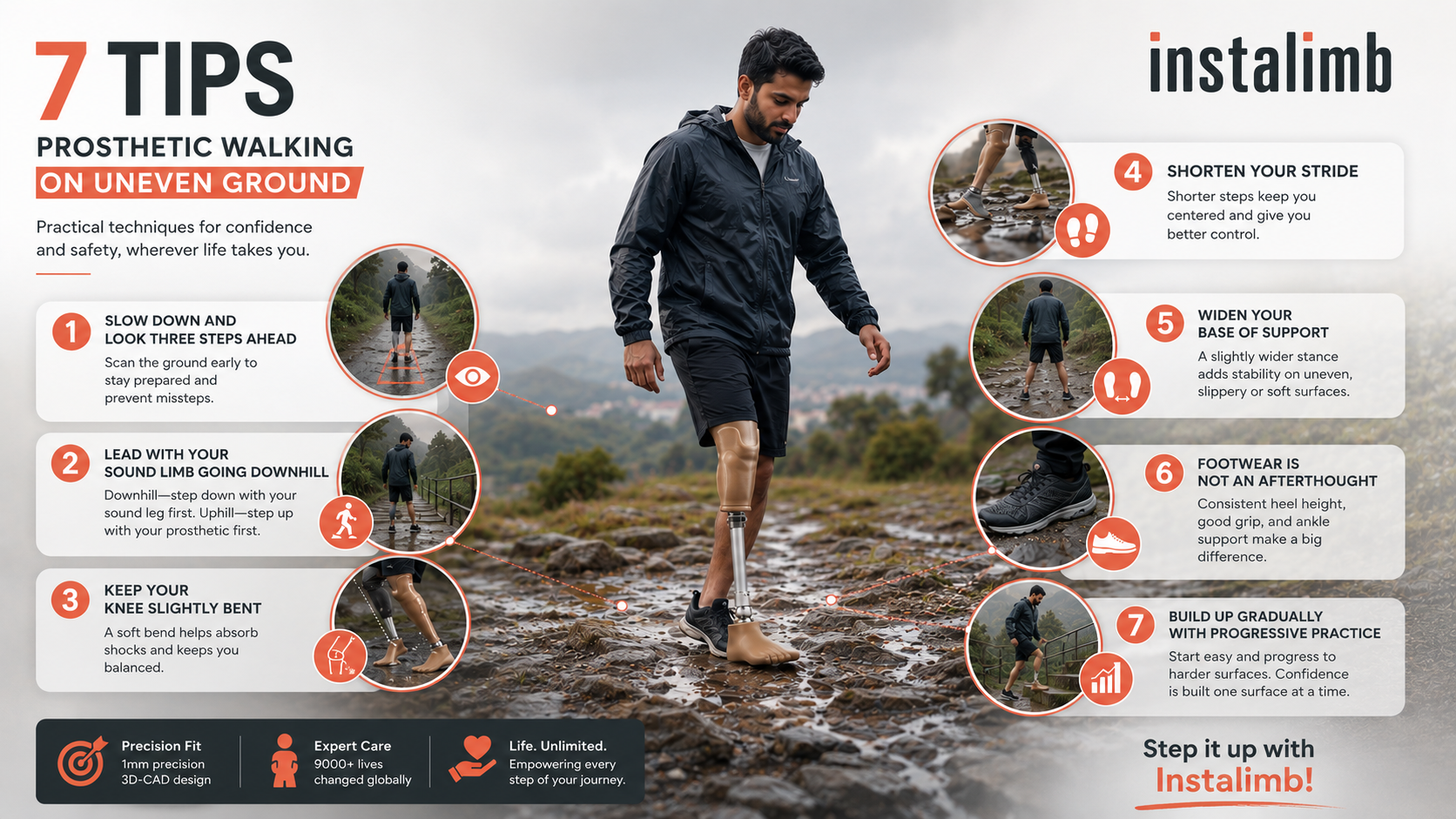
Disclaimer: This is an AI generated image
Tip 1: Slow Down and Look Three Steps Ahead
Speed is your biggest enemy on uneven ground. When you rush, your brain does not have enough time to process what is coming and relay instructions to your hip, residual limb, and core muscles.
Train yourself to scan the ground three steps ahead, not just where your foot is about to land. On busy Delhi streets or a Bangalore footpath that turns from smooth concrete to broken tiles without warning, this habit can prevent a fall before it starts.
Slow and deliberate beats fast and reactively every time.
Tip 2: Lead with Your Sound Limb Going Downhill
On a downhill slope, step down first with your intact leg. This gives you a stable base before your prosthetic foot contacts the surface. Going uphill, do the opposite: step up first with your prosthetic leg, then bring the sound limb to meet it.
This approach, sometimes called the "up with the good, down with the bad" rule, is taught in most prosthetic rehabilitation programmes and remains one of the most practical habits you can build.
Tip 3: Keep Your Knee Slightly Bent
Locking your knee straight on uneven ground reduces your ability to absorb sudden changes in height. A slightly flexed knee acts as a natural shock absorber, the way a car's suspension keeps you from feeling every bump in the road.
This applies to both your intact knee and, for above-knee amputees, to the way you load your prosthetic at mid-stance. Practice this micro-bend consciously until it becomes automatic.
Tip 4: Shorten Your Stride
Taking longer strides on uneven ground increases the amount of time your weight is unsupported between steps. Shorter steps keep you more centered over your base and give you more control.
At Instalimb, we have helped design and fit over 500 prosthetics across Delhi, Gurugram, Hyderabad, Bangalore, Mumbai, and Vizag, and stride length adjustment is one of the first things we guide patients on during gait training. A shorter stride is not a sign of weakness; it is smart mechanics.
Tip 5: Widen Your Base of Support
On flat ground, most people walk with their feet roughly hip-width apart. On challenging surfaces, temporarily widening your stance by even 5 to 10 centimeters gives you a much more stable platform.
Think of how you naturally spread your feet apart when standing on a moving bus. The same instinct applies here. Combine a wider base with a shorter stride and you will feel noticeably more stable on grass, gravel, and wet surfaces.
Tip 6: Footwear Is Not an Afterthought
The shoe on your prosthetic foot can make or break your experience on difficult terrain. Key things to look for:
-
Heel height consistency: Your prosthetic is calibrated for a specific heel height. Switching to a shoe with a very different heel can throw off your gait and increase fall risk.
-
Grip: A rubber-soled shoe with good tread is significantly safer on wet monsoon paths than smooth synthetic soles.
-
Ankle support: On your sound limb, a shoe with lateral ankle support adds an extra layer of stability on uneven ground.
If you are unsure which footwear works best with your specific prosthetic foot, ask your prosthetist. Our team at Instalimb uses 1mm-precision 3D-CAD design to ensure your socket and foot unit work together, and footwear is part of that conversation.
Tip 7: Build Up Gradually with Progressive Practice
Do not jump straight from your living room floor to a rocky hiking trail. Progression is the safest path to confidence. A practical sequence:
-
Start on slightly uneven indoor surfaces, such as a thick carpet or a yoga mat.
-
Progress to flat outdoor surfaces, such as a smooth park path.
-
Move to mild outdoor variability: a grassy lawn, a gentle incline.
-
Tackle harder surfaces: gravel, wet tiles, soft mud, uneven pavement.
-
Advance to complex terrain: slopes, crowded footpaths, stairs with no railing.
Each stage builds muscle memory, confidence, and the neural pathways that make the next stage easier.
A Monsoon-Season Note for Indian Amputees
India's monsoon brings specific challenges: waterlogged paths, slippery tiles, muddy construction zones, and uneven kerbs made worse by poor drainage. Cities like Mumbai and Hyderabad can see heavily flooded footpaths for weeks at a time.
A few extra precautions for the season:
-
Carry a dry cloth or small towel to wipe down your socket sleeve if it gets wet during suction suspension.
-
Inspect the sole of your prosthetic shoe weekly; monsoon puddles accelerate wear.
-
If your socket uses pin-locking, check the pin more frequently, as humidity can affect the mechanism.
-
Consider waterproof prosthetic covers if you are regularly caught in rain.
Every Step Forward Is a Win
Uneven terrain does not have to be a barrier. With the right technique, the right prosthetic fit, and a gradual approach to building confidence, your world gets bigger with every surface you conquer. Whether it is a muddy monsoon lane in Hyderabad or a gravel path in a Bangalore park, you can get there. Take it one step at a time.
Check out our blog section for more!
Frequently Asked Questions
How long does it take to get comfortable walking on uneven terrain with a prosthetic?
Most new prosthetic users gain basic confidence on uneven ground within 3 to 6 months of consistent practice and gait training. Factors like socket fit, the type of prosthetic foot, your activity level, and the quality of your rehabilitation all play a role. Working with a prosthetist for periodic gait assessments speeds up progress considerably.
Is it safe to walk on wet or slippery surfaces with a prosthetic leg?
Yes, with the right precautions. Grip-soled footwear, a slightly wider stance, shorter strides, and reduced speed are the key adjustments. Some prosthetic feet are specifically designed for dynamic terrain and offer better grip and ankle articulation. Ask your prosthetist whether your current foot is suited to your activity level.
Can I walk on the beach or in sand with a prosthetic?
Sand is one of the most challenging surfaces because it shifts under load and offers no firm resistance. Use a wider base, shorter steps, and significantly reduced speed. Dry, compact sand close to the waterline is easier than deep, loose sand. After beach walks, clean your prosthetic thoroughly; sand is highly abrasive to components and liners.
Does the type of prosthetic foot affect performance on uneven terrain?
Yes, significantly. Dynamic response feet (also called energy-return feet) handle terrain variability much better than basic SACH feet, offering better push-off and ankle articulation. Multi-axial feet allow the ankle to move in multiple planes, which is particularly useful on slopes and uneven ground. Your K-level and activity needs should guide which foot is prescribed for you.
What should I do if I feel unstable on a surface I am not used to?
Stop, find a stable support point (a wall, railing, or companion), and reassess. There is no shame in choosing a safer route. If instability is recurring on surfaces you used to manage well, it may signal a change in your socket fit, which warrants a check-up with your prosthetist.
So, if you‘re looking for a new artificial leg, interested in a free consultation, confused if your socket is the right fit, or have any other queries, now is the time to reach out to us and try a test socket free of cost. Step it up with Instalimb - Contact us today!
Recent Posts
September 10, 2026
September 8, 2026
September 3, 2026
September 1, 2026
August 29, 2026
August 25, 2026
August 20, 2026
August 18, 2026
August 11, 2026