Driving with a Prosthetic Leg: Tips and Legal Guide
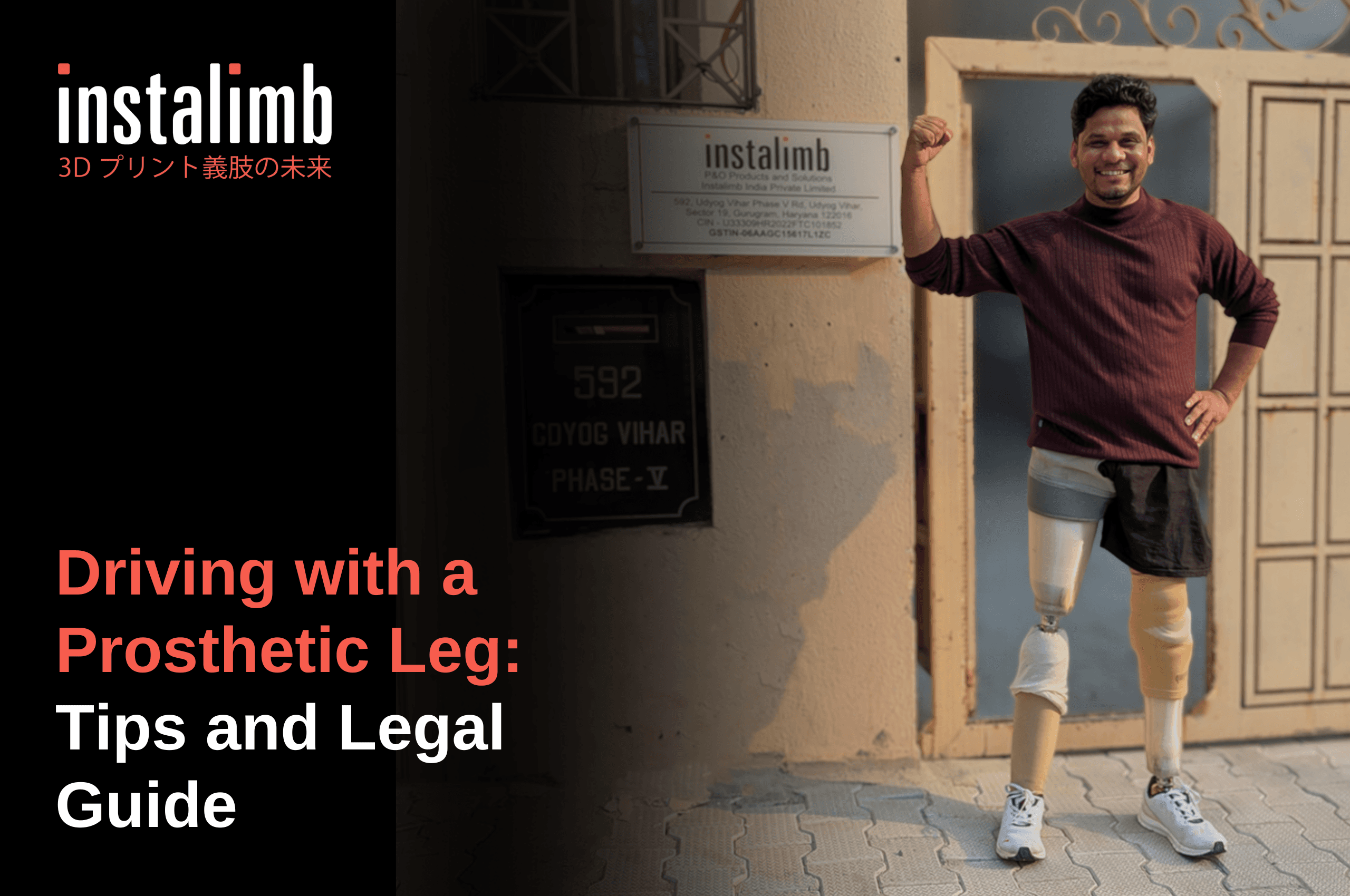
If you use a prosthetic leg, one question comes up sooner than you might expect: "Can I still drive?" The good news is that yes, most amputees can drive safely, and in India, thousands already do every day.
Driving with a prosthetic leg takes understanding three things: which leg is affected, what type of prosthetic you use, and whether your car needs any modifications. Once you have those answers, the road ahead looks a lot clearer. In cities like Delhi, Hyderabad, Bangalore, and Mumbai, our patients regularly ask us about this, and this guide covers everything you need to know.
Is Driving with a Prosthetic Leg Legal in India?
Driving with a prosthetic leg is legal in India. Under the Motor Vehicles Act 1988 (amended 2019), persons with disabilities can obtain a driving licence for an adapted vehicle. You need a medical fitness certificate from a government-approved doctor and, in most cases, an RTO assessment. Your licence will carry an LMV-ADAP (adapted vehicle) endorsement.
Under Rule 15 of the Central Motor Vehicles Rules, your regional transport office (RTO) can issue a licence for "Motor Vehicle with Adaptation." To apply:
-
Visit your regional RTO and request the disability accommodation form
-
Submit Form 1 (medical fitness certificate) from an authorized medical officer
-
Request an LMV or MCWG licence with the hand-control or other adaptation endorsement
-
Undergo a supervised assessment drive if required by your RTO
Right-leg amputees typically need hand controls or an automatic transmission. Left-leg below-knee amputees who have good prosthetic function can often qualify to drive an automatic vehicle with no major modification, depending on socket fit and functional ability.
Right Leg vs. Left Leg: What Changes for Drivers?
This is the most important factor in planning your return to driving. Think of it like writing with your non-dominant hand: it takes adjustment, but it becomes natural with practice.
Right-leg amputees: The right foot controls the accelerator and brake in most Indian vehicles. If you have a below-knee prosthetic with good sensory feedback and ankle function, your prosthetist may clear you to use your prosthetic foot for pedal control. Above-knee amputees or those with limited prosthetic control almost always need hand controls fitted to the vehicle.
Left-leg amputees: In a standard Indian vehicle, the left foot works the clutch in manual-transmission cars. Many left-leg amputees adapt well to automatic vehicles or have the clutch substituted with a hand-operated device. Below-knee prosthetic users often manage automatic cars with little or no structural modification.
Vehicle Modifications That Make Driving Safer
Driving aids are more accessible and affordable than most people realise. A certified automobile adaptation centre can assess your needs and fit:
-
Hand controls (accelerator and brake levers) - suited for right-leg amputees
-
Left-foot accelerator pedal - for right-leg amputees in automatic vehicles
-
Automatic transmission conversion - the single biggest ease-of-driving upgrade for most amputees
-
Extended brake pedal or pedal guards - to prevent accidental contact from a prosthetic foot
-
Spinner knob for steering - useful if one arm is also affected
The Rehabilitation Council of India and the National Institute for the Orthopaedically Handicapped (NIOH) have both published guidelines on assistive technology for drivers with disabilities. Research published by NIOH found that properly fitted vehicle adaptations reduce collision risk for amputee drivers to levels comparable with the general driving population.
How Your Prosthetic Socket Fit Affects Driving Safety
This is where your prosthetic choice really matters. A poorly fitted socket creates unpredictable movement inside the socket, which is dangerous at the wheel. If your residual limb shifts even a centimetre while you apply the brake, your reaction time and accuracy suffer.
At Instalimb, our 3D-printed sockets are designed with 1 mm-level precision using AI-assisted CAD modelling and Japanese technology. Over 500 patients across Delhi, Hyderabad, Bangalore, Mumbai, Gurugram, and Vizag have experienced the difference that a digitally precise socket makes in daily activities, including driving. A socket that fits like a second skin gives you the proprioceptive confidence to operate pedals or hand controls naturally and reliably.
If you notice your socket shifting, loosening, or causing discomfort during drives, those are signs the fit needs to be reviewed. Never ignore a poorly fitting socket, especially when driving.
7 Practical Tips Before You Start Driving Again
1. Get clearance from both your prosthetist and your doctor before getting behind the wheel
2. Practice in a safe, empty space like a car park before entering traffic
3. Start with short, low-traffic routes before attempting highway or peak-hour driving
4. Inform your car insurer: failing to disclose a relevant disability can void your policy
5. Carry your disability certificate and adaptation inspection report in the car at all times
6. Consider refresher lessons with an instructor experienced in adaptive driving
7. Use monsoon-season caution: wet, slippery roads require extra stopping distance for all drivers, especially while you are recalibrating with a new prosthetic or hand controls
Managing Long Drives and Limb Volume Changes
Limb volume can fluctuate during extended time in a car seat. India's heat and humidity, particularly during the monsoon season, can cause your residual limb to swell or sweat inside the socket, affecting the fit mid-drive.
-
Use prosthetic socks or a liner to help manage minor volume changes
-
Take short breaks every 60 to 90 minutes to stand, stretch, and let your residual limb breathe
-
Keep a small dry cloth or tissue in the car to wipe down the socket interior during stops
-
Have your socket fit reviewed if you are planning a long road trip
Instalimb's 3D-printed sockets are engineered to accommodate minor volume fluctuations better than traditional plaster-cast sockets because the digital design process accounts for the natural variations in your residual limb shape throughout the day.
Frequently Asked Questions
Do I need a special driving licence if I use a prosthetic leg?
Yes, in most cases. Under Rule 15 of the Central Motor Vehicles Rules, your licence should specify the vehicle type and any adaptations required. A left-leg below-knee amputee driving an automatic car with no modifications may only need a medical fitness endorsement. A right-leg amputee using hand controls will need the LMV-ADAP category. Check with your local RTO for the latest requirements in your state.
Can I drive a manual transmission car with a prosthetic leg?
It depends on which leg is amputated and your prosthetic function. Left-leg below-knee amputees with a well-fitted socket sometimes manage a clutch with practice. Right-leg amputees are generally advised to switch to an automatic transmission or use hand controls, as operating the brake with a prosthetic foot introduces safety risks that most clinicians recommend avoiding.
How long after amputation can I start driving again?
Most rehabilitation guidelines suggest waiting until your residual limb has stabilised (typically 3 to 6 months post-surgery), you have been fitted with a prosthetic, and your prosthetist confirms functional independence. Always get written clearance from your surgeon and physiotherapist before attempting to drive.
Does insurance cover vehicle modifications for amputees in India?
Standard vehicle insurance policies in India do not automatically cover adaptive modifications. Some insurers offer add-on cover for assistive devices. Check with your insurer and explore the PM-DAKSH scheme, which provides assistive technology support for persons with disabilities. Certain state-level schemes also offer financial assistance for vehicle adaptations.
Will my socket loosen during a long drive?
Limb volume can fluctuate with temperature, activity, and extended sitting. Long drives in India's heat or monsoon humidity can cause your residual limb to swell slightly or sweat inside the socket. Use prosthetic socks to manage volume, take regular breaks, and ensure your socket is regularly checked for fit. Instalimb's precision 3D-printed sockets are designed to manage minor volume changes better than traditional moulded sockets.
Getting back behind the wheel is not just about convenience: it is about independence, employment, and the freedom to move through life on your own terms. With the right legal clearance, appropriate vehicle modifications, and a well-fitted prosthetic socket, driving with a prosthetic leg is completely achievable. You have already shown incredible resilience in adapting to life with a prosthetic. The open road is just one more challenge you are ready for.
Check out our blog section for more!
So, if you‘re looking for a new artificial leg, interested in a free consultation, confused if your socket is the right fit, or have any other queries, now is the time to reach out to us and try a test socket free of cost. Step it up with Instalimb - Contact us today!
Recent Posts
June 18, 2026
June 15, 2026
June 11, 2026
June 3, 2026