Hip and Knee Contractures: 7 Stretches for Amputees
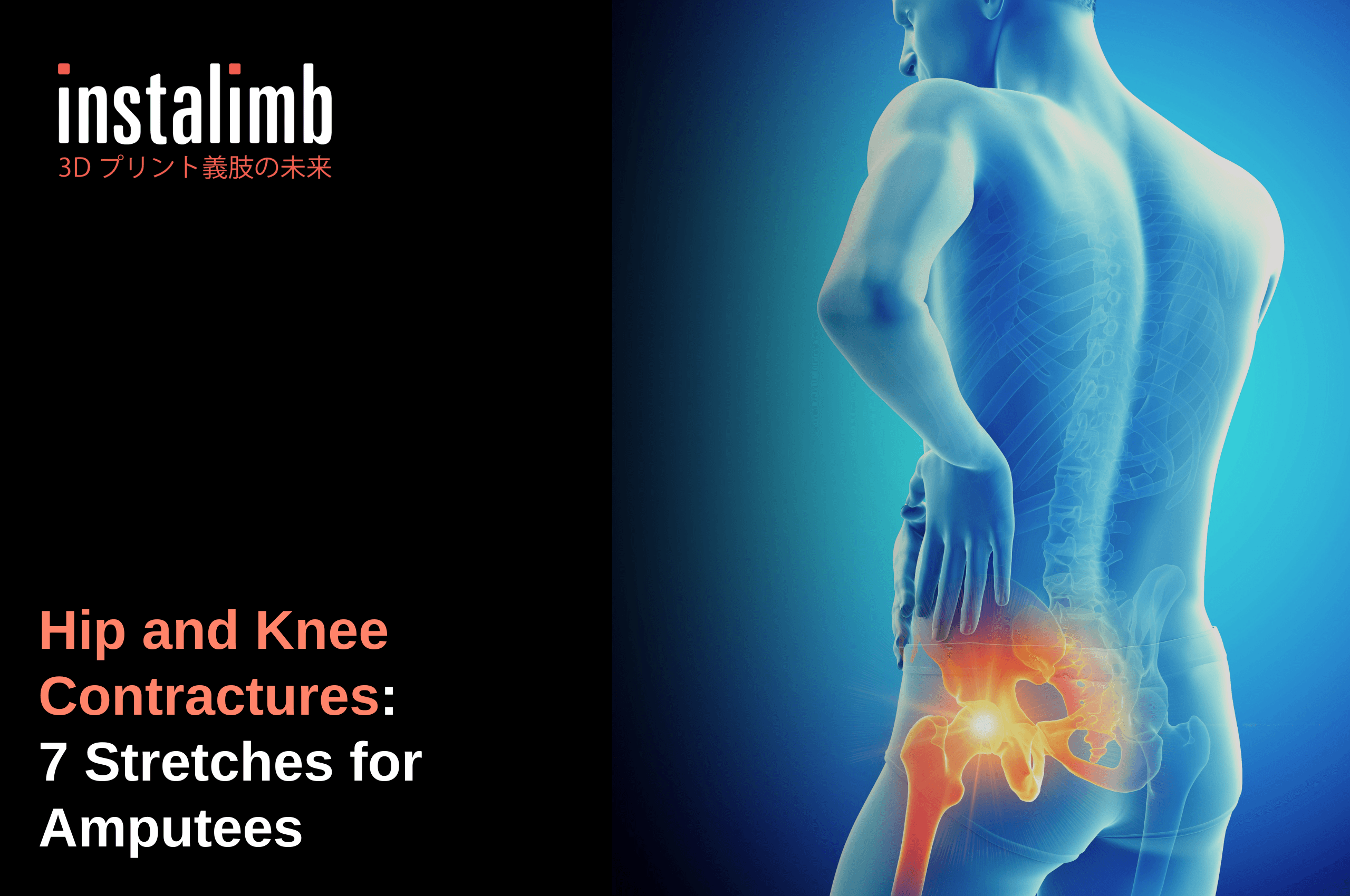
You've been doing everything right since your amputation: attending physiotherapy, wearing your liner correctly, and practising your walk every day. But if you spend most of your day sitting with your knee bent or your hip curled forward, your joints can quietly stiffen without you even noticing. Hip and knee contractures are one of the most common and most preventable complications after limb loss, and they catch even careful amputees off guard.
What Is a Hip or Knee Contracture?
A contracture happens when the muscles and tendons around a joint tighten permanently, locking it in a bent position. For amputees, this often develops from long hours in a flexed position, such as sitting in a wheelchair or resting with a pillow tucked under the knee.
Research on transtibial amputees shows that knee flexion contractures develop in roughly 13% of patients, with some studies reporting rates as high as 24%, according to a peer-reviewed clinical review (source cited below). Above-knee amputees face a similar risk at the hip: once the joint is flexed beyond 15 degrees, fitting a well-aligned prosthesis becomes significantly harder. Diabetes, prolonged bed rest, and skipping physiotherapy all raise the odds. The tricky part is that contractures build up slowly. You might not notice the stiffness until your prosthetist tells you your socket alignment has shifted, or until you try to stand fully upright and can't.
Why Hip and Knee Contractures Make Prosthetic Fitting Harder
Think of your prosthetic socket like a custom-tailored shoe. It is built around the exact shape and alignment of your residual limb at a specific moment. When a hip or knee contracture sets in, that alignment shifts, and the socket that fit perfectly a few months ago no longer sits flush against your skin.
A hip flexed just 10 to 15 degrees can force your prosthetist to rebuild your entire socket, changing your gait and burning more energy with every step.
A stiff knee can prevent a below-knee socket from seating properly, leading to pressure sores at the areas taking the extra load. At Instalimb, our prosthetists use AI-assisted 3D scanning and 1mm-level socket customisation to catch these small alignment shifts early, before they force a full socket rebuild.
Positioning Habits That Protect Your Joints
Most contractures develop quietly, from daily habits, not accidents. A few small changes in how you sit, sleep, and rest can protect your hip and knee for the long term.
-
Skip the pillow under your knee or thigh. It feels comfortable in the moment, but it trains your joint to stay bent.
-
Avoid long unbroken stretches of sitting. Stand, stretch, or reposition every 30 to 45 minutes.
-
Lie face-down (prone) for 10 to 20 minutes, twice a day, to stretch your hip and knee in the opposite direction of a contracture.
-
Sleep with your leg as flat as possible rather than propped on cushions.
Lying face-down for just 10 to 20 minutes, twice daily, is one of the simplest habits that protects your hip and knee from stiffening.
7 Stretching Exercises to Prevent Hip and Knee Contractures
Stretching works best when it is consistent, not intense. Hold each position for about 30 seconds and repeat several times a day.
-
Prone lying: Rest on your stomach for 10 to 20 minutes to stretch both the hip and knee at once.
-
Standing hip extension: Hold a wall or chair, step your residual limb back, and press the hip gently forward.
-
Adductor stretch: Sit against a wall with your limb positioned out to the side, especially useful for above-knee amputees.
-
Heel prop knee extension: Prop your heel on a rolled towel and let gravity gently straighten the knee.
-
Hamstring stretch: Sit with your leg extended and reach toward your toes without rounding your back.
-
Standing hip flexor stretch: Lunge gently forward, keeping your back leg straight to open the front of the hip.
-
Active knee bends: Slowly bend and straighten the knee through its full range, several times a day, to maintain mobility.
Consistent stretching, even five minutes at a time, does more for your joints than one long session a week.
How 3D-Printed Sockets Help Protect Healthy Alignment
Traditional plaster-cast sockets are hard to adjust once early signs of a contracture appear. Instalimb's approach is different. Our prosthetists combine 3D CAD scanning with AI-assisted design to model your residual limb's exact shape and adjust the socket to 1mm precision, so small changes in your joint position get caught during routine reviews rather than after they have caused a problem.
At Instalimb, we have designed over 500 prosthetics across Delhi, Gurugram, Hyderabad, Bangalore, Mumbai, and Vizag, and our clinicians routinely screen new and returning patients for early signs of hip or knee stiffness before finalising a socket fit. If a contracture is already present, our team can factor it into the design rather than forcing your joint into a position it cannot comfortably hold.
When to Call Your Prosthetist: Red Flags You Shouldn't Ignore
Not every ache means a contracture, but a few signs are worth a same-week call to your clinic:
-
Your knee or hip won't fully straighten even after stretching for several days.
-
Your socket suddenly feels tight on one side or loose on the other.
-
You notice new pressure marks or redness that doesn't fade within 20 minutes.
-
Standing fully upright feels different from it did a month ago.
Catching a developing contracture early usually means a simple adjustment. Waiting means a full socket rebuild.
If you're ever unsure, Instalimb offers a free test socket fitting, so there is no cost barrier to getting checked.
Frequently Asked Questions
Can hip and knee contractures be reversed?
Mild contractures can often improve with consistent stretching, positioning changes, and physiotherapy, especially when caught early. More severe or long-standing contractures may need bracing, serial casting, or, in rare cases, surgical release. The earlier you address stiffness, the more likely gentle stretching alone will work.
How long does it take for a contracture to develop after amputation?
Some amputees develop noticeable stiffness within just a few weeks of prolonged bed rest or inactivity, while others take months. Hip and knee contractures often develop during the early recovery period, which is why physiotherapists recommend starting positioning and stretching routines within days of surgery, not after discharge.
Are contractures more common in above-knee or below-knee amputees?
Both above-knee and below-knee amputees are at risk, though the joint involved differs. Below-knee amputees more often develop knee flexion contractures, affecting roughly 13 to 24 percent of patients in various studies, while above-knee amputees are more prone to hip flexion contractures that complicate prosthetic alignment.
Do stretching exercises really prevent contractures?
Yes, consistent stretching combined with proper positioning is one of the most effective ways to prevent contractures. Holding each stretch for around 30 seconds, several times a day, keeps the muscles and tendons around your hip and knee from shortening, especially when paired with several hours of general daily activity.
Can a 3D-printed socket accommodate an existing contracture?
Yes. Unlike a rigid, one-time-cast socket, a 3D-printed socket built with CAD design can be adjusted to accommodate a mild contracture while still supporting a stable gait. At Instalimb, our prosthetists can factor an existing joint limitation into the socket alignment rather than asking your body to force a position it cannot hold.
Conclusion
A hip or knee contracture is one of those complications that sneaks up quietly, but it responds just as quietly to consistent care. A few minutes of stretching, a little more attention to how you sit and sleep, and a prosthetist who checks your alignment regularly can keep your joints and your mobility exactly where you want them.
Check out our blog section for more!
So, if you‘re looking for a new artificial leg, interested in a free consultation, confused if your socket is the right fit, or have any other queries, now is the time to reach out to us and try a test socket free of cost. Step it up with Instalimb - Contact us today!
Recent Posts
July 15, 2026
June 30, 2026
June 18, 2026
June 15, 2026
June 11, 2026
June 3, 2026