Why 3D Digital Scanning Beats Plaster Casting for Prosthetics?
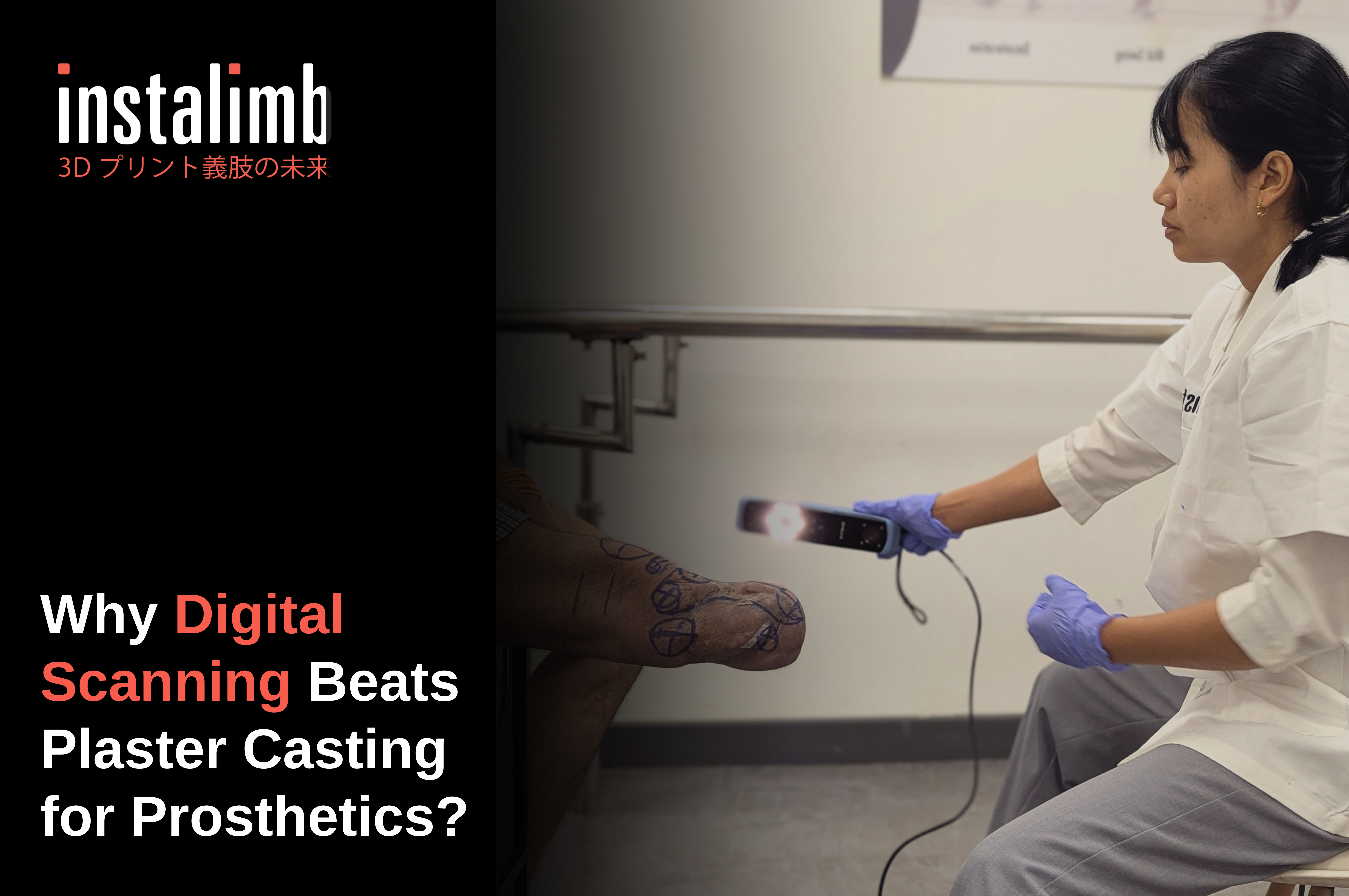
If you have ever had a traditional prosthetic made, you probably remember the plaster casting process: a messy, time-consuming session where your residual limb was wrapped in wet bandages and left to set. For decades, this was the only way to capture the shape of a stump. Today, digital scanning for prosthetics has changed the game entirely, and clinics across India, including Instalimb's centres in Delhi, Hyderabad, Bangalore, and Mumbai, are making the switch fast. Here is why.
How Traditional Plaster Casting Works
In brief: Traditional plaster casting captures a static, single-moment impression of a residual limb using wet plaster bandages. It is a manual process that depends heavily on the skill of the individual prosthetist and can introduce distortions. The resulting mould is used to fabricate a socket, but it cannot be revised without repeating the entire process.
Plaster casting has been the standard in prosthetics for over a century. The process works like this: the prosthetist wraps wet plaster-of-Paris bandages around your residual limb and holds it in position while the plaster sets. Once it hardens, the cast is carefully removed and used to create a positive model of your limb, which is then used to form the socket.
The method is not without merit. Experienced prosthetists can produce good results with plaster, and for resource-limited settings it remains accessible. But it has well-documented limitations. The cast only captures your limb at a single moment in time. It is sensitive to how much pressure was applied during the wrapping, the angle your limb was held, and even how quickly or slowly the plaster set. Small errors at this stage become embedded in the final socket.
How 3D Digital Scanning Works
3D digital scanning replaces the wet plaster step entirely. A handheld or desktop 3D scanner uses structured light or laser technology to capture thousands of surface data points from your residual limb in a matter of minutes. The result is a precise digital mesh of your limb's exact shape, stored as a 3D CAD file that can be viewed, measured, and modified on a computer screen.
At Instalimb, this digital file becomes the foundation of your socket design. Our prosthetists use AI-assisted CAD tools to refine the scan, add relief zones for sensitive areas, and adjust socket geometry at 1mm precision before a single component is printed. The entire design process happens digitally, meaning changes take minutes rather than days.
According to a study published in Prosthetics and Orthotics International, digital scanning achieves dimensional accuracy within 0.3 to 0.5 millimetres on average, compared to 2 to 4 millimetres with manual plaster casting. For a socket that needs to distribute body weight evenly across soft tissue, that difference is significant.
Plaster Casting vs Digital Scanning: A Direct Comparison
Here is how the two approaches compare across the factors that matter most to you as a patient:
Accuracy: Digital scanning captures your limb geometry at sub-millimetre precision. Plaster casting introduces human variability at every step, from bandage tension to holding position.
Speed: A 3D scan takes 5 to 10 minutes. A plaster cast takes 30 to 45 minutes and then needs several hours to dry before the prosthetist can work with it.
Patient comfort: No wet bandages, no smell, no mess. Digital scanning is completely non-contact for most systems, which is especially important for patients with sensitive or recently healed residual limbs.
Revisability: If your limb changes shape, a digital file can be updated quickly without repeating a full casting session. A plaster mould must be remade from scratch.
Documentation: A digital scan is a permanent, shareable record of your limb geometry. It can be accessed by any Instalimb centre across Delhi, Hyderabad, Bangalore, Mumbai, or Vizag, so you are never starting over if you move cities or need a replacement socket.
Storage: A physical plaster mould takes up space and degrades over time. A digital file is stored in the cloud indefinitely.
Why India's Prosthetic Clinics Are Making the Switch
For many years, 3D scanning equipment was expensive and out of reach for most prosthetic clinics in India. That has changed. The cost of quality handheld scanners has fallen significantly, and the software needed to process scans and design sockets is now more accessible than ever.
The other driver is patient expectations. Amputees in Indian cities are more informed than they were a few years ago. They are researching their options online, comparing clinics, and asking better questions. When patients understand that a digital scan produces a more accurate socket in less time, they choose clinics that offer it.
There is also a supply-chain benefit. A clinic that stores socket designs digitally can reprint a replacement in days, not weeks. For a patient who cracks a socket during the monsoon season or whose limb volume shifts during recovery, that responsiveness matters enormously.
What This Means for Your Socket Fit
The practical benefit of digital scanning for you as a patient comes down to one thing: a socket that fits better on day one and can be adjusted faster when your body changes.
At Instalimb, we have designed over 500 prosthetics across Delhi, Hyderabad, Bangalore, Mumbai, and Vizag using our digital scan-to-socket workflow. The precision of the scan feeds directly into our AI-assisted CAD design, which lets our prosthetists model contact pressure, adjust trim lines, and refine socket geometry before printing. Patients who have previously worn plaster-cast sockets consistently report improved initial fit and fewer early adjustments with a digitally designed socket.
We also offer a Free Test Socket Fitting at every Instalimb centre. This means you wear a test version of your socket before the final one is made, so any fit issues are caught before they become a problem. Digital design makes this step faster and more precise because our team can modify the digital file between fittings in real time.
FAQs About Digital Scanning for Prosthetics
Is digital scanning more accurate than plaster casting for prosthetics?
Yes. Research published in Prosthetics and Orthotics International shows digital scanning achieves accuracy within 0.3 to 0.5 millimetres on average, compared to 2 to 4 millimetres for manual plaster casting. This improved precision translates directly to a better-fitting socket with fewer pressure points and adjustments.
Does digital scanning hurt or feel uncomfortable?
No. Digital scanning is a completely non-contact process for most systems. The scanner captures the surface of your residual limb using light or laser projection without touching your skin. It is particularly suitable for patients with sensitive, recently healed, or post-surgical residual limbs who find plaster wrapping uncomfortable or painful.
Can I get a replacement socket if my limb shape changes?
Yes, and this is one of the biggest advantages of digital scanning. Your limb geometry is stored as a digital file that can be updated and reprinted without a full re-casting session. If your residual limb volume changes due to weight fluctuation, activity level, or seasonal swelling, your Instalimb prosthetist can modify the existing file and produce a revised socket quickly.
Are all prosthetic clinics in India switching to digital scanning?
Not all, but the trend is clear. Clinics serving informed, urban patients in Delhi, Mumbai, Hyderabad, and Bangalore are increasingly adopting digital workflows. Traditional plaster casting is still used in some rural and lower-cost settings where scanning equipment is not yet accessible, but technology costs have fallen significantly and adoption is accelerating across India.
What is the difference between 3D scanning and 3D printing in prosthetics?
3D scanning captures the shape of your residual limb as a digital file. 3D printing uses that file, after design refinement, to manufacture the physical socket. They are two separate steps in the same digital workflow. Instalimb uses all three: scanning for measurement, AI-assisted CAD for design, and 3D printing for fabrication.
The Future Is Already Here
Plaster casting served the prosthetics field well for generations, but digital scanning does everything it does, faster, more accurately, and with a far better patient experience. If you have been fitted with plaster casts before and found the process uncomfortable or the results imperfect, it is worth asking your next clinic whether they use digital scanning. At Instalimb, it is part of every fitting from day one.
Check out our blog section for more!
So, if you‘re looking for a new artificial leg, interested in a free consultation, confused if your socket is the right fit, or have any other queries, now is the time to reach out to us and try a test socket free of cost. Step it up with Instalimb - Contact us today!
Recent Posts
June 18, 2026
June 15, 2026
June 11, 2026
June 3, 2026
November 26, 2024