K-Level System Explained: K0 to K4 for Amputees 2026
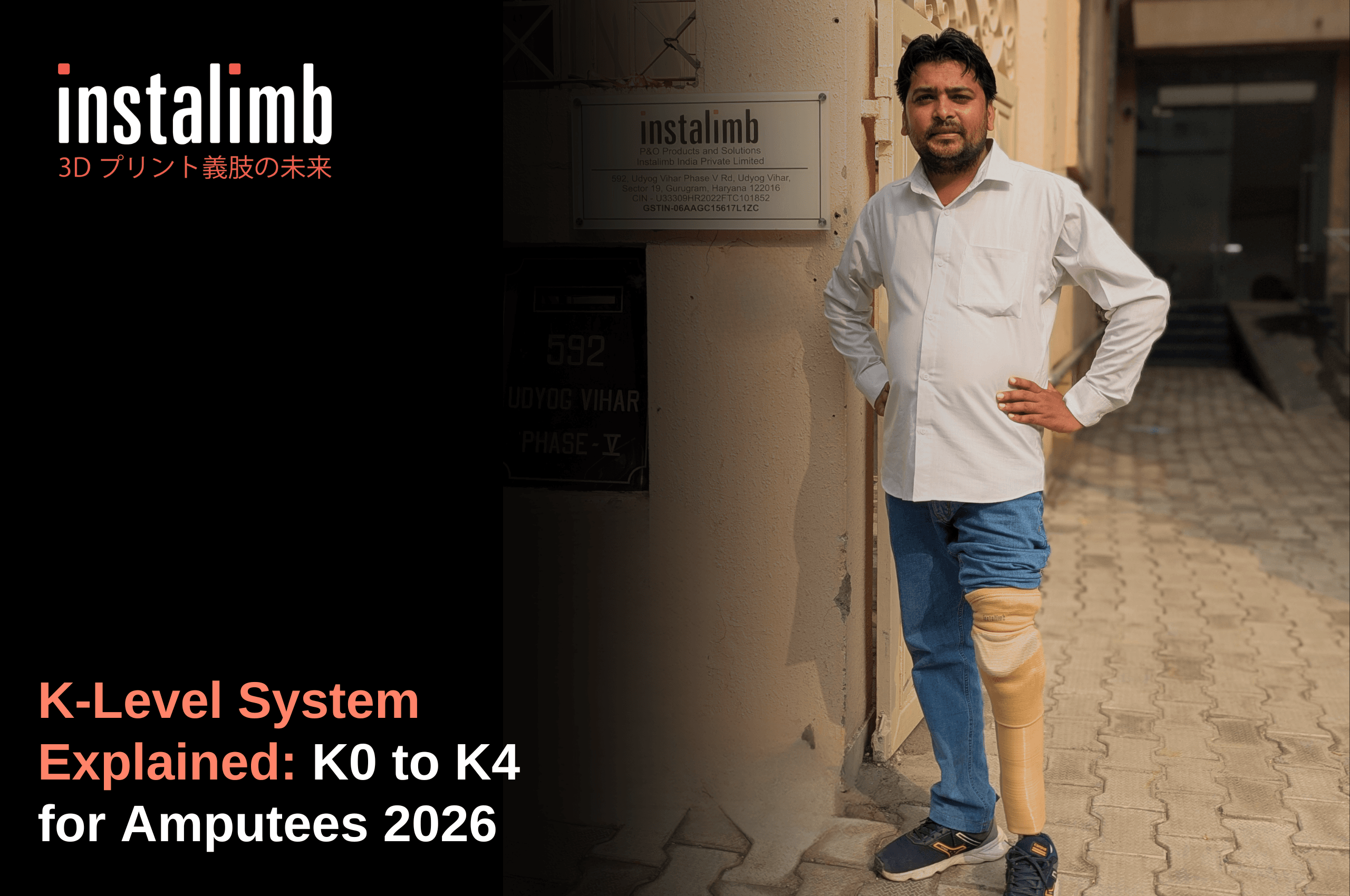
Your prosthetist mentions your "K-level" during a fitting and suddenly you are nodding along to a term nobody actually explained to you. Understanding the K-level system is one of the most useful things you can do for your own care, because it quietly shapes which foot, which knee, and which socket design genuinely suit your body. Once you know your level, every conversation with your clinical team gets clearer.
What Is the K-Level System?
The K-level system is a five-point mobility grading scale, K0 through K4, that clinicians use to describe how much walking you can do today and how much you have the potential to do. Your prosthetist matches components to that level so your device supports your real daily life rather than someone else's.
Think of it like sizing a pair of shoes for the terrain you actually walk on. A soft indoor slipper is wrong for a construction site, and a heavy trekking boot is wrong for shuffling to the kitchen at night. The K-level is simply a shared shorthand that helps your whole care team agree on the terrain of your life.
Your K-level describes your function, not your worth. It is a clinical planning tool, nothing more, and it should never feel like a verdict on what you are capable of becoming.
K0 to K4: What Each Level Really Means
Here is the plain-language version of the five levels used by prosthetists worldwide:
-
K0: No current ability or potential to walk or transfer safely, even with help. A prosthesis would not improve mobility at this stage, so care focuses on comfort, positioning, and skin health.
-
K1: Able to transfer and walk on flat, even surfaces at one steady pace. Think of moving safely around your own home, often with a walker or cane.
-
K2: Able to handle low-level obstacles such as kerbs, a few stairs, or slightly uneven ground. This is the limited community walker who manages a short trip to the neighbourhood shop.
-
K3: Able to walk at variable speeds and clear most everyday obstacles, with work, exercise, or therapy activity on top of basic walking.
-
K4: Walking ability that goes beyond everyday demand, with high impact, high stress, or high energy use. This is the level of children, very active adults, and athletes.
Most adults who reach comfortable, confident walking settle somewhere around K2 or K3. That is a healthy, ordinary place to be, and it opens up far more of daily life than many new users expect.
How Your Prosthetist Works Out Your K-Level
Your level is never guessed from your age or your diagnosis alone. A good assessment looks at the whole picture, and it usually includes:
-
Your walking history before amputation and your progress since surgery
-
Balance, hip and core strength, and the condition of your sound limb
-
Standardised tests such as the Amputee Mobility Predictor, which scores tasks like sitting, standing, and stepping over an obstacle
-
Your home layout, your commute, your work, and the goals you name yourself
-
Residual limb shape, volume stability, and skin tolerance
This matters because measurable differences exist between levels. A cross-sectional study published on PubMed Central found meaningful differences in hip muscle strength and static balance between transfemoral prosthesis users classified at different K-levels, which is exactly why strength work changes what your device can safely offer you.
Tell your prosthetist about your goals, not just your symptoms. If you want to return to a two-wheeler commute in Bangalore or climb the stairs to your office in Mumbai, say so. Goals shape the assessment.
Why Your K-Level Shapes Your Device Match
Components behave differently, and the wrong match makes walking harder than it needs to be. In broad terms:
-
Lower levels are usually matched with feet built for stability and predictable, gentle motion, and with knees that offer strong stance support or a manual lock.
-
Middle levels often suit feet that flex over uneven ground and knees that adapt to a moderate change of pace.
-
Higher levels typically use dynamic-response feet that return energy with each step, and knees that keep up with fast, variable walking, including microprocessor knees where stability and speed both matter.
At Instalimb, we have designed over 500 prosthetics across Delhi, Gurugram, Hyderabad, Bangalore, Mumbai, and Vizag, and this is the pattern we see again and again: when the socket and components match the person's real activity level, gait improves within weeks rather than months.
Your K-Level Is Not Permanent
This is the part most people are never told. Your level can move up as you build strength, confidence, and walking hours, and it can move down after a long illness, a fall, weight change, or a stretch of inactivity.
A yearly review of your K-level is as important as a yearly review of your socket. Many users outgrow their first device long before they think to ask for a reassessment. Others quietly struggle with a device that is now too demanding for their balance, which raises fall risk.
Access is the bigger hurdle in many places. The World Health Organization estimates that only about 1 in 10 people who need assistive products, prosthetics included, actually have them. Knowing your K-level helps you ask precise questions when you do reach a clinic, and precise questions get better care.
How 3D Printing Supports Every K-Level
Your K-level tells your team what your device must handle. The socket is what decides whether you can tolerate wearing it long enough to get there.
Instalimb builds sockets using 3D scanning, 3D-CAD, and AI-assisted design with 1mm-level customisation, which means the socket is shaped to your limb rather than your limb being asked to adapt to a generic shape. For a K1 or K2 user, that precision often decides whether the day ends in redness or in comfort. For a K3 or K4 user, it decides whether the socket keeps up with faster, harder walking without slipping.
Because the design is digital, adjustments are quick when your limb volume changes or your activity level climbs. Your free test socket fitting exists for exactly this reason: to prove the fit before anything is finalised.
Frequently Asked Questions
What does K-level mean for an amputee?
K-level is a mobility grade from K0 to K4 that describes how much walking a person with limb loss can do or has the potential to do. Prosthetists use it to match feet, knees, and socket design to real daily activity, so the device supports the terrain, pace, and demands of that person's actual life.
Who decides my K-level?
Your prosthetist and rehabilitation team decide it together, usually alongside your treating doctor and physiotherapist. They combine your walking history, strength and balance testing, standardised tools like the Amputee Mobility Predictor, your home and work environment, and the personal goals you tell them you want to reach.
Can my K-level change over time?
Yes, and it often does. Most new users improve as strength, balance, and walking hours build, moving from a lower level toward K2 or K3. Levels can also drop after illness, a fall, or long inactivity. Ask for a reassessment at least once a year, or sooner if your walking noticeably changes.
What K-level do most prosthetic leg users reach?
Most adults who commit to rehabilitation settle at K2 or K3, meaning they manage kerbs, stairs, uneven ground, and variable walking speeds. Children and highly active adults often reach K4. Your starting level matters far less than your consistency with strengthening, gait practice, and a socket that fits properly.
Does my K-level limit what prosthetic I can have?
It guides the match rather than sets a ceiling. Components are chosen to suit your current function safely, because a device built for high-impact walking can feel unstable for someone still building balance. As your function improves, your team can reassess and step you up to components that match your new level.
Conclusion
Knowing your K-level turns you from a passenger into a partner in your own care. It gives you the vocabulary to ask better questions, the confidence to push for a reassessment when your walking improves, and a clear sense of what your next milestone looks like. You are allowed to aim higher, and your device should be able to follow.
Check out our blog section for more!
So, if you‘re looking for a new artificial leg, interested in a free consultation, confused if your socket is the right fit, or have any other queries, now is the time to reach out to us and try a test socket free of cost. Step it up with Instalimb - Contact us today!
Recent Posts
October 1, 2026
September 29, 2026
September 26, 2026
September 24, 2026
September 22, 2026
September 10, 2026
September 8, 2026
September 3, 2026
September 1, 2026